Vauxhall Insignia I Country Tourer: A Ruggedized European Workhorse
The Vauxhall Insignia I Country Tourer represents a distinctive variant within the first generation of Vauxhall’s popular mid-size car, the Insignia. Launched in 2013 and produced until 2017, this model catered specifically to the European market, particularly in the United Kingdom where Vauxhall operates as a sister brand to Opel. Positioned as a more rugged and versatile alternative to the standard Insignia Sports Tourer (wagon), the Country Tourer aimed to combine the practicality of a family station wagon with the aesthetic appeal and enhanced capability (though this specific variant is front-wheel drive) of an “all-road” vehicle. It competed in a growing segment for vehicles that blended traditional car comfort with SUV-like styling cues, offering a compelling package for those seeking both efficiency and adaptability without the full commitment to an SUV.
This particular iteration, the 2.0 CDTi ecoTEC (163 Hp) Automatic, was a cornerstone of the Country Tourer lineup, emphasizing fuel efficiency and robust performance for long-distance cruising and everyday utility. While not officially sold in the United States, the Insignia platform was known there as the Buick Regal, highlighting its global engineering roots. The Country Tourer, however, remained a European specialty, designed to navigate diverse road conditions, from urban streets to light rural tracks, with comfort and competence.
Engine and Performance of the Vauxhall Insignia I Country Tourer
At the heart of the Vauxhall Insignia I Country Tourer 2.0 CDTi ecoTEC (163 Hp) Automatic lies a formidable and efficient diesel powertrain. The engine, designated A20DTH, is a 2.0-liter (1956 cm³ or 119.36 cu. in.) inline four-cylinder unit, featuring a DOHC (Double Overhead Camshaft) valvetrain and a common rail diesel fuel injection system. To boost both power and efficiency, it is equipped with a turbocharger and an intercooler, a standard setup for modern diesel engines of its time.
This powerplant generates a respectable 163 horsepower at 4000 rpm, delivering a power output of 83.3 horsepower per liter. More significantly for a diesel, it boasts a substantial peak torque of 258.15 lb.-ft. (350 Nm), available across a broad rev range from 1750 to 2500 rpm. This wide torque band ensures strong, flexible acceleration and effortless cruising, particularly beneficial when the vehicle is loaded or towing. The engine’s front, transverse layout drives the front wheels through a smooth 6-speed automatic transmission, optimizing power delivery and driver convenience.
Performance figures for this model underscore its balanced nature. The Country Tourer can accelerate from 0 to 60 mph in a brisk 9.6 seconds, with a top speed reaching 129.87 mph (209 km/h). These numbers are quite competitive for a mid-size wagon of its weight class (kerb weight 3820.61 lbs. or 1733 kg). Fuel economy was a major selling point, with a combined rating of 42 US mpg (5.6 l/100 km), an impressive 52.3 US mpg (4.5 l/100 km) on the extra-urban cycle, and 31.4 US mpg (7.5 l/100 km) in urban driving. These figures, coupled with a 18.49 US gallon (70 l) fuel tank, granted the Insignia I Country Tourer an excellent cruising range. The vehicle also met Euro 5 emission standards, with CO2 emissions of 149 g/km, reflecting its ecoTEC designation and Vauxhall’s commitment to environmental responsibility for the era.
Design and Features
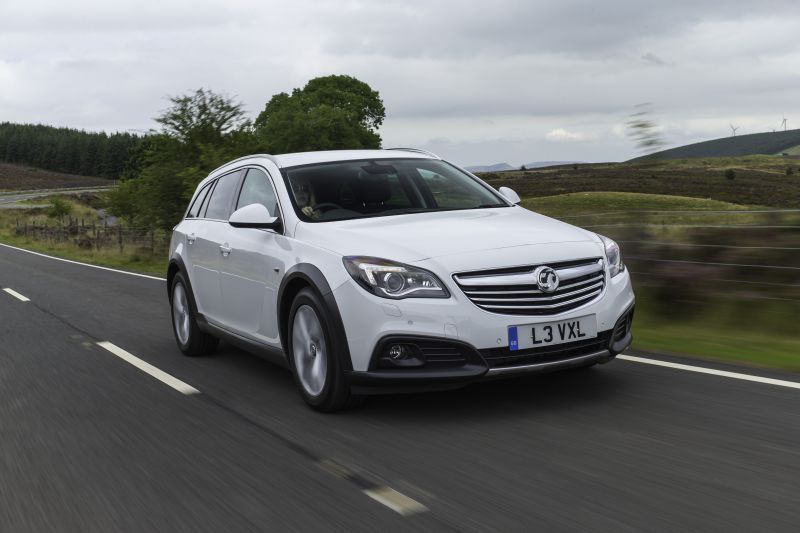
The design of the Vauxhall Insignia I Country Tourer distinguishes itself from its conventional Insignia siblings through a series of rugged aesthetic enhancements. While retaining the sleek and aerodynamic lines of the first-generation Insignia, the Country Tourer adopted a more adventurous persona. It features protective body cladding around the wheel arches and lower body, revised bumpers with skid plate-like elements, and often a slightly raised ride height (though not explicitly detailed in the provided data, it’s a common characteristic of such variants) to suggest enhanced off-road capability and provide better protection against minor scrapes.
As a five-door station wagon (estate), practicality is at the forefront of its design. The generous dimensions, with a length of 193.7 inches (4920 mm) and a width of 73.07 inches (1856 mm), translate into a spacious interior for five occupants. The cabin is designed for comfort and utility, offering ample headroom and legroom. Cargo capacity is a significant strength, with a minimum trunk space of 19.07 cu. ft. (540 l) behind the rear seats, expanding to a cavernous 54.03 cu. ft. (1530 l) with the rear seats folded down. This flexibility makes it an ideal vehicle for families, outdoor enthusiasts, or anyone requiring substantial hauling capability.
Underneath its robust exterior, the Country Tourer employs a sophisticated chassis setup. The front suspension consists of an independent McPherson strut design with coil springs and an anti-roll bar, while the rear features an independent multi-link suspension. This combination provides a comfortable ride and agile handling. Braking is handled by ventilated discs at the front and solid discs at the rear, augmented by an Anti-lock Braking System (ABS) for enhanced safety and control in various conditions. Additional features include a particulate filter in the exhaust system, crucial for meeting diesel emission standards and reducing environmental impact.
Technical Specifications: Vauxhall Insignia I Country Tourer 2.0 CDTi ecoTEC (163 Hp) Automatic
| Category | Specification | Value |
|---|---|---|
General Information |
||
| Brand | Vauxhall | |
| Model | Insignia | |
| Generation | Insignia I Country Tourer | |
| Type (Engine) | 2.0 CDTi ecoTEC (163 Hp) Automatic | |
| Start of production | 2013 year | |
| End of production | 2017 year | |
| Powertrain Architecture | Internal Combustion engine | |
| Body type | Station wagon (estate) | |
| Seats | 5 | |
| Doors | 5 | |
Performance Specifications |
||
| Fuel consumption (economy) – urban | 7.5 l/100 km (31.4 US mpg) | |
| Fuel consumption (economy) – extra urban | 4.5 l/100 km (52.3 US mpg) | |
| Fuel consumption (economy) – combined | 5.6 l/100 km (42 US mpg) | |
| CO2 emissions | 149 g/km | |
| Fuel Type | Diesel | |
| Acceleration 0 – 60 mph | 9.6 sec | |
| Acceleration 0 – 100 km/h | 10.1 sec | |
| Maximum speed | 209 km/h (129.87 mph) | |
| Emission standard | Euro 5 | |
| Weight-to-power ratio | 10.6 kg/Hp (94.1 Hp/tonne) | |
| Weight-to-torque ratio | 5 kg/Nm (202 Nm/tonne) | |
Engine Specifications |
||
| Power | 163 Hp @ 4000 rpm | |
| Power per liter | 83.3 Hp/l | |
| Torque | 350 Nm @ 1750-2500 rpm (258.15 lb.-ft.) | |
| Engine layout | Front, Transverse | |
| Engine Model/Code | A20DTH | |
| Engine displacement | 1956 cm³ (119.36 cu. in.) | |
| Number of cylinders | 4 | |
| Engine configuration | Inline | |
| Cylinder Bore | 83 mm (3.27 in.) | |
| Piston Stroke | 90.4 mm (3.56 in.) | |
| Fuel injection system | Diesel Commonrail | |
| Engine aspiration | Turbocharger, Intercooler | |
| Valvetrain | DOHC | |
| Engine oil capacity | 4.5 l (4.76 US qt) | |
| Engine oil specification | Not specified in data | |
| Coolant capacity | 9 l (9.51 US qt) | |
| Engine systems | Particulate filter | |
Space, Volume and Weights |
||
| Kerb Weight | 1733 kg (3820.61 lbs.) | |
| Trunk (boot) space – minimum | 540 l (19.07 cu. ft.) | |
| Trunk (boot) space – maximum | 1530 l (54.03 cu. ft.) | |
| Fuel tank capacity | 70 l (18.49 US gal) | |
| Permitted trailer load with brakes (12%) | 1600 kg (3527.4 lbs.) | |
| Permitted trailer load without brakes | 750 kg (1653.47 lbs.) | |
Dimensions |
||
| Length | 4920 mm (193.7 in.) | |
| Width | 1856 mm (73.07 in.) | |
| Width including mirrors | 2084 mm (82.05 in.) | |
| Height | 1523 mm (59.96 in.) | |
| Wheelbase | 2737 mm (107.76 in.) | |
| Front overhang | 1020 mm (40.16 in.) | |
| Rear overhang | 1163 mm (45.79 in.) | |
| Minimum turning circle (turning diameter) | 11.4 m (37.4 ft.) | |
Drivetrain, Brakes and Suspension Specifications |
||
| Drivetrain Architecture | Internal Combustion engine drives front wheels | |
| Drive wheel | Front wheel drive | |
| Number of gears and type of gearbox | 6 gears, automatic transmission | |
| Front suspension | Independent, type McPherson with coil spring and anti-roll bar | |
| Rear suspension | Independent multi-link suspension | |
| Front brakes | Ventilated discs | |
| Rear brakes | Disc | |
| Assisting systems | ABS (Anti-lock braking system) | |
Legacy and Market Impact of the Vauxhall Insignia I Country Tourer
The Vauxhall Insignia I Country Tourer carved out a niche for itself in the highly competitive European mid-size segment. While the standard Insignia was a strong contender against rivals like the Ford Mondeo, Volkswagen Passat, and Skoda Superb, the Country Tourer variant aimed at a slightly different demographic. Its main competitors included other “all-road” wagons such as the Volkswagen Passat Alltrack, Skoda Octavia Scout, and, at a higher price point, the Audi A4 Allroad. The Insignia Country Tourer generally offered a more accessible price point compared to its German premium counterparts, presenting a strong value proposition for buyers in the UK and continental Europe.
Its reputation was built on a foundation of practicality, reliability, and fuel efficiency – hallmarks of the Vauxhall/Opel brand in Europe. The 2.0 CDTi ecoTEC engine, in particular, was praised for its robust torque delivery and excellent real-world fuel economy, making it a popular choice for long-distance commuters and families. The automatic transmission further enhanced its appeal, providing a smooth and comfortable driving experience in both urban and highway conditions.
The Country Tourer’s rugged styling cues and increased versatility resonated with consumers who desired the aesthetic and perceived robustness of an SUV but preferred the driving dynamics, fuel efficiency, and lower center of gravity of a traditional station wagon. It was particularly well-suited for regions with challenging weather conditions or those who frequently ventured onto unpaved roads, even if this specific FWD variant offered more in terms of looks than outright off-road prowess. Its substantial cargo capacity and respectable towing capabilities (up to 3527.4 lbs. with brakes) further solidified its position as a highly functional family and utility vehicle.
In essence, the Vauxhall Insignia I Country Tourer 2.0 CDTi ecoTEC (163 Hp) Automatic served as a testament to Vauxhall’s understanding of the European market’s demand for versatile, efficient, and well-equipped vehicles. It successfully blended the attributes of a comfortable family car with a more adventurous image, leaving a legacy as a practical and economical choice for a wide array of buyers during its production run.