Vauxhall Insignia I Hatchback 2.0 CDTi ecoTEC (160 Hp) Automatic: An Overview of GM Europe’s Mid-Size Contender
The Vauxhall Insignia I Hatchback 2.0 CDTi ecoTEC (160 Hp) Automatic represents a pivotal model in General Motors’ European portfolio, serving as a sophisticated and modern replacement for the long-running Vauxhall Vectra. Launched in 2008 and produced until 2013, this first-generation Insignia aimed to elevate Vauxhall’s presence in the highly competitive D-segment (mid-size family car market) in the United Kingdom, mirroring its Opel-badged counterpart across continental Europe. It quickly garnered attention for its striking design, improved driving dynamics, and a strong emphasis on technology and efficiency, particularly with its advanced diesel powertrain options like the 2.0 CDTi ecoTEC.
While the Vauxhall Insignia was never officially sold in the United States under its original badging, its platform and underlying engineering principles found their way into other GM products globally, including the Buick Regal. For the European market, however, the Insignia was a flagship model, designed to compete with established rivals by offering a compelling blend of practicality, style, and a refined driving experience. The Hatchback variant, with its five doors and spacious interior, offered superior versatility compared to its sedan sibling, making it a popular choice for families and business users alike.
Engine and Performance of the Vauxhall Insignia I Hatchback
At the heart of the Vauxhall Insignia I Hatchback 2.0 CDTi ecoTEC (160 Hp) Automatic lies a robust and efficient 2.0-liter (1956 cm³) four-cylinder inline diesel engine, known by its internal code A20DTH. This powertrain was engineered with modern diesel technology, featuring a common rail fuel injection system, a turbocharger, and an intercooler to optimize power delivery and fuel efficiency. The engine’s double overhead camshaft (DOHC) valvetrain with four valves per cylinder ensured precise control over combustion, contributing to both performance and emissions compliance.
The 2.0 CDTi ecoTEC unit produced a respectable 160 horsepower at 4000 rpm, which was a significant output for a family diesel in its era. More importantly for daily driving, it delivered a substantial 258.15 lb.-ft. of torque, available across a broad rev range from 1750 to 2500 rpm. This ample torque ensured strong acceleration and effortless cruising, particularly when paired with the smooth-shifting 6-speed automatic transmission. Power was sent to the front wheels, a conventional and cost-effective layout for this segment.
Performance figures for this variant were competitive: the Insignia could accelerate from 0 to 60 mph in a brisk 8.6 seconds, with a top speed reaching 134.22 mph. Despite its performance capabilities, the “ecoTEC” designation signified a focus on environmental responsibility. The vehicle achieved a combined fuel economy of 34.6 US mpg (6.8 l/100 km) and emitted 179 g/km of CO2, meeting the stringent Euro 5 emission standards of the time. Features like a particulate filter further reduced harmful emissions, showcasing Vauxhall’s commitment to cleaner diesel technology.
Design and Features
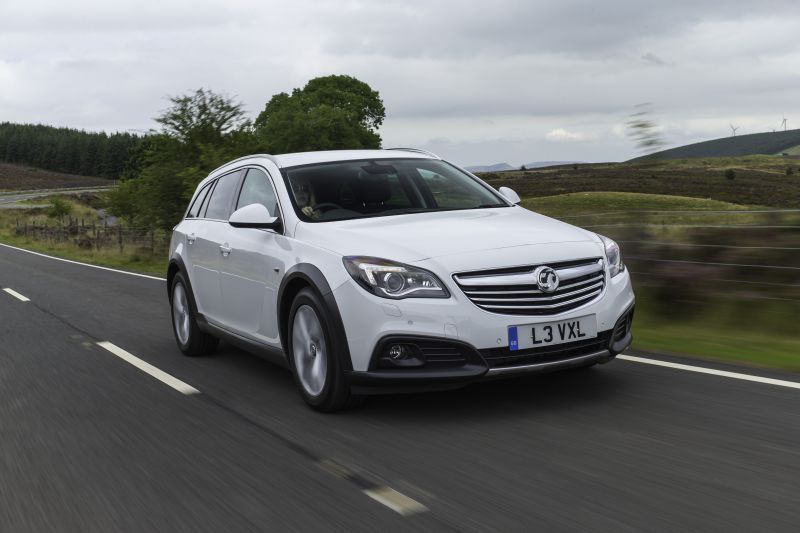
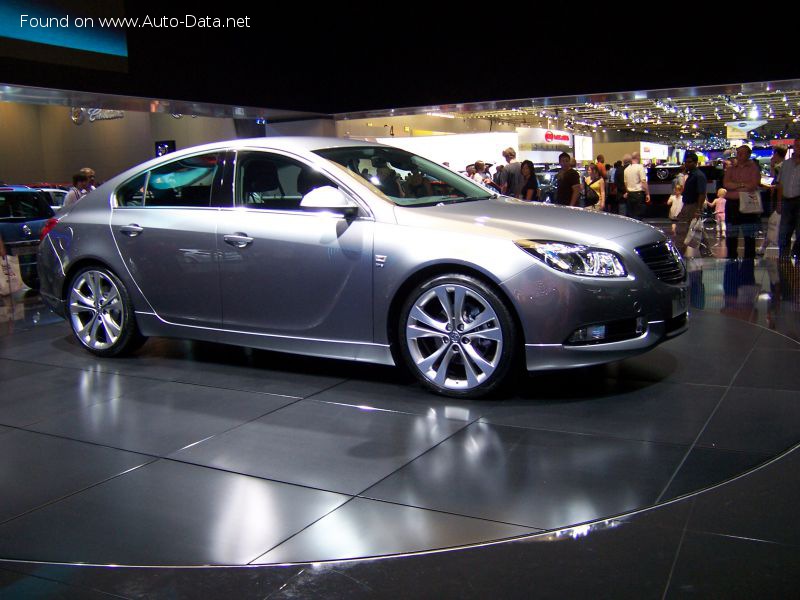
The design of the first-generation Vauxhall Insignia marked a dramatic departure from its predecessor, the Vectra. It introduced a bold, sculpted aesthetic that General Motors dubbed “Sculptural Artistry meets German Precision.” The Hatchback body style, with its flowing lines and coupé-like roofline, was particularly well-received, giving the family car a more dynamic and premium appearance. Measuring 190.16 inches in length, 73.07 inches in width (82.05 inches including mirrors), and 58.98 inches in height, the Insignia possessed a substantial road presence. Its relatively low drag coefficient of 0.27 was excellent for the segment, contributing to both fuel efficiency and reduced wind noise at speed.
Inside, the Insignia offered a well-appointed and comfortable cabin designed for five occupants. The hatchback configuration provided exceptional practicality, with a minimum trunk space of 18.36 cubic feet (520 liters) that could expand to an impressive 51.67 cubic feet (1463 liters) with the rear seats folded down. This generous cargo capacity made it ideal for families needing space for luggage, groceries, or sports equipment.
Underneath its stylish exterior, the Insignia featured a sophisticated chassis designed for a balanced ride and handling. It utilized an independent McPherson strut front suspension with coil springs and an anti-roll bar, paired with an independent multi-link rear suspension. This setup provided a comfortable ride over varied road surfaces while maintaining confident handling characteristics. Braking was handled by ventilated discs at the front and solid discs at the rear, supported by an Anti-lock Braking System (ABS) for enhanced safety. Hydraulic power steering provided precise feedback, and the vehicle rode on 225/55 R17 tires mounted on 17-inch wheel rims, striking a good balance between comfort and grip.
Technical Specifications
| Category | Specification | US Equivalent |
|---|---|---|
General Information |
||
| Brand | Vauxhall | N/A |
| Model | Insignia | N/A |
| Generation | Insignia I Hatchback | N/A |
| Type (Engine) | 2.0 CDTi ecoTEC (160 Hp) Automatic | N/A |
| Start of production | 2008 year | N/A |
| End of production | 2013 year | N/A |
| Powertrain Architecture | Internal Combustion engine | N/A |
| Body type | Hatchback | N/A |
| Seats | 5 | N/A |
| Doors | 5 | N/A |
Performance Specs |
||
| Fuel consumption (urban) | 9.3 l/100 km | 25.3 US mpg |
| Fuel consumption (extra urban) | 5.3 l/100 km | 44.4 US mpg |
| Fuel consumption (combined) | 6.8 l/100 km | 34.6 US mpg |
| CO2 emissions | 179 g/km | N/A |
| Fuel Type | Diesel | N/A |
| Acceleration 0 – 60 mph | 8.6 sec | N/A |
| Maximum speed | 216 km/h | 134.22 mph |
| Emission standard | Euro 5 | N/A |
| Weight-to-power ratio | 9.9 kg/Hp | 101.3 Hp/tonne |
| Weight-to-torque ratio | 4.5 kg/Nm | 221.5 Nm/tonne |
Engine Specs |
||
| Power | 160 Hp @ 4000 rpm | N/A |
| Power per litre | 81.8 Hp/l | N/A |
| Torque | 350 Nm @ 1750-2500 rpm | 258.15 lb.-ft. @ 1750-2500 rpm |
| Engine layout | Front, Transverse | N/A |
| Engine Model/Code | A20DTH | N/A |
| Engine displacement | 1956 cm3 | 119.36 cu. in. (2.0 Liters) |
| Number of cylinders | 4 | N/A |
| Engine configuration | Inline | N/A |
| Cylinder Bore | 83 mm | 3.27 in. |
| Piston Stroke | 90.4 mm | 3.56 in. |
| Compression ratio | 18:1 | N/A |
| Number of valves per cylinder | 4 | N/A |
| Fuel injection system | Diesel Commonrail | N/A |
| Engine aspiration | Turbocharger, Intercooler | N/A |
| Valvetrain | DOHC | N/A |
| Engine oil capacity | 4.5 l | 4.76 US qt |
| Coolant | 9 l | 9.51 US qt |
| Engine systems | Particulate filter | N/A |
Space, Volume and Weights |
||
| Kerb Weight | 1580 kg | 3483.3 lbs. |
| Max. weight | 2170 kg | 4784.03 lbs. |
| Max load | 590 kg | 1300.73 lbs. |
| Trunk (boot) space – minimum | 520 l | 18.36 cu. ft. |
| Trunk (boot) space – maximum | 1463 l | 51.67 cu. ft. |
| Fuel tank capacity | 70 l | 18.49 US gal |
| Permitted trailer load with brakes (12%) | 1600 kg | 3527.4 lbs. |
| Permitted trailer load without brakes | 750 kg | 1653.47 lbs. |
Dimensions |
||
| Length | 4830 mm | 190.16 in. |
| Width | 1856 mm | 73.07 in. |
| Width including mirrors | 2084 mm | 82.05 in. |
| Height | 1498 mm | 58.98 in. |
| Wheelbase | 2737 mm | 107.76 in. |
| Front track | 1585 mm | 62.4 in. |
| Rear (Back) track | 1585 mm | 62.4 in. |
| Front overhang | 1015 mm | 39.96 in. |
| Rear overhang | 1078 mm | 42.44 in. |
| Ride height (ground clearance) | 160 mm | 6.3 in. |
| Drag coefficient (Cd) | 0.27 | N/A |
| Minimum turning circle (turning diameter) | 10.97 m | 35.99 ft. |
Drivetrain, Brakes and Suspension Specs |
||
| Drivetrain Architecture | The Internal combustion engine (ICE) drives the front wheels of the vehicle. | N/A |
| Drive wheel | Front wheel drive | N/A |
| Number of gears and type of gearbox | 6 gears, automatic transmission | N/A |
| Front suspension | Independent, type McPherson with coil spring and anti-roll bar | N/A |
| Rear suspension | Independent multi-link suspension | N/A |
| Front brakes | Ventilated discs | N/A |
| Rear brakes | Disc | N/A |
| Assisting systems | ABS (Anti-lock braking system) | N/A |
| Power steering | Hydraulic Steering | N/A |
| Tires size | 225/55 R17 | N/A |
| Wheel rims size | 17 | N/A |
Legacy and Market Impact of the Vauxhall Insignia I Hatchback
The Vauxhall Insignia I Hatchback, particularly in its 2.0 CDTi ecoTEC (160 Hp) Automatic guise, left a significant mark on the European automotive landscape. It was a crucial model for General Motors in its bid to redefine its mainstream offerings and shed the somewhat conservative image associated with its predecessor, the Vectra. Upon its debut, the Insignia was widely praised for its aspirational design, which resonated strongly with buyers looking for style without sacrificing practicality. This design ethos, spearheaded by Mark Adams, earned the Insignia the prestigious European Car of the Year award in 2009, a testament to its impact and perceived quality.
In the fiercely competitive D-segment, the Insignia faced formidable rivals such as the Ford Mondeo, Volkswagen Passat, Mazda6, Peugeot 508, and Citroën C5. The Insignia differentiated itself with its bold styling, refined ride, and a strong lineup of efficient engines, with the 2.0 CDTi ecoTEC being a particular highlight for its blend of performance and economy. Its spacious interior, especially in the versatile hatchback form, and its strong safety ratings (a five-star Euro NCAP rating) made it an attractive proposition for both private buyers and large fleet operators.
While the Vauxhall Insignia was a European-market exclusive under the Vauxhall and Opel badges, its success and underlying Epsilon II platform were instrumental in GM’s global product strategy. The platform went on to underpin several other vehicles, including the second-generation Buick LaCrosse and the fifth-generation Chevrolet Malibu in the North American market, as well as the Buick Regal, which essentially was a rebadged Opel Insignia. This cross-pollination of engineering demonstrated GM’s capability to develop a versatile global architecture that could be adapted to different brand identities and market demands.
The Insignia’s legacy is one of transformation for Vauxhall/Opel. It successfully repositioned the brand in the mid-size segment, proving that a mainstream offering could be stylish, technologically advanced, and efficient. It helped to rebuild consumer confidence in the brand’s ability to produce desirable and competitive vehicles, laying the groundwork for future models that would continue this trend towards more premium design and engineering. The Vauxhall Insignia I Hatchback 2.0 CDTi ecoTEC (160 Hp) Automatic therefore stands as a significant vehicle in the history of European automotive design and engineering, celebrated for its blend of practicality, performance, and groundbreaking aesthetics.