The Vauxhall Insignia I Hatchback 2.0i Turbo ecoTEC (220 Hp): A European Mid-Size Contender
The Vauxhall Insignia I Hatchback 2.0i Turbo ecoTEC (220 Hp) represents a significant stride for General Motors’ European operations, specifically for the Vauxhall marque in the United Kingdom and Opel across the rest of Europe. Introduced in 2008 as the successor to the long-running Vectra, the first-generation Insignia aimed to elevate the brand’s presence in the highly competitive D-segment (mid-size) market. Unlike its more utilitarian predecessor, the Insignia adopted a more sophisticated, coupe-like design language and offered a premium feel that belied its mainstream positioning. This model was not sold in the United States under the Vauxhall badge; however, its Opel counterpart was later rebadged as the Buick Regal for the North American market, showcasing its global platform underpinnings.
The Insignia I Hatchback 2.0i Turbo ecoTEC (220 Hp) variant, produced from 2008 to 2013, stood out as a performance-oriented option within the range. It combined spirited driving dynamics with the practicality of a five-door hatchback, making it an attractive proposition for families and fleet buyers seeking a blend of power, efficiency, and comfort. Its introduction marked a new era for Vauxhall, emphasizing modern technology, improved driving dynamics, and a more upmarket aesthetic that resonated with European consumers looking for a refined and capable daily driver.
Engine and Performance: The 2.0i Turbo ecoTEC (220 Hp) Heart
At the core of the Vauxhall Insignia I Hatchback 2.0i Turbo ecoTEC (220 Hp) was a robust and technologically advanced powertrain designed to deliver both exhilarating performance and reasonable efficiency for its class. The engine, designated A20NHT, was a 1,998 cubic centimeter (approximately 2.0-liter) inline four-cylinder unit. This powerplant featured a Double Overhead Camshaft (DOHC) valvetrain with four valves per cylinder, ensuring optimal airflow and combustion.
Key to its impressive output was the sophisticated induction system, which included a twin-scroll turbocharger and an intercooler. This setup minimized turbo lag, providing a broad and responsive power band. Fuel delivery was handled by a direct injection system, further enhancing fuel atomization and combustion efficiency. The engine produced a substantial 220 horsepower at 5,300 rpm, giving the Insignia a significant performance edge. Torque figures were equally impressive, peaking at 258.15 lb.-ft. (350 Nm) across a wide range from 2,000 to 4,000 rpm, ensuring strong acceleration and flexible in-gear performance.
Power was transmitted to the front wheels via a precise 6-speed manual transmission, offering engaging control for the driver. This combination allowed the Insignia I Hatchback 2.0i Turbo ecoTEC (220 Hp) to accelerate from 0 to 60 mph in a brisk 6.8 seconds (0-100 km/h in 7.2 seconds) and reach a top speed of 149.75 mph (241 km/h). Despite its performance capabilities, Vauxhall’s “ecoTEC” branding indicated efforts to balance power with environmental responsibility. The vehicle complied with Euro 5 emission standards, emitting 209 g/km of CO2. Fuel economy for the combined cycle was rated at 26.4 US mpg (8.9 l/100 km), which was respectable for a turbocharged mid-size car of its era with this level of performance. The engine’s layout was front, transverse, contributing to the car’s overall packaging and front-wheel-drive architecture.
Design and Features: A Statement of Modernity
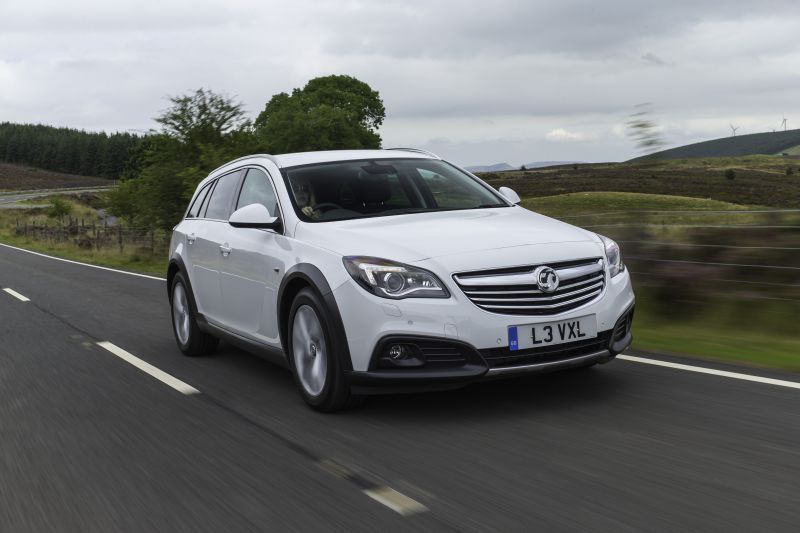
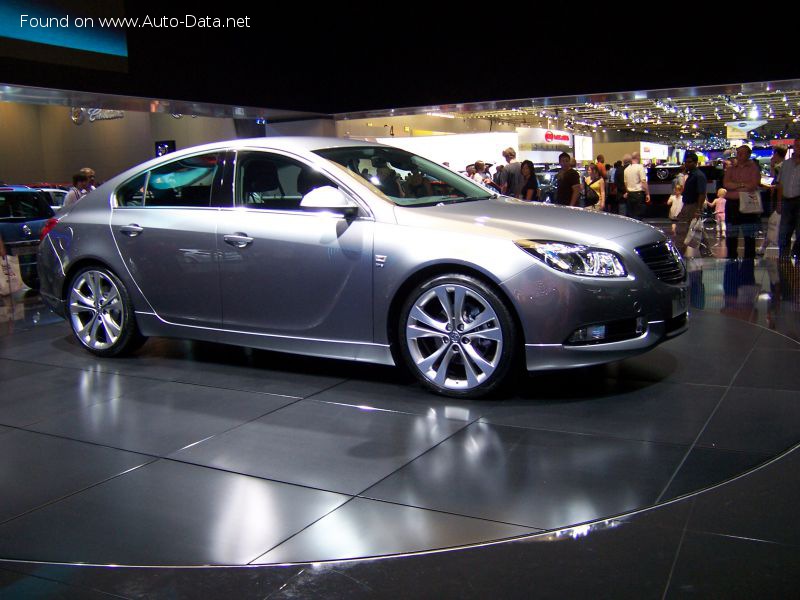
The design of the Vauxhall Insignia I Hatchback marked a radical departure from its predecessor, embracing a more dynamic and sculpted aesthetic that earned it the prestigious European Car of the Year award in 2009. The hatchback body style, with its five doors and seating for five occupants, offered a practical yet stylish alternative to traditional sedans. Its sleek profile, characterized by flowing lines and a distinctive “blade” motif along the side, gave the Insignia a strong visual presence on the road. The vehicle measured 190.16 inches in length, 73.07 inches in width (82.05 inches including mirrors), and 58.98 inches in height, with a substantial wheelbase of 107.76 inches, contributing to a stable ride and generous interior space.
Inside, the Insignia offered a contemporary and driver-focused cabin. The dashboard featured an elegant, wraparound design, with high-quality materials and intuitive controls that were a significant step up from previous Vauxhall models. Standard features for a car of its class in the late 2000s would include climate control, a multi-function steering wheel, and a sophisticated infotainment system. Safety was a key consideration, and the Insignia came equipped with an Anti-lock Braking System (ABS) as standard, along with a comprehensive suite of airbags and a rigid body structure designed to protect occupants.
Practicality was a strong suit for the hatchback variant, offering a minimum trunk space of 18.36 cubic feet (520 liters), which could expand to a cavernous 51.67 cubic feet (1463 liters) with the rear seats folded down. This made it highly versatile for family duties or transporting larger items. The chassis featured an independent McPherson strut front suspension and an independent multi-link rear suspension, providing a comfortable ride and agile handling. Hydraulic power steering offered precise feedback, while ventilated disc brakes at the front and disc brakes at the rear ensured strong stopping power. The car rode on 215/60 R16 tires, fitted to 16-inch wheel rims, providing a good balance of comfort and grip. Its drag coefficient (Cd) of 0.27 was also impressive for its class, contributing to both fuel efficiency and reduced wind noise.
Technical Specifications
| General Information | |
|---|---|
| Brand | Vauxhall |
| Model | Insignia |
| Generation | Insignia I Hatchback |
| Type (Engine) | 2.0i Turbo ecoTEC (220 Hp) |
| Start of Production | 2008 year |
| End of Production | 2013 year |
| Powertrain Architecture | Internal Combustion engine |
| Body type | Hatchback |
| Seats | 5 |
| Doors | 5 |
| Performance Specifications | |
| Fuel Consumption (Economy) – Urban | 12.7 l/100 km (18.5 US mpg) |
| Fuel Consumption (Economy) – Extra Urban | 6.7 l/100 km (35.1 US mpg) |
| Fuel Consumption (Economy) – Combined | 8.9 l/100 km (26.4 US mpg) |
| CO2 Emissions | 209 g/km |
| Fuel Type | Petrol (Gasoline) |
| Acceleration 0 – 60 mph | 6.8 sec |
| Acceleration 0 – 100 km/h | 7.2 sec |
| Maximum Speed | 241 km/h (149.75 mph) |
| Emission Standard | Euro 5 |
| Weight-to-Power Ratio | 7.1 kg/Hp (140.1 Hp/tonne) |
| Weight-to-Torque Ratio | 4.5 kg/Nm (222.9 Nm/tonne) |
| Engine Specifications | |
| Power | 220 Hp @ 5300 rpm |
| Power per liter | 110.1 Hp/l |
| Torque | 350 Nm (258.15 lb.-ft.) @ 2000-4000 rpm |
| Engine Layout | Front, Transverse |
| Engine Model/Code | A20NHT |
| Engine Displacement | 1998 cm3 (121.93 cu. in.) |
| Number of Cylinders | 4 |
| Engine Configuration | Inline |
| Cylinder Bore | 86 mm (3.39 in.) |
| Piston Stroke | 86 mm (3.39 in.) |
| Compression Ratio | 9.3:1 |
| Number of Valves per Cylinder | 4 |
| Fuel Injection System | Direct injection |
| Engine Aspiration | Twin-scroll turbo, Intercooler |
| Valvetrain | DOHC |
| Engine Oil Capacity | 6 l (6.34 US qt) |
| Coolant Capacity | 7.3 l (7.71 US qt) |
| Space, Volume and Weights | |
| Kerb Weight | 1570 kg (3461.26 lbs.) |
| Max. Weight | 2150 kg (4739.94 lbs.) |
| Max Load | 580 kg (1278.68 lbs.) |
| Trunk (Boot) Space – Minimum | 520 l (18.36 cu. ft.) |
| Trunk (Boot) Space – Maximum | 1463 l (51.67 cu. ft.) |
| Fuel Tank Capacity | 70 l (18.49 US gal) |
| Permitted Trailer Load with Brakes (12%) | 1700 kg (3747.86 lbs.) |
| Permitted Trailer Load without Brakes | 750 kg (1653.47 lbs.) |
| Dimensions | |
| Length | 4830 mm (190.16 in.) |
| Width | 1856 mm (73.07 in.) |
| Width Including Mirrors | 2084 mm (82.05 in.) |
| Height | 1498 mm (58.98 in.) |
| Wheelbase | 2737 mm (107.76 in.) |
| Front Track | 1585 mm (62.4 in.) |
| Rear (Back) Track | 1585 mm (62.4 in.) |
| Front Overhang | 1015 mm (39.96 in.) |
| Rear Overhang | 1078 mm (42.44 in.) |
| Ride Height (Ground Clearance) | 160 mm (6.3 in.) |
| Drag Coefficient (Cd) | 0.27 |
| Minimum Turning Circle (Turning Diameter) | 10.89 m (35.73 ft.) |
| Drivetrain, Brakes and Suspension Specifications | |
| Drivetrain Architecture | The Internal combustion engine (ICE) drives the front wheels of the vehicle. |
| Drive Wheel | Front wheel drive |
| Number of Gears and Type of Gearbox | 6 gears, manual transmission |
| Front Suspension | Independent, type McPherson with coil spring and anti-roll bar |
| Rear Suspension | Independent multi-link suspension |
| Front Brakes | Ventilated discs |
| Rear Brakes | Disc |
| Assisting Systems | ABS (Anti-lock braking system) |
| Power Steering | Hydraulic Steering |
| Tires Size | 215/60 R16 |
| Wheel Rims Size | 16 |
Legacy and Market Impact
The Vauxhall Insignia I Hatchback, particularly its potent 2.0i Turbo ecoTEC (220 Hp) variant, carved out a significant niche in the European automotive landscape during its production run from 2008 to 2013. It successfully shed the somewhat conservative image of its Vectra predecessor, ushering in a new era of design and perceived quality for Vauxhall and Opel. The Insignia was widely praised for its stylish exterior, comfortable interior, and refined driving dynamics, which made it a formidable competitor in the D-segment.
In the United Kingdom and across Europe, the Insignia faced stiff competition from established rivals such as the Ford Mondeo, Volkswagen Passat, Mazda 6, Skoda Superb, and French offerings like the Peugeot 508 and Citroën C5. Despite this crowded market, the Insignia managed to stand out, particularly in the fleet market, where its blend of executive styling, practical space, and efficient (for its performance level) powertrains made it a popular choice for company car drivers. The 2.0i Turbo ecoTEC (220 Hp) model, in particular, offered a compelling option for those seeking a more engaging driving experience without sacrificing the core attributes of a family car.
Its historical significance lies in its role as a design and engineering benchmark for General Motors’ European division. The Insignia signaled a global strategy, with its platform forming the basis for the Buick Regal in North America and the Holden Commodore in Australia, demonstrating the versatility and global appeal of its underlying architecture. The success of the first-generation Insignia paved the way for subsequent iterations and solidified Vauxhall’s reputation for producing well-rounded, attractive, and capable vehicles that could compete effectively against premium and mainstream brands alike. Its blend of performance, practicality, and modern features ensured its place as a respected and enduring model in the European mid-size segment.