Vauxhall Insignia I Sports Tourer 2.0 CDTi ecoTEC (130 Hp): A Comprehensive Overview
The Vauxhall Insignia I Sports Tourer 2.0 CDTi ecoTEC (130 Hp) represents a significant offering from General Motors’ European division, specifically under the Vauxhall brand in the United Kingdom and Opel across continental Europe. Launched in 2008, the first-generation Insignia was designed to replace the long-running Vectra and Omega models, signaling a shift towards a more premium, stylish, and technologically advanced approach in the competitive D-segment (mid-size) market. The Sports Tourer variant, a station wagon (known as an estate in Europe), was particularly crucial, catering to families and business users who required ample cargo space without compromising on design or driving dynamics. This specific iteration, equipped with the 2.0 CDTi ecoTEC engine producing 130 horsepower, was a cornerstone of the lineup, balancing robust performance with impressive fuel efficiency, a key selling point in European markets during its production run from 2008 to 2013.
For a US audience, understanding the Insignia’s context is vital. While never sold under the Vauxhall or Opel badge in North America, its platform (GM Epsilon II) did underpin several vehicles familiar to American consumers, such as the Buick Regal and Chevrolet Malibu. The Insignia, however, carved out its own identity with a distinct European design philosophy and powertrain offerings tailored to regional preferences, particularly the strong demand for efficient diesel engines like the 2.0 CDTi ecoTEC. Its role was to elevate Opel/Vauxhall’s image, offering a sophisticated package that combined practicality, comfort, and an engaging driving experience.
Engine and Performance of the Vauxhall Insignia I Sports Tourer 2.0 CDTi ecoTEC (130 Hp)
At the heart of the Vauxhall Insignia I Sports Tourer 2.0 CDTi ecoTEC (130 Hp) lies a sophisticated 2.0-liter (1956 cm3 or 119.36 cubic inches) inline four-cylinder turbo-diesel engine, designated A20DT. This powerplant was engineered for a blend of usable torque, efficiency, and refined operation, making it a popular choice for daily commuting and long-distance travel. The engine features a Double Overhead Camshaft (DOHC) valvetrain with four valves per cylinder, ensuring optimal airflow and combustion. Fuel delivery is handled by a common rail diesel injection system, which precisely controls fuel atomization for improved efficiency and reduced emissions.
Power output for this specific ecoTEC variant is 130 horsepower (Hp) delivered at 4000 rpm. More significantly for a diesel engine, it produces a substantial 221.27 lb.-ft. (300 Nm) of torque, available across a broad rev range from 1750 to 2500 rpm. This wide torque band contributes to the vehicle’s excellent drivability and pulling power, particularly useful for a station wagon often laden with passengers and cargo, or when towing. The engine’s power-to-liter ratio stands at a respectable 66.5 Hp/l, showcasing its efficient design.
Performance figures for the Insignia Sports Tourer 2.0 CDTi ecoTEC (130 Hp) are competitive for its class and intended purpose. It accelerates from 0 to 60 mph in a calculated 10.4 seconds (0-100 km/h in 10.9 seconds) and can reach a maximum speed of 124.27 mph (200 km/h). These figures demonstrate adequate performance for highway merging and overtaking maneuvers, without aiming for outright sportiness.
A key aspect of the ecoTEC designation is its focus on fuel economy and environmental performance. The vehicle achieves an impressive combined fuel consumption of 39.9 US mpg (5.9 l/100 km). Urban driving yields 30.5 US mpg (7.7 l/100 km), while extra-urban (highway) driving can see figures as high as 48 US mpg (4.9 l/100 km). With CO2 emissions of 157 g/km, the Insignia met the stringent Euro 5 emission standard, a crucial factor for its success in European markets with increasing environmental regulations. A particulate filter was also standard, further reducing harmful emissions. Power is sent to the front wheels via a smooth-shifting 6-speed manual transmission, offering driver engagement and optimizing fuel efficiency.
Design and Features
The Insignia Sports Tourer: Form Meets Function
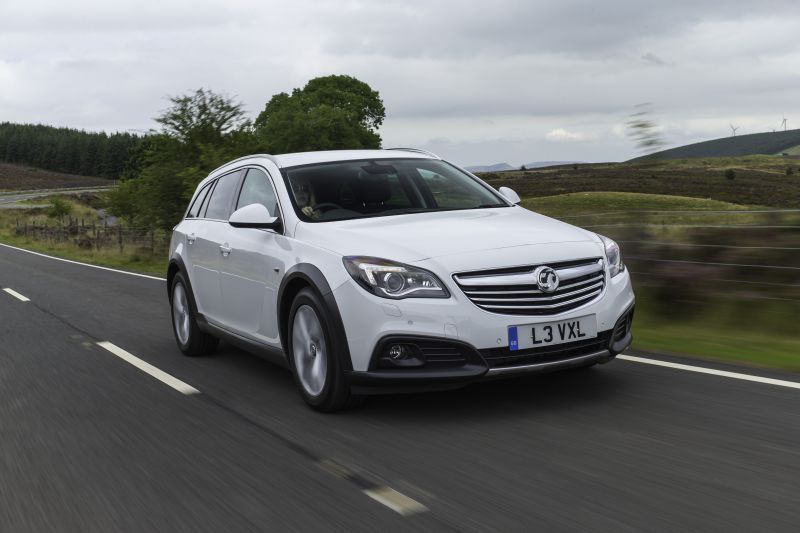
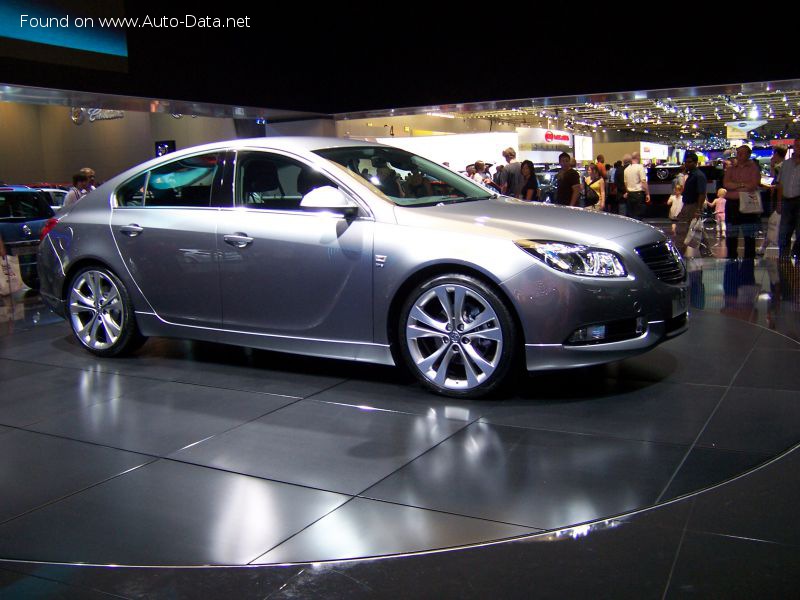
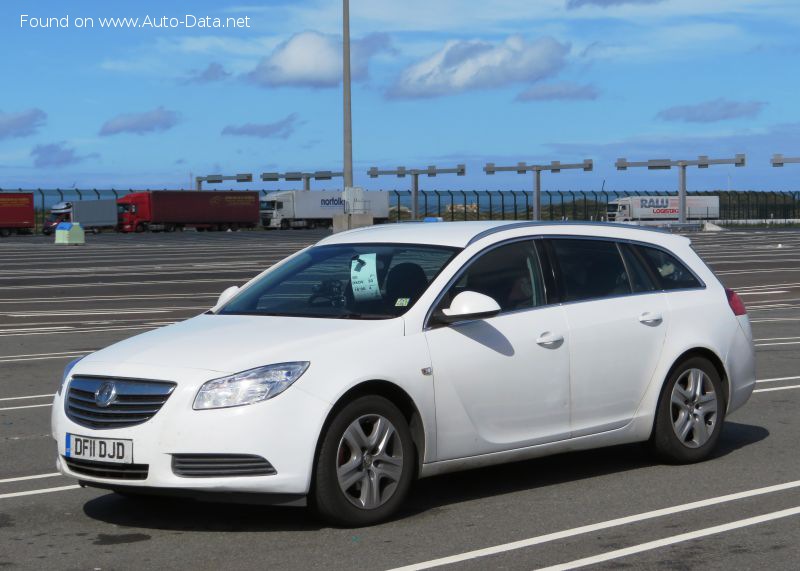
The Vauxhall Insignia I Sports Tourer made a strong visual statement upon its debut, departing from the more conservative styling of its predecessors. Its design was characterized by flowing lines, a coupe-like roofline, and distinctive “blade” elements on the side, giving it a dynamic and upscale appearance. Despite its sporty moniker, the “Sports Tourer” body type is a highly practical five-door station wagon, designed to offer superior cargo flexibility while maintaining aesthetic appeal.
Measuring 193.23 inches (4908 mm) in length, 73.07 inches (1856 mm) in width (82.05 inches or 2084 mm including mirrors), and 59.84 inches (1520 mm) in height, the Insignia Sports Tourer possessed a substantial road presence. Its generous 107.76-inch (2737 mm) wheelbase contributed to a stable ride and a spacious cabin for its five occupants. The sleek design was also aerodynamically efficient, boasting a drag coefficient (Cd) of 0.30, which aided both fuel economy and reduced wind noise at higher speeds.
Practicality and Interior Amenities
As a station wagon, the Insignia Sports Tourer excelled in versatility. It offered a minimum trunk (boot) space of 19.07 cubic feet (540 liters) with all seats in place, expanding significantly to 53.33 cubic feet (1510 liters) when the rear seats were folded down. This considerable cargo capacity made it an ideal choice for families, travelers, and those needing to transport larger items. The practical design also included a substantial 70-liter (18.49 US gallons) fuel tank, providing an excellent cruising range, especially with the efficient diesel engine.
Underneath, the Insignia featured an independent McPherson strut front suspension with coil springs and an anti-roll bar, paired with an independent multi-link rear suspension. This setup provided a comfortable yet composed ride, characteristic of European mid-size vehicles. Stopping power came from ventilated disc brakes at the front and disc brakes at the rear, augmented by an Anti-lock Braking System (ABS) for enhanced safety. Hydraulic power steering offered precise feedback, a preference for many drivers. The vehicle typically rode on 215/60 R16 tires mounted on 16-inch wheel rims, providing a good balance of comfort and grip.
Technical Specifications
| Category | Specification |
|---|---|
| General Information | |
| Brand | Vauxhall |
| Model | Insignia |
| Generation | Insignia I Sports Tourer |
| Engine Type | 2.0 CDTi ecoTEC (130 Hp) |
| Production Start | 2008 |
| Production End | 2013 |
| Body Type | Station wagon (estate), 5 Doors, 5 Seats |
| Drivetrain Architecture | Internal Combustion engine, Front Wheel Drive |
| Performance Specifications | |
| Fuel Consumption (Urban) | 7.7 l/100 km (30.5 US mpg) |
| Fuel Consumption (Extra Urban) | 4.9 l/100 km (48 US mpg) |
| Fuel Consumption (Combined) | 5.9 l/100 km (39.9 US mpg) |
| CO2 Emissions | 157 g/km |
| Fuel Type | Diesel |
| Acceleration 0-60 mph | 10.4 sec |
| Acceleration 0-100 km/h | 10.9 sec |
| Maximum Speed | 200 km/h (124.27 mph) |
| Emission Standard | Euro 5 |
| Weight-to-Power Ratio | 12.6 kg/Hp (79.5 Hp/tonne) |
| Weight-to-Torque Ratio | 5.5 kg/Nm (183.5 Nm/tonne) |
| Engine Specifications | |
| Power | 130 Hp @ 4000 rpm |
| Power per Liter | 66.5 Hp/l |
| Torque | 300 Nm (221.27 lb.-ft.) @ 1750-2500 rpm |
| Engine Layout | Front, Transverse |
| Engine Model/Code | A20DT |
| Engine Displacement | 1956 cm3 (2.0 L / 119.36 cu. in.) |
| Number of Cylinders | 4, Inline |
| Cylinder Bore | 83 mm (3.27 in.) |
| Piston Stroke | 90.4 mm (3.56 in.) |
| Valves per Cylinder | 4 |
| Fuel Injection System | Diesel Commonrail |
| Engine Aspiration | Turbocharger, Intercooler |
| Valvetrain | DOHC |
| Engine Oil Capacity | 4.5 l (4.76 US qt) |
| Coolant Capacity | 9 l (9.51 US qt) |
| Engine Systems | Particulate filter |
| Dimensions, Volume & Weights | |
| Kerb Weight | 1635 kg (3604.56 lbs.) |
| Max. Weight | 2265 kg (4993.47 lbs.) |
| Max Load | 630 kg (1388.91 lbs.) |
| Trunk Space (Minimum) | 540 l (19.07 cu. ft.) |
| Trunk Space (Maximum) | 1510 l (53.33 cu. ft.) |
| Fuel Tank Capacity | 70 l (18.49 US gal) |
| Permitted Trailer Load (with brakes) | 1600 kg (3527.4 lbs.) |
| Permitted Trailer Load (without brakes) | 750 kg (1653.47 lbs.) |
| Length | 4908 mm (193.23 in.) |
| Width | 1856 mm (73.07 in.) |
| Width (incl. mirrors) | 2084 mm (82.05 in.) |
| Height | 1520 mm (59.84 in.) |
| Wheelbase | 2737 mm (107.76 in.) |
| Front Track | 1585 mm (62.4 in.) |
| Rear Track | 1585 mm (62.4 in.) |
| Front Overhang | 1015 mm (39.96 in.) |
| Rear Overhang | 1156 mm (45.51 in.) |
| Ride Height (Ground Clearance) | 160 mm (6.3 in.) |
| Drag Coefficient (Cd) | 0.30 |
| Minimum Turning Circle | 10.89 m (35.73 ft.) |
| Drivetrain, Brakes & Suspension | |
| Drive Wheel | Front-wheel drive |
| Number of Gears | 6 gears, manual transmission |
| Front Suspension | Independent, McPherson with coil spring and anti-roll bar |
| Rear Suspension | Independent multi-link suspension |
| Front Brakes | Ventilated discs |
| Rear Brakes | Disc |
| Assisting Systems | ABS (Anti-lock braking system) |
| Power Steering | Hydraulic Steering |
| Tires Size | 215/60 R16 |
| Wheel Rims Size | 16 inches |
Legacy and Market Impact
The Vauxhall Insignia I Sports Tourer, especially in its 2.0 CDTi ecoTEC (130 Hp) guise, played a crucial role in Vauxhall/Opel’s strategy to re-establish itself as a formidable contender in the highly competitive European D-segment. It faced stiff competition from established rivals such as the Ford Mondeo, Volkswagen Passat, Skoda Superb, Peugeot 508, Citroën C5, Mazda6, and Toyota Avensis. The Insignia’s success stemmed from several key attributes that resonated with European consumers.
Firstly, its design was a significant departure from the utilitarian look of many previous Opel/Vauxhall models. The Insignia’s sleek, almost coupe-like profile for the sedan and the dynamic lines of the Sports Tourer were widely praised, helping it stand out in a segment often dominated by more conservative aesthetics. This fresh design language attracted a broader customer base and helped shed the brand’s somewhat staid image.
Secondly, the focus on efficiency, particularly with the ecoTEC diesel engines, was a major draw. The 2.0 CDTi (130 Hp) engine struck an excellent balance between performance and fuel economy, making it an economically sensible choice for both private buyers and, crucially, large fleet operators. In Europe, where company cars and long-distance travel are prevalent, low running costs and favorable CO2 emissions for tax purposes are paramount. The Insignia’s Euro 5 compliance and strong fuel economy figures made it a popular choice in these segments.
The Sports Tourer variant, in particular, solidified the Insignia’s reputation for practicality. Its generous trunk space, comfortable seating for five, and robust towing capabilities made it a versatile family hauler and a reliable workhorse. The combination of a stylish exterior with a highly functional interior was a winning formula.
Mechanically, the Insignia’s well-tuned chassis, featuring an independent multi-link rear suspension, offered a comfortable and stable ride, crucial for European roads which can vary from smooth highways to cobblestone streets. While not overtly sporty, its handling was competent and predictable, instilling confidence in drivers.
In terms of legacy, the first-generation Insignia successfully rebooted Opel/Vauxhall’s presence in the mid-size segment. It proved that the brand could produce stylish, efficient, and well-built vehicles that could compete head-on with offerings from Volkswagen and Ford. Its influence extended beyond Europe, with its platform and design cues informing models sold in other global markets, including North America. The Vauxhall Insignia I Sports Tourer 2.0 CDTi ecoTEC (130 Hp) is remembered as a well-rounded and impactful vehicle that defined its era for the brand, embodying a blend of European design flair, practical utility, and diesel efficiency that was highly valued in its primary markets.