
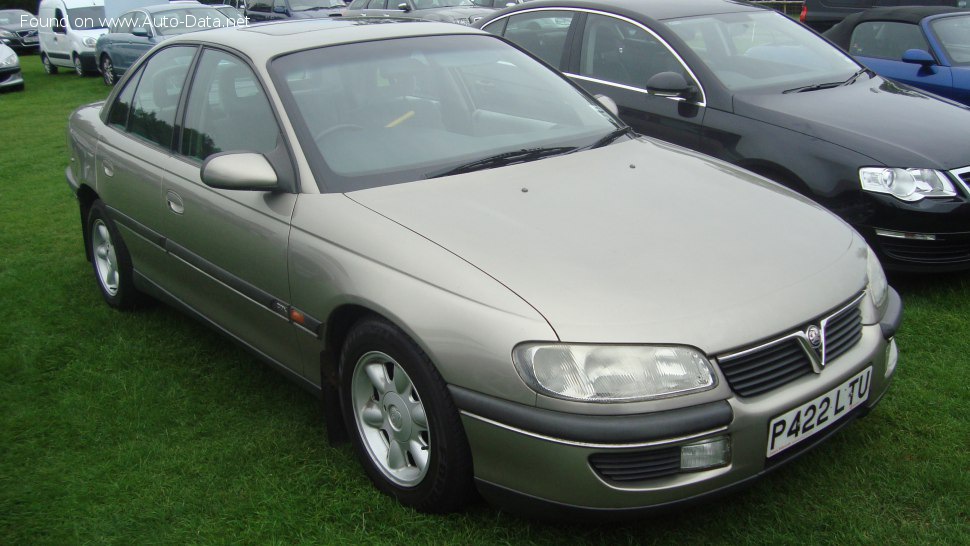
The Vauxhall Omega B 2.5i V6 24V (170 Hp) Automatic represents a significant offering from the British marque Vauxhall, a subsidiary of General Motors, during the mid-to-late 1990s. As a rebadged version of the Opel Omega B, this executive sedan was primarily targeted at the European market, where it competed in the fiercely contested large family and executive car segments. Produced from 1994 to 1999, the Omega B generation succeeded the original Omega A (known as the Vauxhall Carlton in the UK) and embodied a shift towards more refined aesthetics, enhanced safety, and improved driving dynamics for its class. The 2.5i V6 24V variant, specifically equipped with an automatic transmission, was positioned as a comfortable and capable cruiser, appealing to those seeking a blend of performance, luxury, and practicality in a rear-wheel-drive package. While never officially sold in the United States, its mechanical underpinnings and design ethos were reflective of global automotive trends of the era, showcasing European engineering prowess in a segment dominated by established German rivals.
The Vauxhall Omega B 2.5i V6 24V (170 Hp) Automatic: Engineering for the European Executive
At the heart of the Vauxhall Omega B 2.5i V6 24V (170 Hp) Automatic lies a sophisticated powertrain designed for smooth, responsive performance tailored to European driving conditions. The engine, designated X25XE, is a 2.5-liter (2498 cm3 or 152.44 cu. in.) V-configuration six-cylinder unit, featuring a double overhead camshaft (DOHC) valvetrain with four valves per cylinder, totaling 24 valves. This naturally aspirated engine delivers a robust 170 horsepower at 6000 rpm, providing ample power for motorway cruising and confident overtaking. Torque output stands at a healthy 227 Nm (167.43 lb.-ft.) at 3200 rpm, ensuring a broad power band and strong mid-range acceleration. The compression ratio of 10.8:1 indicates a design focused on efficiency and power extraction from standard gasoline fuel. With a power-per-liter rating of 68.1 Hp/l, the engine was competitive for its time, balancing performance with reasonable fuel consumption for a vehicle of its size and class.
Power is transmitted to the rear wheels via a 4-speed automatic transmission, a common choice for executive vehicles of the era, prioritizing smooth shifts and driving comfort over outright sportiness. This drivetrain architecture, with a front-longitudinal engine layout and rear-wheel drive, was a hallmark of premium sedans and contributed to the Omega B’s balanced handling characteristics. The vehicle’s top speed is rated at 217 km/h (134.84 mph), making it well-suited for high-speed European autobahns. Fuel economy, while not a primary selling point for large V6 sedans of the 1990s, was rated at 12 liters per 100 kilometers (19.6 US mpg) in urban driving conditions. The Omega B’s weight-to-power ratio of 9.2 kg/Hp (109 Hp/tonne) and weight-to-torque ratio of 6.9 kg/Nm (145.5 Nm/tonne) further underscore its capable performance for a vehicle weighing between 1560 and 1604 kg (3439.21 – 3536.21 lbs) curb weight. The generous 75-liter (19.81 US gal) fuel tank capacity provided an excellent cruising range, a crucial attribute for long-distance European travel.
Design and Features of the Omega B Sedan
The Vauxhall Omega B adopted a sleek, aerodynamic sedan body style, a departure from the more angular designs of its predecessors. Its design philosophy emphasized understated elegance and functionality, characteristic of European executive cars. Measuring 4787 mm (188.46 in.) in length, 1786 mm (70.31 in.) in width (1960 mm or 77.17 in. including mirrors), and 1455 mm (57.28 in.) in height, the Omega B presented a substantial road presence. The generous 2730 mm (107.48 in.) wheelbase contributed significantly to interior space and ride comfort, allowing for comfortable seating for five occupants across its four doors. The vehicle’s drag coefficient (Cd) of 0.29 was commendable for its time, aiding both fuel efficiency and reduced wind noise at higher speeds.
Inside, the Omega B prioritized comfort and practicality. The trunk (boot) offered a substantial 530 liters (18.72 cu. ft.) of cargo space, making it highly practical for family use or business travel. The interior design focused on ergonomics and quality materials, aiming to provide a refined environment for occupants. For its era, the Omega B featured advanced safety and convenience technologies. Anti-lock Braking System (ABS) was a standard assisting system, enhancing braking performance and control, particularly in adverse conditions. The suspension system comprised an independent McPherson strut setup with coil springs and an anti-roll bar at the front, paired with an independent multi-link suspension at the rear. This combination delivered a comfortable ride quality while maintaining composed handling. Braking power was provided by ventilated discs at the front and solid discs at the rear, ensuring reliable stopping performance. The vehicle rode on 205/65 R15 tires mounted on 6J x 15-inch wheel rims, a practical choice offering a balance of comfort and grip. A minimum turning circle of 10.2 meters (33.46 ft) also provided decent maneuverability for a car of its size, aiding urban navigation and parking.
Technical Specifications: Vauxhall Omega B 2.5i V6 24V (170 Hp) Automatic
| Brand | Vauxhall |
| Model | Omega |
| Generation | Omega B |
| Type (Engine) | 2.5i V6 24V (170 Hp) Automatic |
| Start of production | 1994 year |
| End of production | 1999 year |
| Powertrain Architecture | Internal Combustion engine |
| Body type | Sedan |
| Seats | 5 |
| Doors | 4 |
| Fuel consumption (economy) – urban | 12 l/100 km (19.6 US mpg) |
| Fuel Type | Petrol (Gasoline) |
| Maximum speed | 217 km/h (134.84 mph) |
| Weight-to-power ratio | 9.2 kg/Hp (109 Hp/tonne) |
| Weight-to-torque ratio | 6.9 kg/Nm (145.5 Nm/tonne) |
| Power | 170 Hp @ 6000 rpm |
| Power per liter | 68.1 Hp/l |
| Torque | 227 Nm @ 3200 rpm (167.43 lb.-ft. @ 3200 rpm) |
| Engine layout | Front, Longitudinal |
| Engine Model/Code | X25XE |
| Engine displacement | 2498 cm3 (152.44 cu. in.) |
| Number of cylinders | 6 |
| Engine configuration | V-engine |
| Compression ratio | 10.8:1 |
| Number of valves per cylinder | 4 |
| Engine aspiration | Naturally aspirated engine |
| Valvetrain | DOHC |
| Engine oil capacity | 5.75 l (6.08 US qt) |
| Coolant | 9.7 l (10.25 US qt) |
| Kerb Weight | 1560-1604 kg (3439.21 – 3536.21 lbs) |
| Max. weight | 2065-2095 kg (4552.55 – 4618.68 lbs) |
| Max load | 491-505 kg (1082.47 – 1113.33 lbs) |
| Trunk (boot) space – maximum | 530 l (18.72 cu. ft.) |
| Fuel tank capacity | 75 l (19.81 US gal) |
| Max. roof load | 100 kg (220.46 lbs) |
| Permitted trailer load with brakes (12%) | 1750-1850 kg (3858.09 – 4078.55 lbs) |
| Permitted trailer load without brakes | 750 kg (1653.47 lbs) |
| Permitted towbar download | 75 kg (165.35 lbs) |
| Length | 4787 mm (188.46 in.) |
| Width | 1786 mm (70.31 in.) |
| Width including mirrors | 1960 mm (77.17 in.) |
| Height | 1455 mm (57.28 in.) |
| Wheelbase | 2730 mm (107.48 in.) |
| Front track | 1514 mm (59.61 in.) |
| Rear (Back) track | 1528 mm (60.16 in.) |
| Rear overhang | 1140 mm (44.88 in.) |
| Drag coefficient (Cd) | 0.29 |
| Minimum turning circle (turning diameter) | 10.2 m (33.46 ft) |
| Drivetrain Architecture | The Internal combustion engine (ICE) drives the rear wheels of the vehicle. |
| Drive wheel | Rear wheel drive |
| Number of gears and type of gearbox | 4 gears, automatic transmission |
| Front suspension | Independent, type McPherson with coil spring and anti-roll bar |
| Rear suspension | Independent multi-link suspension |
| Front brakes | Ventilated discs |
| Rear brakes | Disc |
| Assisting systems | ABS (Anti-lock braking system) |
| Tires size | 205/65 R15 |
| Wheel rims size | 6J x 15 |
