
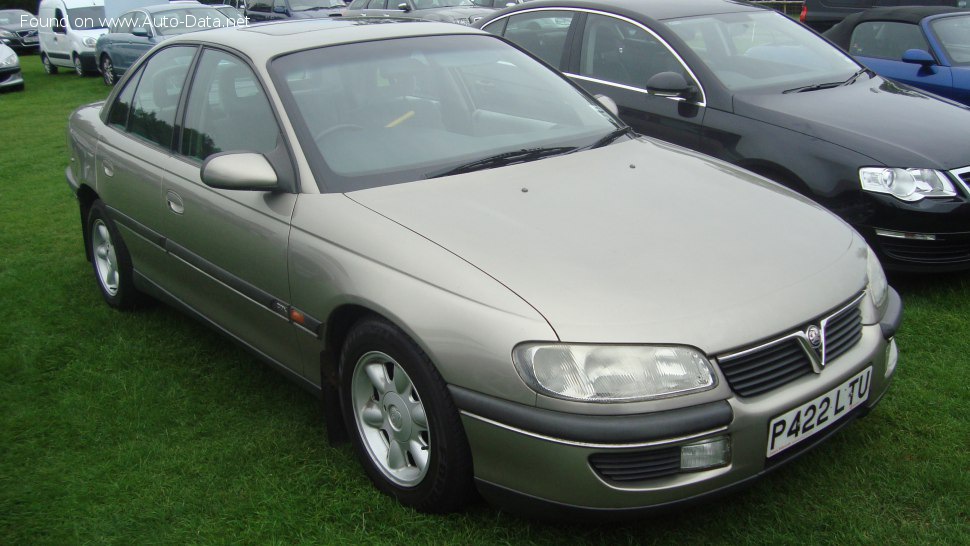
The Vauxhall Omega B 3.0i V6 24V (211 Hp) Automatic represented a significant offering in the executive car segment during its production run from 1994 to 1999. As the second generation of Vauxhall’s flagship sedan in the United Kingdom, the Omega B succeeded the Carlton and was closely related to its European counterpart, the Opel Omega. While never officially sold in the United States, the Omega B played a crucial role in the European market, particularly for business executives and families seeking a spacious, comfortable, and powerful rear-wheel-drive vehicle. This particular variant, equipped with the robust 3.0-liter V6 engine and an automatic transmission, epitomized a blend of refined performance and traditional sedan virtues, positioning itself as a strong competitor against established premium brands in its class. Its design and engineering aimed to provide a sophisticated driving experience with a focus on ride comfort and long-distance cruising capability.
Engine and Performance of the Vauxhall Omega B 3.0i V6 24V (211 Hp) Automatic
At the heart of the Vauxhall Omega B 3.0i V6 24V (211 Hp) Automatic lay a formidable 3.0-liter (2962 cm3 or 180.75 cu. in.) naturally aspirated V6 engine, designated with the internal code X30XE. This powerplant was engineered for smooth, linear power delivery, characteristic of executive sedans of its era. With a power output of 211 horsepower at 6200 rpm, the Omega B offered considerable performance for its segment, translating to a power-per-liter ratio of 71.2 HP/l. The engine’s V-configuration, combined with a DOHC (Double Overhead Camshaft) valvetrain and four valves per cylinder, ensured efficient breathing and combustion. The cylinder bore measured 3.39 inches (86 mm) and the piston stroke was 3.35 inches (85 mm), contributing to its balanced character.
Torque was equally impressive, peaking at 199.14 lb.-ft. (270 Nm) at a relatively accessible 3600 rpm. This ample torque, coupled with the smooth-shifting 4-speed automatic transmission, provided effortless acceleration and strong passing power, making the Omega B well-suited for both urban driving and sustained highway cruising. The powertrain architecture was a classic front, longitudinal engine layout, driving the rear wheels, a configuration favored for its balanced weight distribution and engaging driving dynamics. This setup also contributed to the vehicle’s notable weight-to-power ratio of 7.8 kg/Hp (128 Hp/tonne) and a weight-to-torque ratio of 6.1 kg/Nm (163.7 Nm/tonne).
In terms of outright speed, the Vauxhall Omega B 3.0i V6 24V (211 Hp) Automatic was capable of reaching a maximum speed of 142.92 mph (230 km/h), a respectable figure for a large sedan. Fuel economy, while not its primary focus, was rated at 17.8 US mpg (13.2 l/100 km) in urban conditions, reflecting the substantial displacement and power output of the V6 engine. The use of multi-port manifold injection ensured precise fuel delivery, contributing to both performance and emissions control for its time. The engine required 6.08 US quarts (5.75 liters) of engine oil and 10.25 US quarts (9.7 liters) of coolant, indicating robust cooling and lubrication systems designed for longevity and demanding use.
Design and Features of the Vauxhall Omega B
The Vauxhall Omega B, produced between 1994 and 1999, presented itself as a sophisticated four-door sedan, designed to offer both executive presence and practical functionality. With seating for five occupants, its body type reflected the traditional sedan aesthetic, characterized by clean lines and a purposeful stance. The overall length of the vehicle measured 188.46 inches (4787 mm), with a width of 70.31 inches (1786 mm) (77.17 inches or 1960 mm including mirrors), and a height of 57.28 inches (1455 mm). These dimensions contributed to a spacious interior and a commanding road presence, typical of its segment.
One of the notable design characteristics was its impressive drag coefficient (Cd) of 0.29. This low figure was a testament to Vauxhall’s aerodynamic engineering efforts, contributing not only to fuel efficiency at higher speeds but also to reduced wind noise and improved stability during long journeys. The design language, while understated, exuded a sense of timeless elegance, favoring smooth contours over aggressive styling cues. The wheelbase, at 107.48 inches (2730 mm), was generous, playing a key role in the Omega B’s renowned ride comfort and interior roominess, particularly for rear-seat passengers.
Inside, the Vauxhall Omega B prioritized comfort and convenience. While specific interior features are not detailed in the provided data, a car of this class and era would typically include amenities such as air conditioning, power windows, central locking, and a quality audio system. The vehicle offered a substantial trunk (boot) space of 18.72 cu. ft. (530 liters), making it highly practical for family trips or business travel with significant luggage. Practicality was further enhanced by a fuel tank capacity of 19.81 US gallons (75 liters), providing a good cruising range. For those needing to transport larger items, the Omega B had a maximum roof load capacity of 220.46 lbs. (100 kg) and impressive towing capabilities, rated at 3968.32 lbs. (1800 kg) with brakes and 1653.47 lbs. (750 kg) without brakes, alongside a permitted towbar download of 165.35 lbs. (75 kg).
Safety features for the era included an Anti-lock Braking System (ABS), which was a significant advancement in
