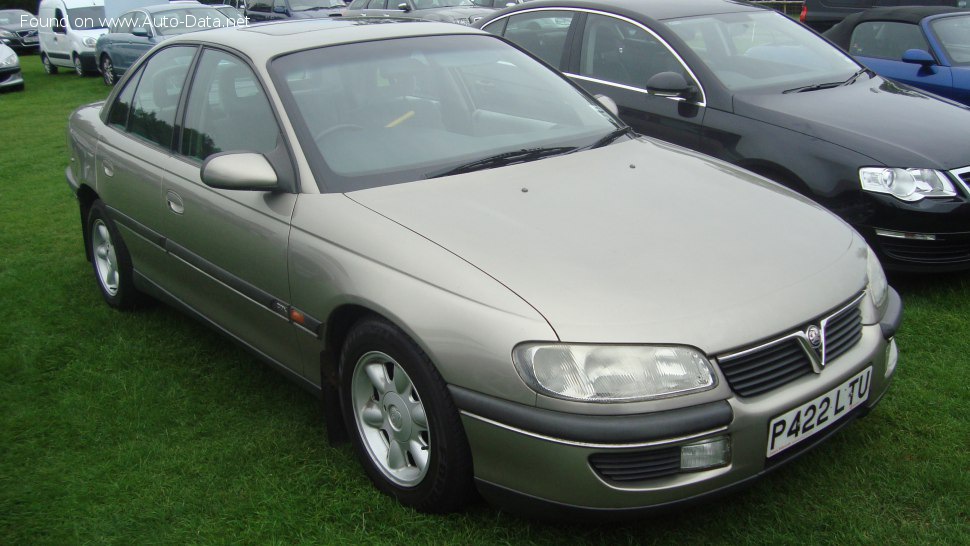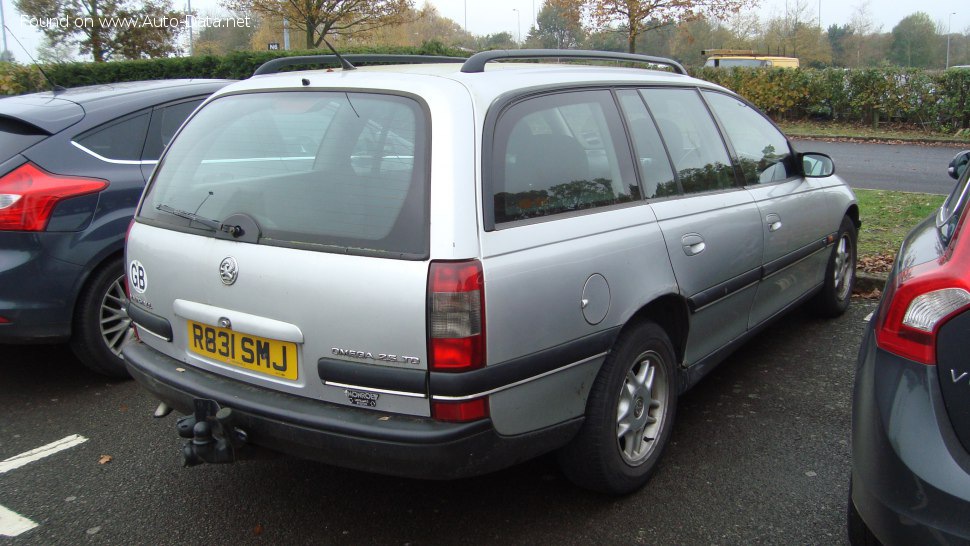
The Vauxhall Omega Estate B 2.0i (116 Hp) Automatic represents a significant offering from the British marque during the mid-1990s, serving as a cornerstone of its large family and executive segment in the United Kingdom. Produced between 1994 and 1998, this generation of the Omega Estate, known internally as the ‘B’ platform, was a rebadged version of the Opel Omega B, developed by General Motors for the European market. As a spacious station wagon, it was designed to cater to families and business users requiring substantial cargo capacity and comfortable long-distance travel, offering a practical yet refined alternative to its sedan counterpart. While the Vauxhall brand was not directly sold in the United States, the Omega’s engineering roots and design philosophy were indicative of global automotive trends, emphasizing safety, efficiency, and driving dynamics relevant to its era. This particular variant, equipped with a 2.0-liter engine and an automatic transmission, aimed to balance accessible performance with everyday usability and fuel economy.
Powertrain and Performance of the Vauxhall Omega Estate B 2.0i (116 Hp) Automatic
At the heart of the Vauxhall Omega Estate B 2.0i (116 Hp) Automatic lies a robust 2.0-liter (1998 cm3 or 121.93 cu. in.) naturally aspirated inline four-cylinder engine, designated by the codes 20SE or X20SE. This powerplant, mounted longitudinally at the front, was designed for smooth power delivery and reliability, characteristic of its segment. With a bore and stroke of 86 mm (3.39 in.) each, it featured a square engine design, typically favoring a balance between torque and higher-revving power. The engine utilized a multi-port manifold injection system and a 10:1 compression ratio to achieve its stated output of 116 horsepower at 5400 rpm. Torque figures were particularly strong for a naturally aspirated 2.0-liter unit of its time, delivering 151.2 lb.-ft. (205 Nm) at a relatively low 1650 rpm. This emphasis on low-end torque made the Omega Estate B feel responsive in urban driving and capable of hauling heavier loads without excessive strain.
Power was channeled to the rear wheels via a conventional 4-speed automatic transmission, a popular choice for its ease of use and comfort, especially in a family-oriented vehicle. This drivetrain architecture, with the internal combustion engine driving the rear wheels, provided a balanced driving dynamic and a sense of traditional European executive car feel. The performance metrics for this configuration were respectable for its class, with a maximum speed of 116.2 mph (187 km/h). While specific 0-60 mph acceleration figures are not provided, the combination of 116 horsepower and 151.2 lb.-ft. of torque, coupled with a kerb weight ranging from 3269.46 to 3403.94 lbs. (1483-1544 kg), suggests a leisurely but adequate pace for everyday driving and highway cruising. The weight-to-power ratio stood at 12.8 kg/Hp (78.2 Hp/tonne), indicating a focus on comfort and practicality over outright speed. Fuel economy, while not a strong suit by modern standards, was competitive for the mid-90s, with urban consumption rated at 20.8 US mpg (11.3 l/100 km). The generous 19.81 US gallon (75-liter) fuel tank capacity ensured a considerable range between fill-ups, ideal for extended journeys.
Design, Features, and Practicality
The Vauxhall Omega Estate B was a quintessential example of a spacious European station wagon, prioritizing functionality and passenger comfort. Its body type, a 5-door estate, provided exceptional versatility. With an overall length of 189.72 inches (4819 mm), a width of 70.31 inches (1786 mm), and a height of 60.83 inches (1545 mm), the Omega Estate commanded a significant road presence. The generous wheelbase of 107.48 inches (2730 mm) contributed significantly to interior roominess and ride stability, accommodating five occupants comfortably. The design, characterized by smooth lines and a relatively low drag coefficient (Cd) of 0.32, was contemporary for the mid-90s, aiming for both aesthetic appeal and aerodynamic efficiency.
Practicality was a cornerstone of the Omega Estate’s design. The trunk (boot) space was particularly impressive, offering a minimum of 19.07 cu. ft. (540 liters) with all seats in place. When the rear seats were folded, this expanded to a cavernous 63.57 cu. ft. (1800 liters), making it highly capable of transporting large items, luggage, or equipment. The maximum permissible load capacity ranged from 1192.7 to 1327.18 lbs. (541-602 kg), further underscoring its utility. Furthermore, its towing capabilities were robust, with a permitted trailer load of 3747.86 lbs. (1700 kg) with brakes and 1653.47 lbs. (750 kg) without, making it suitable for towing caravans or small trailers. A maximum roof load of 220.46 lbs. (100 kg) added to its cargo-carrying versatility.
Underneath, the Omega Estate B featured an independent suspension setup designed for a comfortable and composed ride. The front employed a McPherson strut system with coil springs and an anti-roll bar, providing precise steering and good road holding. The rear utilized an independent multi-link suspension, which was advanced for its time and contributed significantly to ride quality and handling stability, particularly when laden. Braking performance was handled by ventilated discs at the front and solid discs at the rear, augmented by an Anti-lock Braking System (ABS), a key safety feature for the era. The vehicle rode on 195/65 R15 tires mounted on 6.5J x 15-inch wheel rims, a common and cost-effective tire size that offered a good balance of comfort and grip. The minimum turning circle of 33.46 ft. (10.2 m) was reasonable for a vehicle of its size, aiding maneuverability in urban environments.
Market Context and Legacy
The Vauxhall Omega Estate B 2.0i (116 Hp) Automatic played a crucial role in Vauxhall’s lineup during the mid-to-late 1990s, serving as its flagship large family and executive station wagon. In the highly competitive European market, it faced rivals from Ford (Scorpio), Volkswagen (Passat), and various Japanese offerings, as well as premium German brands like BMW and Mercedes-Benz, albeit at a more accessible price point. The Omega was particularly popular with company car fleets and families who needed significant space and comfort without the premium cost associated with luxury marques. Its reputation for solid build quality, comfortable ride, and spacious interior made it a compelling choice for those prioritizing practicality and value.
The Omega B generation built upon the success of its predecessor, the Omega A (marketed as the Carlton in the UK), by offering more refined styling, improved safety features, and enhanced driving dynamics. While the 2.0-liter engine variant provided adequate power for most users, a range of more potent V6 engines was also available for those seeking higher performance. The model’s longevity in production (1994-2003 for the entire Omega B generation) is a testament to its fundamental soundness and market acceptance. Although the Vauxhall Omega, and its Opel counterpart, were eventually discontinued without a direct successor in the executive segment, it left a legacy as a workhorse that capably served the needs of countless families and businesses across Europe. Its focus on spaciousness, comfort, and robust engineering embodied the practical ethos of mainstream European automotive design of its time, making the Vauxhall Omega Estate B 2.0i (116 Hp) Automatic a memorable and significant vehicle in its segment.
Technical Specifications
| Brand | Vauxhall |
| Model | Omega |
| Generation | Omega Estate B |
| Type (Engine) | 2.0i (116 Hp) Automatic |
| Start of production | 1994 year |
| End of production | 1998 year |
| Powertrain Architecture | Internal Combustion engine |
| Body type | Station wagon (estate) |
| Seats | 5 |
| Doors | 5 |
| Fuel consumption (economy) – urban | 11.3 l/100 km (20.8 US mpg / 25 UK mpg / 8.8 km/l) |
| Fuel Type | Petrol (Gasoline) |
| Maximum speed | 187 km/h (116.2 mph) |
| Weight-to-power ratio | 12.8 kg/Hp, 78.2 Hp/tonne |
| Weight-to-torque ratio | 7.2 kg/Nm, 138.2 Nm/tonne |
| Power | 116 Hp @ 5400 rpm. |
| Power per litre | 58.1 Hp/l |
| Torque | 205 Nm @ 1650 rpm. (151.2 lb.-ft. @ 1650 rpm.) |
| Engine layout | Front, Longitudinal |
| Engine Model/Code | 20SE, X20SE |
| Engine displacement | 1998 cm3 (121.93 cu. in.) |
| Number of cylinders | 4 |
| Engine configuration | Inline |
| Cylinder Bore | 86 mm (3.39 in.) |
| Piston Stroke | 86 mm (3.39 in.) |
| Compression ratio | 10:1 |
| Number of valves per cylinder | 4 |
| Fuel injection system | Multi-port manifold injection |
| Engine aspiration | Naturally aspirated engine |
| Engine oil capacity | 4.5 l (4.76 US qt | 3.96 UK qt) |
| Coolant | 8.8 l (9.3 US qt | 7.74 UK qt) |
| Kerb Weight | 1483-1544 kg (3269.46 – 3403.94 lbs.) |
| Max. weight | 2085 kg (4596.64 lbs.) |
| Max load | 541-602 kg (1192.7 – 1327.18 lbs.) |
| Trunk (boot) space – minimum | 540 l (19.07 cu. ft.) |
| Trunk (boot) space – maximum | 1800 l (63.57 cu. ft.) |
| Fuel tank capacity | 75 l (19.81 US gal | 16.5 UK gal) |
| Max. roof load | 100 kg (220.46 lbs.) |
| Permitted trailer load with brakes (12%) | 1700 kg (3747.86 lbs.) |
| Permitted trailer load without brakes | 750 kg (1653.47 lbs.) |
| Permitted towbar download | 75 kg (165.35 lbs.) |
| Length | 4819 mm (189.72 in.) |
| Width | 1786 mm (70.31 in.) |
| Width including mirrors | 1960 mm (77.17 in.) |
| Height | 1545 mm (60.83 in.) |
| Wheelbase | 2730 mm (107.48 in.) |
| Front track | 1514 mm (59.61 in.) |
| Rear (Back) track | 1528 mm (60.16 in.) |
| Rear overhang | 1170 mm (46.06 in.) |
| Drag coefficient (Cd) | 0.32 |
| Minimum turning circle (turning diameter) | 10.2 m (33.46 ft.) |
| Drivetrain Architecture | The Internal combustion engine (ICE) drives the rear wheels of the vehicle. |
| Drive wheel | Rear wheel drive |
| Number of gears and type of gearbox | 4 gears, automatic transmission |
| Front suspension | Independent, type McPherson with coil spring and anti-roll bar |
| Rear suspension | Independent multi-link suspension |
| Front brakes | Ventilated discs |
| Rear brakes | Disc |
| Assisting systems | ABS (Anti-lock braking system) |
| Tires size | 195/65 R15 |
| Wheel rims size | 6.5J x 15 |