
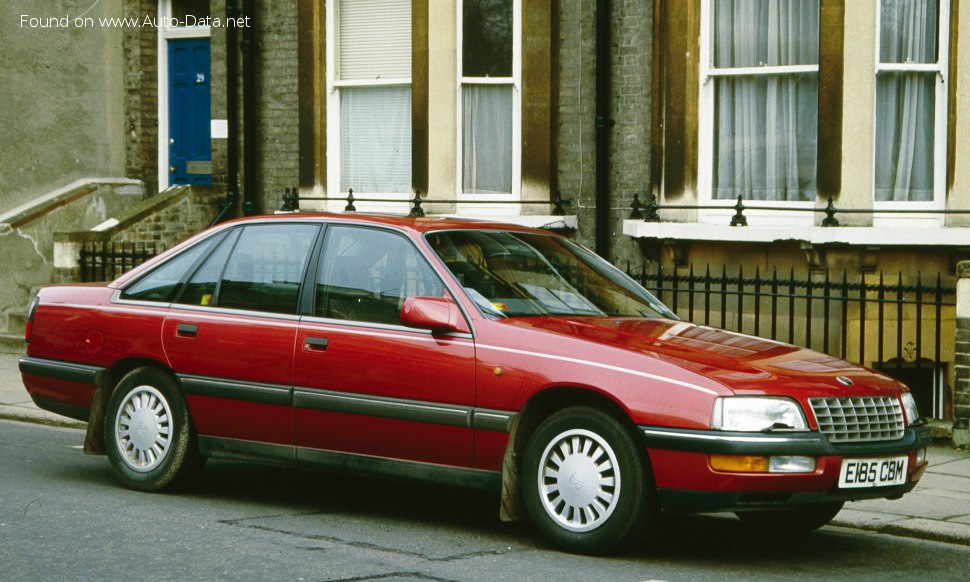
The Vauxhall Senator B 2.5i (140 Hp) Automatic stands as a quintessential executive sedan from the late 1980s, representing Vauxhall’s flagship offering in the United Kingdom and a rebadged version of the Opel Senator B for the British market. Produced from 1987 to 1990, this second-generation Senator built upon the legacy of its predecessor, aiming to compete with established luxury marques by offering a blend of refined performance, advanced features for its era, and a spacious, comfortable cabin. While never officially sold in the United States, the Senator B carved out a significant niche in Europe as a sophisticated, rear-wheel-drive platform designed for discerning buyers seeking a blend of comfort, highway cruising capability, and understated elegance. Its role was to provide a premium experience without the overt flashiness of some competitors, emphasizing solid engineering and a smooth driving experience.
Engineering and Performance of the Vauxhall Senator B 2.5i (140 Hp) Automatic
At the heart of the Vauxhall Senator B 2.5i (140 Hp) Automatic was a robust and well-regarded 2.5-liter (2,490 cubic centimeters or 151.95 cubic inches) inline-six engine, designated by the code 25NE. This naturally aspirated powerplant was a hallmark of Opel/Vauxhall’s engineering prowess, known for its inherent balance and smooth operation, characteristics highly valued in the executive car segment. Featuring a multi-port manifold injection system, the engine delivered a respectable 140 horsepower at 5,200 revolutions per minute, providing ample power for comfortable cruising and confident overtakes. Torque output was equally impressive for its time, peaking at 151.2 pound-feet (205 Newton-meters) at 4,200 rpm, ensuring a flexible powerband that made the car feel responsive in various driving conditions.
The inline-six configuration, with two valves per cylinder and a front, longitudinal engine layout, contributed significantly to the car’s refined demeanor. Power was channeled to the rear wheels through a four-speed automatic transmission, a common choice for luxury vehicles of the period, prioritizing seamless shifts and relaxed driving over aggressive performance. This drivetrain architecture, with the internal combustion engine driving the rear wheels, offered a traditional and balanced feel, appealing to drivers who appreciated classic automotive dynamics. While not designed as a sports sedan, the Senator B 2.5i was capable of reaching a top speed of 124.27 miles per hour (200 kilometers per hour), a commendable figure for a large, automatic sedan of its time. Its weight-to-power ratio of 10.2 kilograms per horsepower (98.2 horsepower per tonne) and a weight-to-torque ratio of 7 kilograms per Newton-meter (143.9 Newton-meters per tonne) highlight its balanced approach to performance, focusing on smooth acceleration rather than raw, neck-snapping power. The 5.55 liters (5.86 US quarts) of engine oil capacity and 10.1 liters (10.67 US quarts) of coolant capacity further underscore the robust design intended for long-distance comfort and durability.
Design and Features of the Vauxhall Senator B
The Vauxhall Senator B presented a sleek and aerodynamic design for its era, a significant departure from the more angular styling of the 1970s and early 1980s. Its four-door sedan body type exuded a sense of understated luxury, with clean lines and a purposeful stance. Measuring 190.75 inches in length, 69.41 inches in width, and 57.09 inches in height, with a generous 107.48-inch wheelbase, the Senator B provided a spacious and comfortable cabin for five occupants. The designers achieved a remarkably low drag coefficient (Cd) of 0.30, a testament to the vehicle’s aerodynamic efficiency, which contributed to both fuel economy and reduced wind noise at higher speeds—a crucial attribute for an executive cruiser.
Inside, the Senator B was equipped with features aimed at enhancing comfort and convenience. While specific trim levels varied, the general emphasis was on plush seating, quality materials, and a well-appointed dashboard. For a car of its generation, the inclusion of an Anti-lock Braking System (ABS) as an assisting system was a significant safety feature, providing enhanced control during emergency braking situations. The independent front suspension, utilizing a McPherson strut design with coil springs and an anti-roll bar, combined with an independent coil spring rear suspension, delivered a ride quality that prioritized smoothness and stability, characteristic of a long-distance executive sedan. Braking performance was handled by ventilated discs at the front and disc brakes at the rear, offering reliable stopping power. The vehicle rode on 205/65 R15 tires mounted on 6J x 15-inch wheel rims, providing a comfortable balance of grip and ride compliance. Practicality was also a strong suit, with a substantial trunk (boot) space of 18.72 cubic feet (530 liters) and a generous 19.81 US gallons (75 liters) fuel tank capacity, ensuring long ranges between fill-ups. The Senator B’s design ethos clearly aimed to offer a sophisticated, comfortable, and safe motoring experience, making it a compelling choice in the European executive market of the late 1980s.
Technical Specifications: Vauxhall Senator B 2.5i (140 Hp) Automatic (1987-1990)
| Brand | Vauxhall |
| Model | Senator |
| Generation | Senator B |
| Engine Type | 2.5i (140 Hp) Automatic |
| Production Start | 1987 |
| Production End | 1990 |
| Powertrain Architecture | Internal Combustion Engine |
| Body Type | Sedan |
| Seats | 5 |
| Doors | 4 |
| Fuel Type | Petrol (Gasoline) |
| Maximum Speed | 124.27 mph (200 km/h) |
| Weight-to-Power Ratio | 10.2 kg/Hp (98.2 Hp/tonne) |
| Weight-to-Torque Ratio | 7 kg/Nm (143.9 Nm/tonne) |
| Power | 140 Hp @ 5200 rpm |
| Power per Liter | 56.2 Hp/l |
| Torque | 151.2 lb.-ft. (205 Nm) @ 4200 rpm |
| Engine Layout | Front, Longitudinal |
| Engine Model/Code | 25NE |
| Engine Displacement | 2.5 liters (2490 cm3 / 151.95 cu. in.) |
| Number of Cylinders | 6 |
| Engine Configuration | Inline |
| Valves per Cylinder | 2 |
| Fuel Injection System | Multi-port manifold injection |
| Engine Aspiration | Naturally aspirated engine |
| Engine Oil Capacity | 5.86 US qt (5.55 l) |
| Coolant Capacity | 10.67 US qt (10.1 l) |
| Kerb Weight | 3141.59 lbs (1425 kg) |
| Max. Weight | 4332.08 lbs (1965 kg) |
| Max Load | 1190.5 lbs (540 kg) |
| Trunk (boot) Space – Maximum | 18.72 cu. ft. (530 l) |
| Fuel Tank Capacity | 19.81 US gal (75 l) |
| Max. Roof Load | 220.46 lbs (100 kg) |
| Permitted Trailer Load with Brakes (12%) | 3306.93 lbs (1500 kg) |
| Permitted Trailer Load without Brakes | 1587.33 lbs (720 kg) |
| Permitted Towbar Download | 165.35 lbs (75 kg) |
| Length | 190.75 in (4845 mm) |
| Width | 69.41 in (1763 mm) |
| Height | 57.09 in (1450 mm) |
| Wheelbase | 107.48 in (2730 mm) |
| Drag Coefficient (Cd) | 0.30 |
| Minimum Turning Circle | 33.14 ft (10.1 m) |
| Drivetrain Architecture | Rear-wheel drive |
| Drive Wheel | Rear wheel drive |
| Number of Gears and Type of Gearbox | 4 gears, automatic transmission |
| Front Suspension | Independent, McPherson with coil spring and anti-roll bar |
| Rear Suspension | Independent coil spring |
| Front Brakes | Ventilated discs |
| Rear Brakes | Disc |
| Assisting Systems | ABS (Anti-lock braking system) |
| Tires Size | 205/65 R15 |
| Wheel Rims Size | 6J x 15 |
