
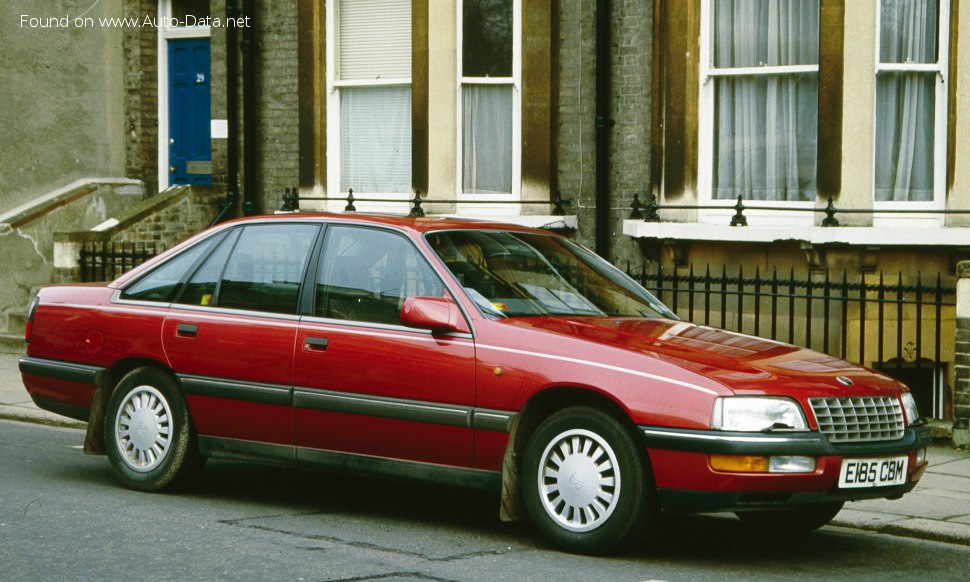
The Vauxhall Senator B 3.0 24V (204 Hp) represents a significant chapter in the history of European executive sedans, particularly for the British market where Vauxhall served as General Motors’ local brand. Launched in 1989 as the second generation of the Senator line, this full-size, four-door sedan was essentially a rebadged Opel Senator B, itself derived from the Opel Omega platform. Positioned as a flagship model, it aimed to offer a blend of luxury, performance, and sophisticated engineering, competing with established German rivals such as the BMW 5 Series and Mercedes-Benz E-Class. The “24V” designation in its name was a critical differentiator, highlighting its advanced multi-valve engine technology, which was a hallmark of performance and modernity in its era. The Senator B was designed to appeal to discerning buyers seeking a comfortable, powerful, and well-equipped vehicle for long-distance cruising and executive transport, embodying the refined engineering capabilities of its time.
Engineering Prowess: The Vauxhall Senator B 3.0 24V (204 Hp) Powertrain
At the heart of the Vauxhall Senator B 3.0 24V (204 Hp) lay its formidable C30SE engine, a 3.0-liter (2969 cm³, or 181.18 cu. in.) naturally aspirated inline-six powerplant. This engine was a testament to late 1980s engineering, featuring a multi-port manifold injection system and, crucially, a 24-valve cylinder head, meaning four valves per cylinder. This valve configuration was a significant technological leap for production cars of the period, allowing for superior gas flow, higher volumetric efficiency, and ultimately, greater power output compared to conventional two-valve designs. The engine was longitudinally mounted at the front, driving the rear wheels, a classic setup for a performance-oriented executive sedan that offered balanced handling characteristics.
The C30SE engine produced a robust 204 horsepower at 6000 rpm, translating to an impressive power per liter of 68.7 Hp/l. Torque figures were equally compelling, peaking at 270 Nm (199.14 lb.-ft.) at a relatively accessible 3600 rpm. This combination of power and torque provided the Senator B with strong acceleration and effortless cruising ability, a critical attribute for its target market. Coupled with a precise 5-speed manual transmission, the powertrain delivered an engaging driving experience. The car’s performance metrics were highly competitive for its class: a maximum speed of 240 km/h (149.13 mph) underscored its Autobahn-bred capabilities. With a curb weight of 3119.54 lbs. (1415 kg), the weight-to-power ratio stood at 6.9 kg/Hp, or 144.2 Hp/tonne, indicating a lively and responsive character for a vehicle of its size. Fuel consumption in urban conditions was rated at 14.3 l/100 km (16.4 US mpg), reflecting the engine’s performance-oriented tuning while still being respectable for a large-displacement inline-six of that era. The engine oil capacity was 5.5 liters (5.81 US qt) and the coolant system held 9.8 liters (10.36 US qt), highlighting the robust cooling and lubrication systems required for sustained high-speed performance.
Design and Features of the Vauxhall Senator B
The Vauxhall Senator B maintained a dignified and understated aesthetic, characteristic of European executive sedans of its time. Its body type was a classic four-door sedan, offering seating for five occupants in a spacious and comfortable cabin. The design prioritized aerodynamic efficiency, evidenced by a commendable drag coefficient (Cd) of 0.30, which contributed to both its top speed and fuel efficiency. The dimensions—a length of 4845 mm (190.75 in.), width of 1763 mm (69.41 in.), and height of 1450 mm (57.09 in.)—established its presence as a substantial vehicle, while a generous wheelbase of 2730 mm (107.48 in.) ensured ample interior room and a composed ride.
For a car produced between 1989 and 1993, the Senator B offered a respectable array of features that underscored its premium positioning. Safety was a growing concern in this period, and the inclusion of an Anti-lock Braking System (ABS) as standard was a significant feature, enhancing driver control under hard braking. The independent McPherson strut front suspension with coil springs and an anti-roll bar, combined with an independent multi-link rear suspension, provided a sophisticated chassis setup that balanced ride comfort with capable handling. Braking power came from ventilated discs at the front and solid discs at the rear, ensuring confident stopping performance. The car rode on 205/65 R15 tires mounted on 6J x 15 wheel rims, a specification that provided a good balance of grip and ride compliance. Practicality was also a strong suit, with a substantial trunk (boot) space of 530 liters (18.72 cu. ft.), making it well-suited for executive travel or family use. The 75-liter (19.81 US gal) fuel tank offered a considerable cruising range, further cementing its long-distance touring credentials. Its turning circle of 10.1 meters (33.14 ft.) also made it surprisingly maneuverable for a car of its size.
Technical Specifications: Vauxhall Senator B 3.0 24V (204 Hp)
| Brand | Vauxhall |
| Model | Senator |
| Generation | Senator B |
| Engine Type | 3.0 24V (204 Hp) |
| Production Start | 1989 |
| Production End | 1993 |
| Powertrain Architecture | Internal Combustion Engine |
| Body Type | Sedan |
| Seats | 5 |
| Doors | 4 |
| Fuel Consumption (Urban) | 14.3 l/100 km (16.4 US mpg) |
| Fuel Type | Petrol (Gasoline) |
| Maximum Speed | 240 km/h (149.13 mph) |
| Weight-to-Power Ratio | 6.9 kg/Hp (144.2 Hp/tonne) |
| Weight-to-Torque Ratio | 5.2 kg/Nm (190.8 Nm/tonne) |
| Power | 204 Hp @ 6000 rpm |
| Power per Liter | 68.7 Hp/l |
| Torque | 270 Nm @ 3600 rpm (199.14 lb.-ft.) |
| Engine Layout | Front, Longitudinal |
| Engine Model/Code | C30SE |
| Engine Displacement | 2969 cm³ (181.18 cu. in.) |
| Number of Cylinders | 6 |
| Engine Configuration | Inline |
| Number of Valves per Cylinder | 4 |
| Fuel Injection System | Multi-port manifold injection |
| Engine Aspiration | Naturally aspirated |
| Engine Oil Capacity | 5.5 l (5.81 US qt) |
| Coolant Capacity | 9.8 l (10.36 US qt) |
| Kerb Weight | 1415 kg (3119.54 lbs.) |
| Maximum Weight | 1965 kg (4332.08 lbs.) |
| Max Load | 550 kg (1212.54 lbs.) |
| Trunk (Boot) Space – Maximum | 530 l (18.72 cu. ft.) |
| Fuel Tank Capacity | 75 l (19.81 US gal) |
| Max. Roof Load | 100 kg (220.46 lbs.) |
| Permitted Trailer Load with Brakes (12%) | 1100 kg (2425.08 lbs.) |
| Permitted Trailer Load without Brakes | 720 kg (1587.33 lbs.) |
| Permitted Towbar Download | 75 kg (165.35 lbs.) |
| Length | 4845 mm (190.75 in.) |
| Width | 1763 mm (69.41 in.) |
| Height | 1450 mm (57.09 in.) |
| Wheelbase | 2730 mm (107.48 in.) |
| Drag Coefficient (Cd) | 0.30 |
| Minimum Turning Circle | 10.1 m (33.14 ft.) |
| Drivetrain Architecture | Rear wheel drive, Internal Combustion Engine |
| Drive Wheel | Rear wheel drive |
| Number of Gears and Type of Gearbox | 5 gears, manual transmission |
| Front Suspension | Independent, McPherson with coil spring and anti-roll bar |
| Rear Suspension | Independent multi-link suspension |
| Front Brakes | Ventilated discs |
| Rear Brakes | Disc |
| Assisting Systems | ABS (Anti-lock braking system) |
| Tires Size | 205/65 R15 |
| Wheel Rims Size | 6J x 15 |
