
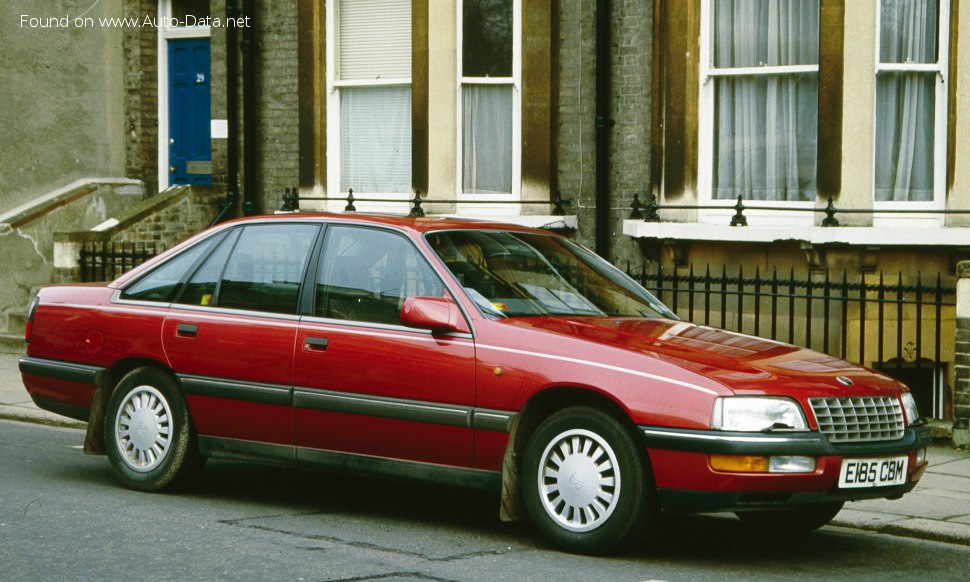
The Vauxhall Senator B 3.0i (156 Hp) Automatic represents a significant chapter in European automotive history, serving as Vauxhall’s flagship executive sedan during its production run from 1987 to 1990. Marketed primarily in the United Kingdom, where Vauxhall is the local badge for General Motors’ Opel models, the Senator B was essentially a rebadged Opel Senator B. This second-generation model built upon its predecessor’s reputation for comfort, robust engineering, and understated luxury, aiming to compete with established premium marques in the fiercely contested executive segment. It offered a compelling blend of space, refinement, and performance, particularly in its higher-specification variants like the 3.0i, which was powered by a durable inline-six engine and paired with a smooth automatic transmission, catering to discerning buyers seeking a capable and comfortable long-distance cruiser.
The Vauxhall Senator B 3.0i (156 Hp) Automatic: A European Executive Standard
In the late 1980s, the European executive car market was a battleground of sophisticated engineering and refined luxury. The Vauxhall Senator B, particularly in its 3.0i Automatic guise, carved out a niche for itself as a value-conscious yet highly capable contender. While it might not have carried the same brand cachet as some German rivals in certain markets, its underlying Opel engineering provided a solid foundation of reliability and dynamic competence. Designed to comfortably transport up to five occupants, this full-size sedan was an attractive option for business executives and families alike who prioritized space, comfort, and a strong, unpretentious road presence. Its relatively conservative styling belied a well-engineered chassis and a powertrain designed for effortless cruising, making it a popular choice for covering long distances on European motorways.
The Senator B’s position in the market was further solidified by its generous standard equipment and the overall quality of its construction. For the era, features such as Anti-lock Braking System (ABS) were not universally standard, making their inclusion in the Senator B a notable selling point for safety-conscious buyers. The vehicle’s design philosophy emphasized practicality and occupant comfort, rather than overtly sporty pretensions, aligning it with the traditional values of an executive cruiser. Its development benefited from General Motors’ extensive resources, leveraging platforms and components shared across its global portfolio, which contributed to its robust build and ease of maintenance, factors that were highly valued by owners looking for a dependable vehicle.
Powertrain and Performance Dynamics
The Robust 3.0-liter Inline-Six
At the heart of the Vauxhall Senator B 3.0i lay a formidable and widely respected 3.0-liter (2969 cm³ or 181.18 cu. in.) inline-six engine, designated with the model code C30LE. This naturally aspirated gasoline engine was renowned for its smooth operation, impressive durability, and linear power delivery, characteristics highly prized in an executive sedan. It utilized a Multi-port manifold injection system for efficient fuel delivery and a CIH (Cam-in-Head) valvetrain with two valves per cylinder, a proven and reliable design for the period. With a compression ratio of 8.6:1, the engine produced a healthy 156 horsepower at 5400 rpm. More importantly for its executive brief, it delivered a substantial 169.64 lb.-ft. of torque, available across a broad rev range from 3800 to 4400 rpm. This ample torque ensured strong acceleration from a standstill and robust in-gear flexibility, making overtaking maneuvers on highways both safe and effortless.
The engine’s configuration as a front, longitudinal layout contributed to a balanced weight distribution and characteristic rear-wheel-drive handling. Its power output of 52.5 horsepower per liter was respectable for a naturally aspirated engine of its time, balancing performance with everyday usability. The C30LE engine was also known for its relatively modest maintenance requirements and longevity, a testament to GM’s engineering prowess in the late 1980s. With an engine oil capacity of 5.81 US quarts, proper lubrication was ensured for sustained high-speed driving. The engineering focus was clearly on providing a refined and dependable power plant that could withstand the rigors of frequent, long-distance travel, rather than chasing peak power figures. This commitment to reliability and smooth performance significantly contributed to the Senator B’s appeal in its target market.
Automatic Transmission and Drivetrain
The 3.0i variant of the Vauxhall Senator B came equipped with a 4-speed automatic transmission, perfectly complementing the engine’s smooth power delivery. This gearbox was designed for comfort and ease of driving, shifting gears seamlessly to maintain the car’s refined demeanor. The powertrain architecture featured an internal combustion engine driving the rear wheels, a classic layout for executive sedans of the era, offering predictable handling characteristics and a more engaging driving experience than front-wheel-drive alternatives. This rear-wheel-drive setup also allowed for a more direct transfer of power to the road, particularly beneficial for a car of its size and power.
Performance-wise, the Senator B 3.0i Automatic was capable of reaching a maximum speed of 130.49 mph (210 km/h), a highly competitive figure for a large sedan in the late 1980s, demonstrating its capability as a comfortable high-speed cruiser. The vehicle’s weight-to-power ratio of 9.3 kg/Hp (107.2 Hp/tonne) and a weight-to-torque ratio of 6.3 kg/Nm (158.1 Nm/tonne) further underscore its balanced performance. These figures highlight the car’s ability to move its substantial kerb weight of 3207.73 lbs (1455 kg) with relative ease, a crucial aspect for a vehicle intended for both city driving and long-haul journeys. The automatic transmission, while perhaps not offering the ultimate in driver engagement, significantly enhanced the car’s appeal to those seeking a relaxed and effortless driving experience, particularly in congested urban environments or during extended motorway travel.
Design, Comfort, and Engineering
Classic Executive Sedan Aesthetics
The Vauxhall Senator B showcased a design language that was characteristic of late 1980s executive sedans: understated, dignified, and functionally elegant. Its four-door sedan body type exuded a sense of presence without being ostentatious. With a length of 190.75 inches (4845 mm), a width of 69.41 inches (1763 mm), and a height of 57.09 inches (1450 mm), the Senator B was a sizable vehicle, offering substantial road presence and interior volume. The design featured clean lines and a relatively low-slung profile for its class, contributing to an impressive drag coefficient (Cd) of 0.30. This aerodynamic efficiency was notable for the era and played a role in both fuel economy and reduced wind noise at higher speeds, enhancing the car’s long-distance cruising comfort. The wheelbase of 107.48 inches (2730 mm) was generous, allowing for a spacious cabin and contributing to the car’s stable ride quality. The design’s enduring appeal lies in its timeless quality, avoiding overly trendy styling cues that might quickly date a vehicle.
Interior Amenities and Practicality
Inside, the Vauxhall Senator B was configured to comfortably accommodate five occupants, offering ample head, leg, and shoulder room, a hallmark of executive sedans. The interior design prioritized ergonomics and functionality, with controls typically well-placed and easy to operate. Practicality was a strong suit, evident in the generous trunk (boot) space, which ranged from a minimum of 18.72 cu. ft. (530 liters) to a maximum of 32.84 cu. ft. (930 liters) with the rear seats folded down, if applicable, providing significant cargo capacity for luggage or other items. This flexibility made the Senator B a versatile vehicle, suitable for both business use and family trips. The fuel tank capacity of 19.81 US gallons (75 liters) ensured a considerable driving range between fill-ups, further enhancing its capabilities as a grand tourer. Features such as hydraulic power steering and a minimum turning circle of 35.93 feet (10.95 meters) made maneuvering this large sedan surprisingly manageable in urban environments.
Chassis and Safety Innovations
The engineering beneath the Senator B’s elegant skin was robust and sophisticated for its time. The suspension system featured an independent McPherson strut setup with coil springs and an anti-roll bar at the front, providing precise steering and good road holding. The rear suspension was also independent, utilizing coil springs, a transverse stabilizer, and trailing arms, a configuration designed to offer a comfortable ride while maintaining composure over varying road surfaces. This independent suspension at all four corners was crucial for delivering the refined ride quality expected of an executive car. Braking performance was handled by ventilated discs at the front and solid discs at the rear, a capable setup for the car’s weight and performance. A significant safety feature for the period was the inclusion of ABS (Anti-lock Braking System), which enhanced braking control and reduced stopping distances, especially in adverse conditions. The steering system, a cone worm with recirculation balls, combined with hydraulic power steering, offered a comfortable and reassuring feel at the wheel. The car rode on 205/65 R15 tires, mounted on 6J x 15 or 7J x 15 wheel rims, providing a good balance of grip and ride comfort. The overall chassis and safety package underscored Vauxhall’s commitment to providing a secure and pleasant driving experience.
Legacy and Market Impact
Although the Vauxhall Senator B 3.0i (156 Hp) Automatic was never officially sold in the United States, it left a lasting impression in its primary European markets, particularly the UK. It was highly regarded for its blend of traditional executive car virtues: comfort, space, robust engineering, and a smooth, powerful inline-six engine. Its accessible price point, compared to some direct premium rivals, made it an attractive proposition for those seeking luxury and performance without the associated premium brand tax. Today, the Senator B is remembered as a well-built, reliable, and comfortable classic executive car, appreciated by enthusiasts for its solid driving dynamics and its representation of Vauxhall’s high-end offerings in the late 20th century. Its impact on the market was to provide a credible, home-grown alternative in a segment often dominated by German manufacturers, solidifying Vauxhall’s reputation for producing capable and refined vehicles.
Technical Specifications: Vauxhall Senator B 3.0i (156 Hp) Automatic
| Brand | Vauxhall |
| Model | Senator |
| Generation | Senator B |
| Type (Engine) | 3.0i (156 Hp) Automatic |
| Start of production | 1987 year |
| End of production | 1990 year |
| Powertrain Architecture | Internal Combustion engine |
| Body type | Sedan |
| Seats | 5 |
| Doors | 4 |
| Fuel Type | Petrol (Gasoline) |
| Maximum speed | 130.49 mph (210 km/h) |
| Weight-to-power ratio | 9.3 kg/Hp, 107.2 Hp/tonne |
| Weight-to-torque ratio | 6.3 kg/Nm, 158.1 Nm/tonne |
| Power | 156 Hp @ 5400 rpm. |
| Power per liter | 52.5 Hp/l |
| Torque | 169.64 lb.-ft. @ 3800-4400 rpm (230 Nm) |
| Engine layout | Front, Longitudinal |
| Engine Model/Code | C30LE |
| Engine displacement | 181.18 cu. in. (2969 cm³) |
| Number of cylinders | 6 |
| Engine configuration | Inline |
| Cylinder Bore | 3.74 in. (95 mm) |
| Piston Stroke | 2.75 in. (69.8 mm) |
| Compression ratio | 8.6:1 |
| Number of valves per cylinder | 2 |
| Fuel injection system | Multi-port manifold injection |
| Engine aspiration | Naturally aspirated engine |
| Valvetrain | CIH |
| Engine oil capacity | 5.81 US qt (5.5 l) |
| Kerb Weight | 3207.73 lbs (1455 kg) |
| Max. weight | 4398.22 lbs (1995 kg) |
| Max load | 1190.5 lbs (540 kg) |
| Trunk (boot) space – minimum | 18.72 cu. ft. (530 l) |
| Trunk (boot) space – maximum | 32.84 cu. ft. (930 l) |
| Fuel tank capacity | 19.81 US gal (75 l) |
| Max. roof load | 220.46 lbs (100 kg) |
| Permitted trailer load with brakes (12%) | 3747.86 lbs (1700 kg) |
| Permitted trailer load without brakes | 1587.33 lbs (720 kg) |
| Permitted towbar download | 165.35 lbs (75 kg) |
| Length | 190.75 in. (4845 mm) |
| Width | 69.41 in. (1763 mm) |
| Width including mirrors | 76.06 in. (1932 mm) |
| Height | 57.09 in. (1450 mm) |
| Wheelbase | 107.48 in. (2730 mm) |
| Front track | 57.09 in. (1450 mm) |
| Rear (Back) track | 57.8 in. (1468 mm) |
| Drag coefficient (Cd) | 0.30 |
| Minimum turning circle (turning diameter) | 35.93 ft. (10.95 m) |
| Drivetrain Architecture | Internal combustion engine (ICE) drives rear wheels |
| Drive wheel | Rear wheel drive |
| Number of gears and type of gearbox | 4 gears, automatic transmission |
| Front suspension | Independent, McPherson with coil spring and anti-roll bar |
| Rear suspension | Independent coil spring, Transverse stabilizer, Trailing arm |
| Front brakes | Ventilated discs |
| Rear brakes | Disc |
| Assisting systems | ABS (Anti-lock braking system) |
| Steering type | Cone worm with recirculation balls |
| Power steering | Hydraulic Steering |
| Tires size | 205/65 R15 |
| Wheel rims size | 6J x 15; 7J x 15 |
