
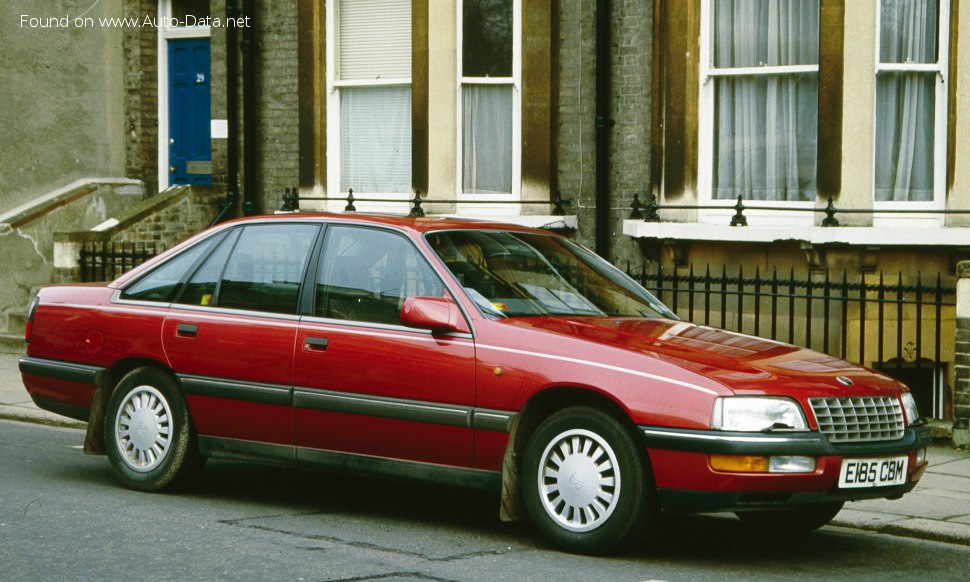
The Vauxhall Senator B 3.0i CAT (177 Hp) Automatic represents a significant era for General Motors’ European operations, particularly within the executive sedan market. Launched in 1988, this second-generation Senator, known internally as the ‘B’ series, succeeded the original Senator A and continued Vauxhall’s tradition of offering large, comfortable, and well-appointed vehicles to a discerning European clientele. While never officially sold in the United States, the Senator B carved out its niche in the UK and other European markets as a flagship model, embodying a blend of robust engineering, refined performance, and a comprehensive list of features that were competitive for its time. It was essentially the British-market equivalent of the Opel Senator B, reflecting GM Europe’s strategy of badge engineering across different territories. This particular variant, the 3.0i CAT with 177 Hp and an automatic transmission, stood as a popular choice for those seeking a smooth, powerful, and understated executive cruiser.
The Vauxhall Senator B 3.0i CAT (177 Hp) Automatic: Engineering and Heritage
The Senator B was built on GM’s V-platform, sharing its underpinnings with the Opel Omega A (Vauxhall Carlton Mk3). This platform provided a solid foundation for a large, rear-wheel-drive sedan, a configuration highly favored for its balanced handling characteristics and the ability to cleanly separate steering and drive forces. The vehicle’s production run from 1988 to 1993 saw it compete against established European luxury marques, offering a compelling alternative with its blend of performance, comfort, and value. Its heritage harks back to an era when large, naturally aspirated inline-six engines were the hallmark of refined motoring, providing a linear power delivery and a distinctive exhaust note that resonated with enthusiasts. The “CAT” in its designation refers to the catalytic converter, a crucial component for emissions control that became standard on many European cars during this period, signaling a growing environmental consciousness in automotive design.
Engine and Performance
At the heart of the Vauxhall Senator B 3.0i CAT (177 Hp) Automatic lay a robust 3.0-liter (2969 cm3 or 181.18 cu. in.) naturally aspirated inline-six engine, designated with the code C30NE. This powerplant was engineered for smooth, reliable power delivery, producing a respectable 177 horsepower at 5800 rpm and 240 Nm (177.01 lb.-ft.) of torque at 4200 rpm. The engine’s inline configuration, with a cylinder bore of 3.74 inches (95 mm) and a piston stroke of 2.75 inches (69.8 mm), contributed to its inherent balance and refinement, qualities highly valued in an executive sedan. It featured a multi-port manifold injection system for precise fuel delivery and a CIH (Cam-in-Head) valvetrain with two valves per cylinder, a common and reliable design for the era. With a compression ratio of 9.2:1, the engine was designed to run on petrol (gasoline).
Power was transferred to the rear wheels via a 4-speed automatic transmission, emphasizing comfort and effortless cruising over outright sportiness. This drivetrain architecture, where the internal combustion engine drives the rear wheels, was a classic setup for premium sedans, offering excellent traction and a predictable feel. Despite its focus on luxury and comfort, the Senator B 3.0i CAT could still deliver a commendable performance for its size and weight. It accelerated from 0 to 60 mph in an estimated 9.8 seconds (0-100 km/h in 10.3 seconds) and boasted a maximum speed of 134.22 mph (216 km/h). Fuel economy, while not a primary selling point for large executive cars of this era, was rated at 15.5 US mpg (15.2 l/100 km) in urban conditions and a more efficient 31.8 US mpg (7.4 l/100 km) on the highway, reflecting the advancements in engine management systems and catalytic converter technology.
Design and Features
The Vauxhall Senator B presented a classic sedan silhouette, characterized by its clean lines, expansive glasshouse, and a dignified presence. Measuring 190.75 inches (4845 mm) in length, 69.41 inches (1763 mm) in width (75.71 inches or 1923 mm including mirrors), and 57.09 inches (1450 mm) in height, the Senator B offered substantial road presence. Its long 107.48-inch (2730 mm) wheelbase contributed to a spacious interior, comfortably accommodating five occupants across its two rows. The design, while distinctly European, prioritized aerodynamic efficiency for its class, evidenced by a relatively low drag coefficient (Cd) of 0.30, which aided both fuel economy and high-speed stability.
Inside, the Senator B was designed to offer a comfortable and well-appointed environment. The generous trunk space, ranging from 18.72 cu. ft. (530 liters) to a maximum of 32.84 cu. ft. (930 liters) with the rear seats folded (if applicable, though typically less common in sedans of this era), underscored its practicality for long journeys and executive use. Key features for the period included hydraulic power steering, providing ease of maneuverability for a vehicle of its size, and an Anti-lock Braking System (ABS) as a standard or optional assisting system, significantly enhancing safety by preventing wheel lock-up during hard braking. The suspension system, featuring an independent McPherson type with coil springs and an anti-roll bar at the front, and an independent coil spring with transverse stabilizer and trailing arm at the rear, was tuned for a compliant ride, absorbing road imperfections while maintaining composure. Stopping power was provided by ventilated discs at the front and solid discs at the rear. The car rode on 205/65 R15 tires, fitted to 6J x 15 or 7J x 15 wheel rims, offering a good balance of grip and ride comfort for the era. The Senator B’s overall design ethos was one of understated elegance and functional luxury, making it a strong contender in the European executive car segment.
Technical Specifications: Vauxhall Senator B 3.0i CAT (177 Hp) Automatic
| Brand | Vauxhall |
| Model | Senator |
| Generation | Senator B |
| Type (Engine) | 3.0i CAT (177 Hp) Automatic |
| Start of production | 1988 year |
| End of production | 1993 year |
| Powertrain Architecture | Internal Combustion engine |
| Body type | Sedan |
| Seats | 5 |
| Doors | 4 |
| Fuel consumption (economy) – urban | 15.2 l/100 km (15.5 US mpg) |
| Fuel consumption (economy) – extra urban | 7.4 l/100 km (31.8 US mpg) |
| Fuel Type | Petrol (Gasoline) |
| Acceleration 0 – 60 mph | 9.8 sec |
| Acceleration 0 – 100 km/h | 10.3 sec |
| Maximum speed | 216 km/h (134.22 mph) |
| Weight-to-power ratio | 8.4 kg/Hp (118.5 Hp/tonne) |
| Weight-to-torque ratio | 6.2 kg/Nm (160.6 Nm/tonne) |
| Power | 177 Hp @ 5800 rpm |
| Power per liter | 59.6 Hp/l |
| Torque | 240 Nm @ 4200 rpm (177.01 lb.-ft. @ 4200 rpm) |
| Engine layout | Front, Longitudinal |
| Engine Model/Code | C30NE |
| Engine displacement | 2969 cm3 (181.18 cu. in.) |
| Number of cylinders | 6 |
| Engine configuration | Inline |
| Cylinder Bore | 95 mm (3.74 in.) |
| Piston Stroke | 69.8 mm (2.75 in.) |
| Compression ratio | 9.2:1 |
| Number of valves per cylinder | 2 |
| Fuel injection system | Multi-port manifold injection |
| Engine aspiration | Naturally aspirated engine |
| Valvetrain | CIH |
| Engine oil capacity | 5.5 l (5.81 US qt) |
| Coolant | 10.1 l (10.67 US qt) |
| Kerb Weight | 1494 kg (3293.71 lbs.) |
| Max. weight | 2005 kg (4420.27 lbs.) |
| Max load | 511 kg (1126.56 lbs.) |
| Trunk (boot) space – minimum | 530 l (18.72 cu. ft.) |
| Trunk (boot) space – maximum | 930 l (32.84 cu. ft.) |
| Fuel tank capacity | 75 l (19.81 US gal) |
| Max. roof load | 100 kg (220.46 lbs.) |
| Permitted trailer load with brakes (12%) | 1700 kg (3747.86 lbs.) |
| Permitted trailer load without brakes | 720 kg (1587.33 lbs.) |
| Permitted towbar download | 75 kg (165.35 lbs.) |
| Length | 4845 mm (190.75 in.) |
| Width | 1763 mm (69.41 in.) |
| Width including mirrors | 1923 mm (75.71 in.) |
| Height | 1450 mm (57.09 in.) |
| Wheelbase | 2730 mm (107.48 in.) |
| Front track | 1450 mm (57.09 in.) |
| Rear (Back) track | 1468 mm (57.8 in.) |
| Drag coefficient (Cd) | 0.30 |
| Minimum turning circle (turning diameter) | 10.95 m (35.93 ft.) |
| Drivetrain Architecture | The Internal combustion engine (ICE) drives the rear wheels of the vehicle. |
| Drive wheel | Rear wheel drive |
| Number of gears and type of gearbox | 4 gears, automatic transmission |
| Front suspension | Independent, type McPherson with coil spring and anti-roll bar |
| Rear suspension | Independent coil spring, Transverse stabilizer, Trailing arm |
| Front brakes | Ventilated discs |
| Rear brakes | Disc |
| Assisting systems | ABS (Anti-lock braking system) |
| Steering type | Cone worm with recirculation balls |
| Power steering | Hydraulic Steering |
| Tires size | 205/65 R15 |
| Wheel rims size | 6J x 15; 7J x 15 |
