
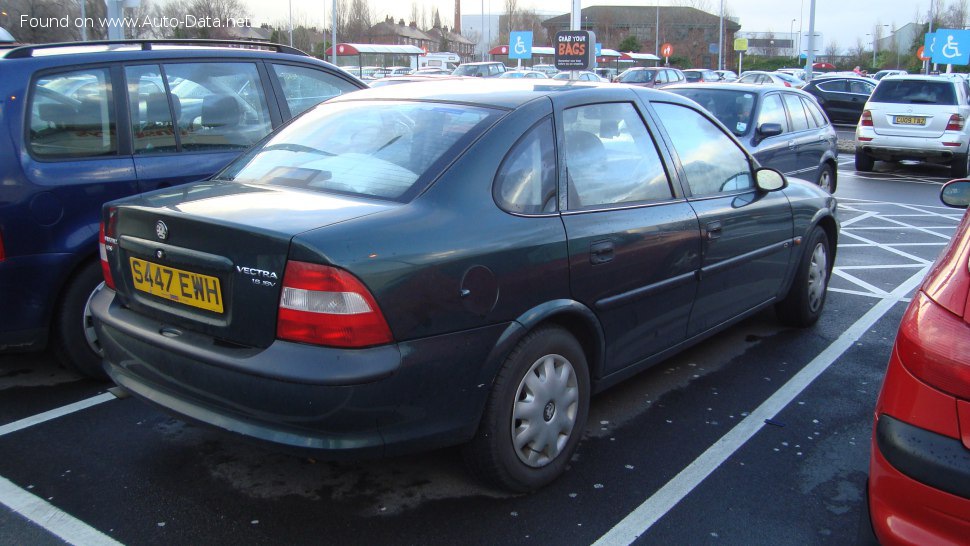
The Vauxhall Vectra B 2.0i 16V, produced between 1995 and 1998, represents a significant step forward for Vauxhall in the mid-size family car segment. As the successor to the Vectra A, the B-series aimed to offer improved refinement, safety, and driving dynamics. While not officially sold in the United States, the Vectra B was a popular choice in the United Kingdom and throughout Europe, competing with models like the Ford Mondeo and Peugeot 406. It served as a key model in Vauxhall’s lineup, demonstrating the brand’s commitment to providing practical and well-equipped vehicles for the everyday driver.
Vauxhall Vectra B 2.0i 16V: An Overview
The Vectra B was a crucial model for Vauxhall (owned by General Motors at the time), embodying the design and engineering philosophies of the era. It was available in several body styles, including a saloon (sedan), hatchback, and estate (wagon), catering to a wide range of customer needs. The 2.0i 16V variant, equipped with a 2.0-liter inline-four engine, was a popular choice, offering a balance of performance and fuel economy. This model aimed to provide a comfortable and reliable driving experience for families and commuters alike.
Engine & Performance
The heart of the Vectra B 2.0i 16V is its 1998 cc (121.93 cu. in.) inline-four cylinder engine, designated the X20XEV. This naturally aspirated engine produces 136 horsepower (Hp) at 5600 rpm and 188 Newton-meters (138.66 lb.-ft.) of torque at 3400 rpm. The engine features multi-port fuel injection and a double overhead camshaft (DOHC) valvetrain with four valves per cylinder, contributing to its relatively high power output for its displacement – 68.1 Hp per liter. Power is delivered to the front wheels via a five-speed manual transmission. Performance figures include a 0-60 mph (0-96.5 km/h) acceleration time of approximately 9.5 seconds and a top speed of 133.59 mph (215 km/h). The weight-to-power ratio of 9.9 kg/Hp and a weight-to-torque ratio of 7.2 kg/Nm indicate a reasonably efficient powertrain for its time.
Design & Features
The Vauxhall Vectra B was offered primarily as a four-door sedan, though hatchback and estate versions were also available in European markets. The design was evolutionary, building upon the styling of the Vectra A but with a more rounded and modern aesthetic. Inside, the Vectra B offered a practical and comfortable cabin with seating for five passengers. Key features included power steering (hydraulic), ventilated front disc brakes, and disc brakes on the rear axle. While not boasting the advanced safety features of modern vehicles, the Vectra B did offer a degree of safety for its era, including a robust chassis and available anti-lock braking system (ABS) on some trims. The trunk (boot) space of 550 liters (19.42 cu. ft.) provided ample room for luggage and cargo. The vehicle’s dimensions – 4495 mm (176.97 in.) in length, 1710 mm (67.32 in.) in width, and 1425 mm (56.1 in.) in height – positioned it squarely within the mid-size segment.
Technical Specifications
| Brand | Vauxhall |
| Model | Vectra |
| Generation | Vectra B |
| Type (Engine) | 2.0i 16V (136 Hp) |
| Start of production | 1995 |
| End of production | 1998 |
| Powertrain Architecture | Internal Combustion engine |
| Body type | Sedan |
| Seats | 5 |
| Doors | 4 |
| Fuel consumption (urban) | 12.3 l/100 km (19.1 US mpg / 23 UK mpg) |
| Fuel consumption (extra urban) | 6.4 l/100 km (36.8 US mpg / 44.1 UK mpg) |
| Fuel Type | Petrol (Gasoline) |
| Acceleration 0 – 100 km/h | 10 sec |
| Acceleration 0 – 62 mph | 10 sec |
| Acceleration 0 – 60 mph | 9.5 sec |
| Maximum speed | 215 km/h (133.59 mph) |
| Weight-to-power ratio | 9.9 kg/Hp |
| Weight-to-torque ratio | 7.2 kg/Nm |
| Power | 136 Hp @ 5600 rpm |
| Torque | 188 Nm @ 3400 rpm (138.66 lb.-ft. @ 3400 rpm) |
| Engine layout | Front, Transverse |
| Engine Model/Code | X20XEV |
| Engine displacement | 1998 cm3 (121.93 cu. in.) |
| Number of cylinders | 4 |
| Engine configuration | Inline |
| Cylinder Bore | 86 mm (3.39 in.) |
| Piston Stroke | 86 mm (3.39 in.) |
| Compression ratio | 10.8:1 |
| Number of valves per cylinder | 4 |
| Fuel injection system | Multi-port manifold injection |
| Engine aspiration | Naturally aspirated |
| Valvetrain | DOHC |
| Engine oil capacity | 4 l (4.23 US qt | 3.52 UK qt) |
| Coolant capacity | 7.1 l (7.5 US qt | 6.25 UK qt) |
| Kerb Weight | 1345 kg (2965.22 lbs.) |
| Max. weight | 1860 kg (4100.6 lbs.) |
| Max load | 515 kg (1135.38 lbs.) |
| Trunk (boot) space – maximum | 550 l (19.42 cu. ft.) |
| Fuel tank capacity | 60 l (15.85 US gal | 13.2 UK gal) |
| Length | 4495 mm (176.97 in.) |
| Width | 1710 mm (67.32 in.) |
| Width including mirrors | 1841 mm (72.48 in.) |
| Height | 1425 mm (56.1 in.) |
| Wheelbase | 2637 mm (103.82 in.) |
| Front track | 1464 mm (57.64 in.) |
| Rear (Back) track | 1467 mm (57.76 in.) |
| Drivetrain Architecture | Front wheel drive |
| Number of gears and type of gearbox | 5 gears, manual transmission |
| Front brakes | Ventilated discs |
| Rear brakes | Disc |
| Steering type | Steering rack and pinion |
| Power steering | Hydraulic |
| Tires size | 195/65 R15 |
| Wheel rims size | 5.5J x 15 |
The Vauxhall Vectra B 2.0i 16V, while not a performance icon, represented a solid and dependable family car for its time. Its blend of practicality, reasonable performance, and comfortable ride made it a popular choice in the European market, and a testament to Vauxhall’s engineering capabilities during the 1990s.
