
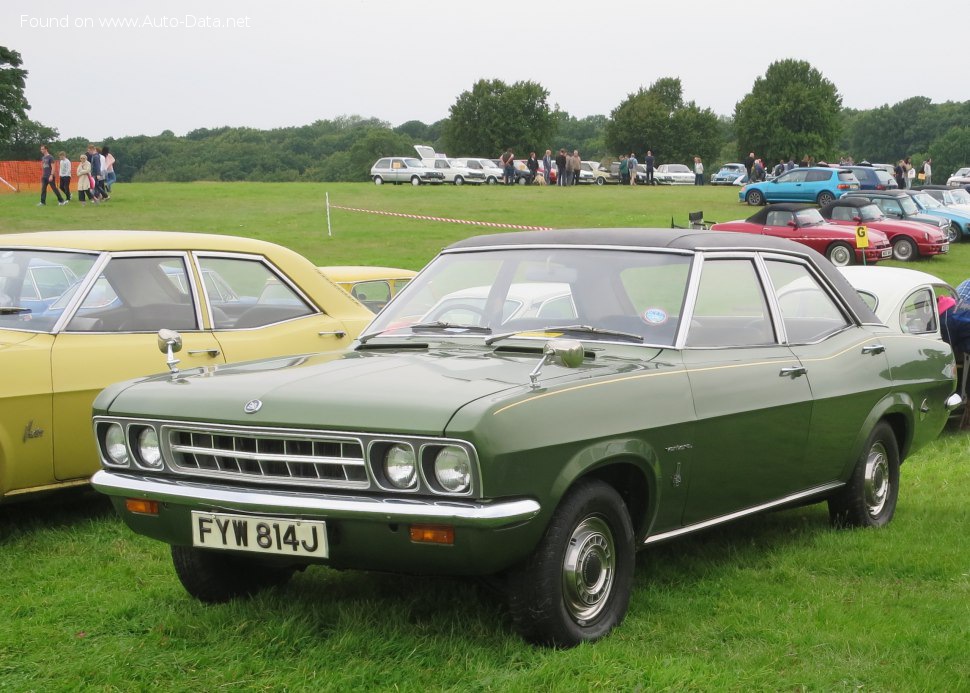
The Vauxhall Ventora 3300, produced between 1968 and 1974, was a large family car manufactured by Vauxhall, then a prominent British automaker. Positioned as a premium offering within the Vauxhall lineup, the Ventora aimed to provide a blend of comfort, performance, and style. It was essentially a rebadged and slightly refined version of the Bedford VX4/FC series, sharing its underlying mechanicals but with more luxurious appointments. While not officially exported to the United States, the Ventora represents a significant example of British automotive engineering during the late 1960s and early 1970s, reflecting the design trends and technological capabilities of the era. The Ventora competed with other large British saloons like the Ford Zephyr and Triumph Stag, offering a spacious interior and a relatively powerful engine for its time.
Vauxhall Ventora 3300: A Detailed Overview
The Ventora nameplate had a history with Vauxhall, previously used on a high-performance variant of the PA Cresta in the late 1950s. The 1968 Ventora represented a revival of the name, signifying a return to a more upscale market segment. The 3300 designation refers to the engine displacement, a key selling point for the vehicle. The car was designed to appeal to buyers seeking a comfortable and capable family saloon with a touch of sporting character. It was a popular choice for those needing a reliable and spacious vehicle for long-distance travel.
Engine & Performance
The heart of the Ventora 3300 was its 3.3-liter (3293 cc or 200.95 cu. in.) straight-six engine. This naturally aspirated engine produced 124 horsepower, a respectable figure for the period. The engine utilized a carburettor fuel system and an overhead valve (OHV) valvetrain. While not a particularly high-revving engine, it delivered strong low-end torque, making it well-suited for relaxed cruising and effortless acceleration. The engine’s power output translated to a power-to-weight ratio of 10.1 kg/Hp (98.9 Hp/tonne). Performance figures included a 0-60 mph acceleration time of 12.5 seconds and a maximum speed of 101.9 mph (164 km/h). The engine required 5 liters (5.28 US qt | 4.4 UK qt) of engine oil and 8.4 liters (8.88 US qt | 7.39 UK qt) of coolant for optimal operation. The drivetrain consisted of a rear-wheel drive configuration coupled with a four-speed manual transmission.
Design & Features
The Vauxhall Ventora 3300 was a four-door sedan with a classic, understated design. Its body style reflected the prevailing trends of the late 1960s, characterized by clean lines, a relatively long wheelbase (2667 mm or 105 in.), and a spacious interior. The car measured 4554 mm (179.29 in.) in length and 1699 mm (66.89 in.) in width, providing ample room for passengers and luggage. The trunk (boot) offered a generous 595 liters (21.01 cu. ft.) of storage space. Safety features, while limited by the standards of the time, included disc brakes on the front wheels and drum brakes on the rear. Steering was handled by a steering rack and pinion system. The Ventora rode on 14-inch wheels fitted with 185/70 R14 tires. The interior was typically appointed with comfortable seating for four passengers and featured a relatively well-equipped dashboard, although features like air conditioning were not standard.
Technical Specifications
| Brand | Vauxhall |
| Model | Ventora |
| Generation | Ventora |
| Type (Engine) | 3300 (124 Hp) |
| Start of production | February, 1968 |
| End of production | 1974 |
| Powertrain Architecture | Internal Combustion engine |
| Body type | Sedan |
| Seats | 4 |
| Doors | 4 |
| Fuel Type | Petrol (Gasoline) |
| Acceleration 0 – 60 mph | 12.5 sec |
| Maximum speed | 164 km/h / 101.9 mph |
| Weight-to-power ratio | 10.1 kg/Hp, 98.9 Hp/tonne |
| Power | 124 Hp |
| Power per litre | 37.7 Hp/l |
| Engine displacement | 3293 cm3 / 200.95 cu. in. |
| Number of cylinders | 6 |
| Fuel injection system | Carburettor |
| Engine aspiration | Naturally aspirated engine |
| Valvetrain | OHV |
| Engine oil capacity | 5 l / 5.28 US qt | 4.4 UK qt |
| Coolant | 8.4 l / 8.88 US qt | 7.39 UK qt |
| Kerb Weight | 1254 kg / 2764.6 lbs. |
| Max. weight | 1714 kg / 3778.72 lbs. |
| Max load | 460 kg / 1014.13 lbs. |
| Trunk (boot) space – maximum | 595 l / 21.01 cu. ft. |
| Fuel tank capacity | 65 l / 17.17 US gal | 14.3 UK gal |
| Length | 4554 mm / 179.29 in. |
| Width | 1699 mm / 66.89 in. |
| Height | 1356 mm / 53.39 in. |
| Wheelbase | 2667 mm / 105 in. |
| Front track | 1432 mm / 56.38 in. |
| Rear (Back) track | 1400 mm / 55.12 in. |
| Ride height (ground clearance) | 119 mm / 4.69 in. |
| Minimum turning circle (turning diameter) | 12.0 m / 39.37 ft. |
| Drivetrain Architecture | Rear wheel drive |
| Drive wheel | Rear wheel drive |
| Number of gears and type of gearbox | 4 gears, manual transmission |
| Front brakes | Disc |
| Rear brakes | Drum |
| Steering type | Steering rack and pinion |
| Tires size | 185/70 R14 |
| Wheel rims size | 14 |
The Vauxhall Ventora 3300, while not a groundbreaking vehicle in terms of technological innovation, represented a solid and reliable offering in the British large car market. Its combination of spaciousness, comfortable ride, and respectable performance made it a popular choice for families and individuals seeking a practical and stylish saloon. Today, the Ventora 3300 is appreciated by classic car enthusiasts as a representative example of British automotive design and engineering from a bygone era.
