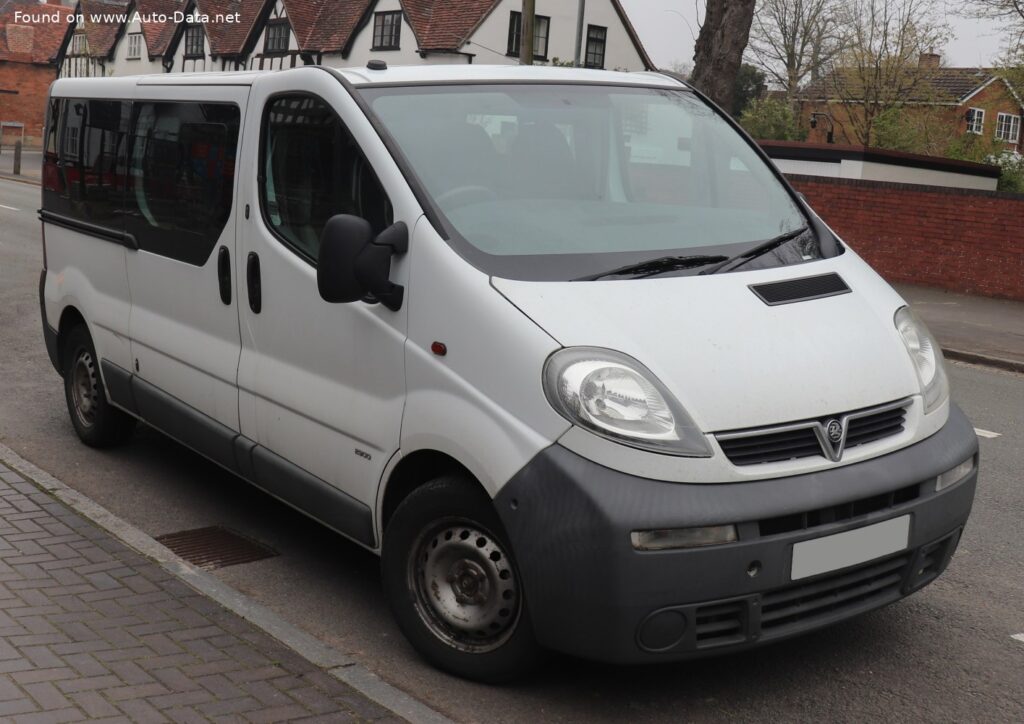
The Vauxhall Vivaro Doublecab SWB (facelift 2006) 2.0 CDTI 16V (115 Hp) DPF is a commercial vehicle produced by Vauxhall, the British arm of Stellantis. Introduced as part of the first-generation Vivaro range, this model served as a popular choice in the European market for businesses and tradespeople requiring a versatile and practical van. The “Doublecab” designation indicates a second row of seats, increasing passenger capacity, while “SWB” denotes a short wheelbase, enhancing maneuverability. The 2006 facelift brought cosmetic and mechanical updates to the original Vivaro, improving its appeal and efficiency. This vehicle was never officially sold in the United States, but similar vans from other manufacturers (Ford, Ram, Mercedes-Benz) occupy the same commercial segment.
Vauxhall Vivaro Doublecab SWB (facelift 2006) Overview
The Vivaro, along with its sister vehicles – the Renault Trafic and Nissan Primastar – was the result of a joint venture between Renault and Nissan. This collaboration allowed each manufacturer to benefit from shared development costs and a wider market reach. The Vivaro aimed to provide a modern alternative to established vans like the Ford Transit and Volkswagen Transporter. The Doublecab SWB variant specifically targeted businesses needing to transport both goods and personnel, offering a balance between cargo space and seating capacity. The inclusion of a Diesel Particulate Filter (DPF) in the 2.0 CDTI engine reflects increasing environmental regulations in Europe at the time.
Engine & Performance
Powering the Vauxhall Vivaro Doublecab SWB (facelift 2006) is a 2.0-liter, four-cylinder CDTI (Common-rail Direct Injection) diesel engine. This engine produces 115 horsepower at 3500 rpm and 290 Nm (213.89 lb.-ft.) of torque at 1600 rpm. The engine utilizes a turbocharger and intercooler to enhance performance and efficiency. The engine’s power-to-weight ratio is 15.7 kg/Hp, and its torque-to-weight ratio is 6.2 kg/Nm. The engine is transversely mounted at the front of the vehicle and drives the front wheels. A six-speed manual transmission is standard, providing a good balance between fuel economy and driver control. Fuel economy figures are rated at 8.5 l/100 km (27.7 US mpg) in urban conditions, 6.6 l/100 km (35.6 US mpg) on the extra-urban cycle, and 7.3 l/100 km (32.2 US mpg) combined. CO2 emissions are rated at 195 g/km, meeting Euro 4 emission standards.
Design & Features
The Vauxhall Vivaro Doublecab SWB (facelift 2006) is a five-door minivan with a practical and functional design. The short wheelbase (3098 mm / 121.97 in.) contributes to its maneuverability in urban environments. The vehicle’s overall length is 4782 mm (188.27 in.), height is 1960 mm (77.17 in.), and width is not specified in the provided data. The Doublecab configuration provides seating for five occupants, with a second row of seats behind the driver and front passenger. The interior is designed with durability and practicality in mind, featuring hard-wearing materials and a functional layout. Key features include a substantial cargo area behind the second row of seats, offering a minimum volume of 3285 liters (116.01 cu. ft.). Safety features, typical for a vehicle of this era, include ABS (Anti-lock Braking System). The vehicle’s suspension consists of an independent McPherson strut setup at the front and a semi-independent longitudinal arm with transverse torsion shaft arrangement at the rear.
Technical Specifications
| Brand | Vauxhall |
| Model | Vivaro |
| Generation | Vivaro Doublecab SWB (facelift 2006) |
| Type (Engine) | 2.0 CDTI 16V (115 Hp) DPF |
| Start of production | 2006 |
| End of production | 2014 |
| Powertrain Architecture | Internal Combustion engine |
| Body type | Minivan |
| Seats | 5 |
| Doors | 5 |
| Fuel consumption (urban) | 8.5 l/100 km (27.7 US mpg) |
| Fuel consumption (extra urban) | 6.6 l/100 km (35.6 US mpg) |
| Fuel consumption (combined) | 7.3 l/100 km (32.2 US mpg) |
| CO2 emissions | 195 g/km |
| Fuel Type | Diesel |
| Emission standard | Euro 4 |
| Weight-to-power ratio | 15.7 kg/Hp |
| Weight-to-torque ratio | 6.2 kg/Nm |
| Power | 115 Hp @ 3500 rpm |
| Torque | 290 Nm @ 1600 rpm (213.89 lb.-ft. @ 1600 rpm) |
| Engine layout | Front, Transverse |
| Engine Model/Code | M9R 782, M9R 630 |
| Engine displacement | 1995 cm3 (121.74 cu. in.) |
| Number of cylinders | 4 |
| Engine configuration | Inline |
| Number of valves per cylinder | 4 |
| Fuel injection system | Diesel Commonrail |
| Engine aspiration | Turbocharger, Intercooler |
| Valvetrain | DOHC |
| Engine oil capacity | 7.7 l (8.14 US qt | 6.78 UK qt) |
| Coolant capacity | 6.4 l (6.76 US qt | 5.63 UK qt) |
| Kerb Weight | 1804 kg (3977.14 lbs.) |
| Max. weight | 2935 kg (6470.57 lbs.) |
| Max load | 1131 kg (2493.43 lbs.) |
| Trunk (boot) space – minimum | 3285 l (116.01 cu. ft.) |
| Fuel tank capacity | 90 l (23.78 US gal | 19.8 UK gal) |
| Length | 4782 mm (188.27 in.) |
| Height | 1960 mm (77.17 in.) |
| Wheelbase | 3098 mm (121.97 in.) |
| Front overhang | 833 mm (32.8 in.) |
| Rear overhang | 851 mm (33.5 in.) |
| Minimum turning circle | 11.84 m (38.85 ft.) |
| Drivetrain Architecture | Front wheel drive, Internal Combustion engine |
| Number of gears | 6 |
| Gearbox type | Manual transmission |
| Front suspension | Independent, McPherson with coil spring and anti-roll bar |
| Rear suspension | Semi-independent, longitudinal arms with transverse torsion shafts |
| Front brakes | Ventilated discs, 305 mm |
| Rear brakes | Disc, 280 mm |
| Assisting systems | ABS (Anti-lock braking system) |
| Steering type | Steering rack and pinion |
| Power steering | Hydraulic |
| Tires size | 205/65 R16 |