
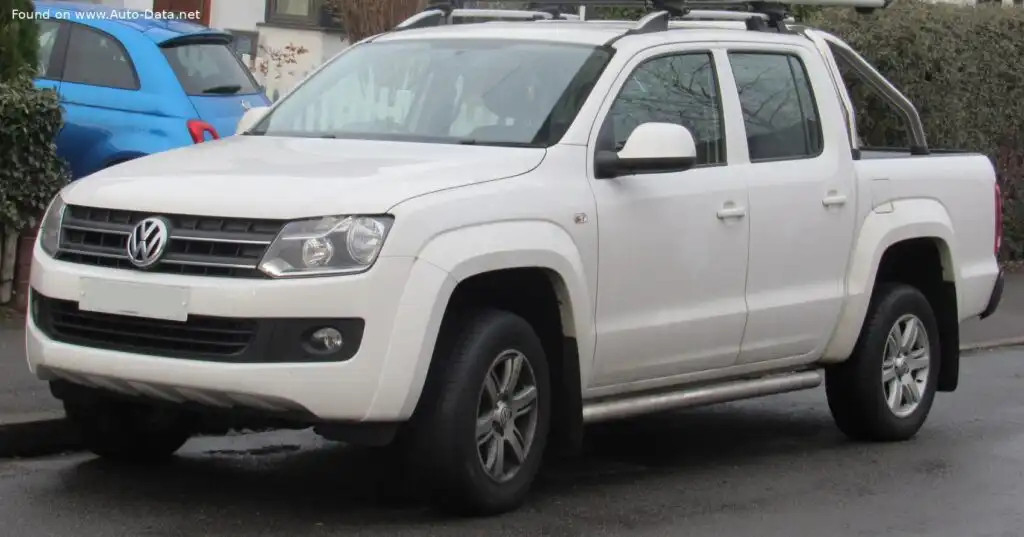
The Volkswagen Amarok I Double Cab 2.0 TDI BMT (140 Hp) 4MOTION represents a significant model within the first generation of Volkswagen’s mid-size pickup truck lineup. Produced between 2010 and 2016, this specific variant was engineered to offer a compelling balance of robust utility, advanced diesel technology, and all-terrain capability. As part of the Amarok’s initial foray into the highly competitive global pickup market, this model combined a practical four-door, five-seat double cab configuration with the efficiency of Volkswagen’s BlueMotion Technology (BMT) and the traction of its renowned 4MOTION all-wheel-drive system. Powered by a 2.0-litre Turbocharged Direct Injection (TDI) engine, it was positioned as a versatile vehicle, equally adept at serving as a dependable workhorse on a job site as it was a capable lifestyle vehicle for weekend adventures. Its introduction marked Volkswagen’s serious intent to carve out a niche in a segment traditionally dominated by Japanese and American manufacturers, leveraging German engineering principles of durability, efficiency, and driver comfort.
Historical Context and Development
The first-generation Volkswagen Amarok, designated Type 2H, was unveiled in 2010 after a lengthy development process aimed at creating a truly global pickup truck. The name Amarok means wolf in the Inuit language, a name chosen to evoke strength, endurance, and superiority over the terrain. Volkswagen’s objective was to blend the toughness expected of a one-tonne utility vehicle with the refinement, comfort, and safety features characteristic of its passenger cars.
The introduction of the 2.0 TDI engine was a strategic move. At a time when many competitors relied on larger displacement engines (typically 2.5 to 3.0 litres), Volkswagen opted for a smaller, more technologically advanced powerplant designed to deliver comparable torque while offering superior fuel economy and lower emissions. The 140 horsepower variant, equipped with BlueMotion Technology, was a key part of this strategy, appealing to markets with stringent emissions regulations and high fuel costs. The 4MOTION all-wheel-drive system further solidified its credentials as a serious off-road contender, offering drivers confidence and control across a wide spectrum of challenging environments, from muddy farm tracks to icy mountain roads.
Powertrain and Drivetrain
At the heart of the Volkswagen Amarok I Double Cab 2.0 TDI BMT (140 Hp) 4MOTION is an internal combustion engine that reflects the engineering prowess of the Volkswagen Group during this period.
Engine Specifications
The vehicle is powered by the CNFB engine model, a 2.0-litre (1968 cm³) inline four-cylinder diesel engine. This powerplant utilizes a sophisticated design featuring a Double Overhead Camshaft (DOHC) valvetrain with 16 valves (four per cylinder), which enhances airflow and engine breathing for improved efficiency and performance.
Key to its operation is the high-pressure Diesel Commonrail fuel injection system, which allows for precise fuel metering and multiple injections per combustion cycle. This technology, combined with a turbocharger and intercooler, enables the engine to generate its peak power of 140 horsepower (104 kW) at a relatively low 3500 rpm. More critically for a utility vehicle, it produces a substantial maximum torque of 340 Nm (250.77 lb.-ft.) across a broad and accessible rev range, from 1600 to 2250 rpm. This flat torque curve ensures strong pulling power from low speeds, which is essential for hauling heavy loads, towing, and navigating difficult off-road obstacles.
The engine features a bore of 81 mm and a stroke of 95.5 mm, with a compression ratio of 16.5:1. This model also includes BlueMotion Technology (BMT), a suite of innovations designed to reduce fuel consumption and emissions, which typically includes features like a start-stop system, low rolling resistance tires, and regenerative braking. Complying with the Euro 5 emissions standard, the engine is fitted with a diesel particulate filter to minimize soot emissions.
Transmission and 4MOTION System
Power from the 2.0 TDI engine is managed by a 6-speed manual transmission. This gearbox is designed with ratios that complement the engine’s torque characteristics, providing a low first gear for crawling and pulling power, while the higher gears allow for relaxed, fuel-efficient cruising at highway speeds.
The 4MOTION designation signifies the inclusion of Volkswagen’s permanent or selectable all-wheel-drive system. This drivetrain is fundamental to the Amarok’s identity as an all-terrain vehicle. The system intelligently distributes torque between the front and rear axles to maintain optimal traction on various surfaces, including pavement, gravel, mud, and snow. This enhances not only its off-road capability but also its on-road stability and safety, particularly in adverse weather conditions.
Performance of the Volkswagen Amarok I Double Cab 2.0 TDI BMT (140 Hp) 4MOTION
While primarily designed for utility, the Amarok offers respectable performance metrics for a vehicle of its size and class. It can accelerate from 0 to 100 km/h (0 to 62 mph) in a range of 13.1 to 13.5 seconds, with a calculated 0-60 mph time of approximately 12.4 seconds. The maximum speed is rated between 162 and 167 km/h (100.7 to 103.8 mph), making it fully capable of keeping pace with modern traffic on motorways.
Fuel efficiency is a standout feature, largely due to the BMT enhancements and the efficient TDI engine. The combined fuel consumption is rated between 7.0 and 7.5 litres per 100 kilometres. In urban environments, consumption ranges from 8.2 to 8.7 l/100 km, while extra-urban or highway driving sees this figure drop to an impressive 6.3 to 6.8 l/100 km. These figures, coupled with a large 80-litre fuel tank, give the Amarok an excellent operational range. Reflecting its adherence to the Euro 5 standard, its CO2 emissions are rated between 185 and 197 g/km.
Chassis, Suspension, and Off-Road Capability
The Amarok is built on a robust ladder-frame chassis, a traditional and proven design for pickup trucks that provides exceptional strength, durability, and load-bearing capacity.
The suspension system is engineered to provide a compromise between load-hauling ruggedness and passenger comfort. The front features an independent McPherson strut suspension, which enhances on-road handling, steering precision, and ride quality. The rear suspension consists of a heavy-duty leaf spring setup, designed to support substantial payloads in the cargo bed and manage the stresses of towing without compromising stability.
Braking is handled by ventilated discs at the front for effective heat dissipation and consistent stopping power, with traditional drum brakes at the rear, a common and durable solution for commercial vehicles. An Anti-lock Braking System (ABS) is standard.
The vehicle’s dimensions and geometry underscore its off-road prowess. It boasts a ground clearance of 192 mm (7.56 inches) and a wading depth of 500 mm (19.69 inches), allowing it to traverse moderately deep water crossings. Its off-road angles are equally competent:
Approach Angle: 28°
Departure Angle: 23.6°
Ramp-over (Breakover) Angle: 21.4°
These figures, combined with the 4MOTION system, enable the Amarok to tackle steep inclines, declines, and uneven terrain with confidence.
Dimensions, Weight, and Utility
The Double Cab configuration makes the Amarok a practical five-seater vehicle with four full-size doors for easy access. Its exterior dimensions are substantial, reflecting its one-tonne pickup classification.
Length: 5254 mm (206.85 in.)
Width: 1944 mm (76.54 in.)
Height: 1834 mm (72.2 in.)
* Wheelbase: 3095 mm (121.85 in.)
The long wheelbase contributes to high-speed stability and a smoother ride. The kerb weight of the vehicle is 1957 kg, and it has a maximum permissible weight of 2820 kg. This allows for an impressive maximum payload capacity of 863 kg (1902.59 lbs), making it highly capable for commercial and recreational use. The ample cargo bed and robust construction further enhance its utility for carrying tools, equipment, or recreational gear.
Conclusion
The Volkswagen Amarok I Double Cab 2.0 TDI BMT (140 Hp) 4MOTION stands as a testament to Volkswagen’s successful entry into the competitive pickup truck segment. By combining a fuel-efficient yet torquey 2.0 TDI engine with the all-weather security of the 4MOTION system and the practicality of a five-seat double cab, Volkswagen created a vehicle that defied convention. It proved that a modern pickup could be both a rugged work tool and a comfortable, refined vehicle suitable for daily driving and family duties. Its blend of performance, economy, and off-road capability made it a compelling choice for a wide range of buyers during its production run and ensures its place as a significant model in the history of the modern pickup truck.
Full Technical Specifications
| Category | Specification |
| ———————— | ————————————————————————————————————————- |
| General Information | |
| Brand | Volkswagen |
| Model | Amarok |
| Generation | Amarok I Double Cab |
| Engine Variant | 2.0 TDI BMT (140 Hp) 4MOTION |
| Production Start | 2010 |
| Production End | 2016 |
| Powertrain Architecture | Internal Combustion Engine |
| Body Type | Pick-up |
