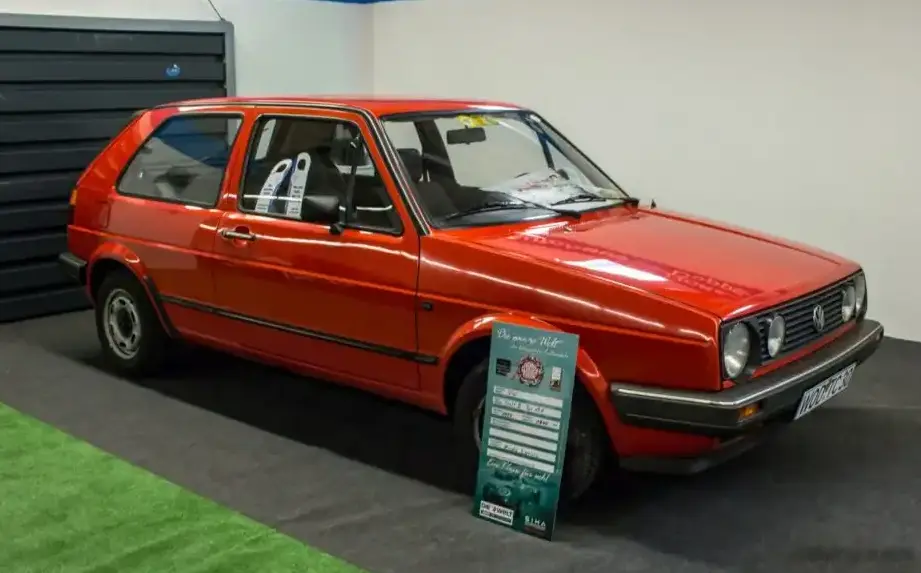
The Volkswagen Golf Mk2, produced from 1983 to 1992, represented a significant evolution of the original Golf, offering increased refinement, space, and a wider range of engine options. The 3-door 1.3-liter (55 hp) variant, produced from 1983-1985, served as the entry point into the Mk2 Golf lineup, particularly in European markets. It was designed to provide affordable and economical transportation, appealing to first-time buyers and those prioritizing fuel efficiency. This model played a crucial role in establishing the Golf Mk2 as a versatile and popular choice in the compact hatchback segment.
Technical Specifications
| Brand | Volkswagen |
| Model | Golf |
| Generation | Golf II (3-door) |
| Type (Engine) | 1.3 (55 Hp) |
| Start of production | 1983 |
| End of production | 1985 |
| Powertrain Architecture | Internal Combustion engine |
| Body type | Hatchback |
| Seats | 5 |
| Doors | 3 |
| Fuel consumption (urban) | 7.9 l/100 km (29.8 US mpg) |
| Fuel consumption (extra urban) | 5.5 l/100 km (42.8 US mpg) |
| Fuel Type | Petrol (Gasoline) |
| Acceleration 0 – 100 km/h | 16.7 sec |
| Acceleration 0 – 62 mph | 16.7 sec |
| Acceleration 0 – 60 mph | 15.9 sec |
| Maximum speed | 151 km/h (93.83 mph) |
| Weight-to-power ratio | 15.4 kg/Hp |
| Weight-to-torque ratio | 8.8 kg/Nm |
| Power | 55 Hp @ 5400 rpm |
| Power per litre | 43.2 Hp/l |
| Torque | 96 Nm @ 3300 rpm (70.81 lb.-ft. @ 3300 rpm) |
| Engine layout | Front, Transverse |
| Engine Model/Code | HK |
| Engine displacement | 1272 cm3 (77.62 cu. in.) |
| Number of cylinders | 4 |
| Engine configuration | Inline |
| Cylinder Bore | 75 mm (2.95 in.) |
| Piston Stroke | 72 mm (2.83 in.) |
| Compression ratio | 9.5:1 |
| Number of valves per cylinder | 2 |
| Fuel injection system | Carburettor |
| Engine aspiration | Naturally aspirated engine |
| Valvetrain | SOHC |
| Engine oil capacity | 3.5 l (3.7 US qt | 3.08 UK qt) |
| Kerb Weight | 845 kg (1862.91 lbs.) |
| Max. weight | 1360 kg (2998.29 lbs.) |
| Max load | 515 kg (1135.38 lbs.) |
| Trunk (boot) space – minimum | 345 l (12.18 cu. ft.) |
| Trunk (boot) space – maximum | 1145 l (40.44 cu. ft.) |
| Fuel tank capacity | 55 l (14.53 US gal | 12.1 UK gal) |
| Permitted trailer load with brakes (12%) | 800 kg (1763.7 lbs.) |
| Permitted trailer load without brakes | 460 kg (1014.13 lbs.) |
| Length | 3985 mm (156.89 in.) |
| Width | 1665 mm (65.55 in.) |
| Height | 1415 mm (55.71 in.) |
| Wheelbase | 2475 mm (97.44 in.) |
| Front track | 1413 mm (55.63 in.) |
| Rear (Back) track | 1408 mm (55.43 in.) |
| Front overhang | 810 mm (31.89 in.) |
| Rear overhang | 700 mm (27.56 in.) |
| Drag coefficient (Cd) | 0.34 |
| Minimum turning circle (turning diameter) | 10.5 m (34.45 ft.) |
| Drivetrain Architecture | The Internal combustion engine (ICE) drives the front wheels of the vehicle. |
| Drive wheel | Front wheel drive |
| Number of gears and type of gearbox | 4 gears, manual transmission |
| Front suspension | Independent type McPherson |
| Rear suspension | Elastic beam |
| Front brakes | Disc |
| Rear brakes | Drum |
| Steering type | Steering rack and pinion |
| Tires size | 155/65 R13 |
| Wheel rims size | 5J x 13 |
INTRODUCTION
The Volkswagen Golf Mk2 1.3 (55 hp) was a foundational model within the second-generation Golf range. Introduced in 1983 and continuing through 1985, it was built on the 1HX0/A3 platform, which offered improvements in interior space and build quality over its predecessor. This variant was specifically targeted at budget-conscious buyers and those seeking a reliable, economical daily driver. It represented the base level of the Mk2 Golf offering, providing essential transportation without the added cost of more powerful engines or luxurious features.
Powertrain & Engine Architecture
The heart of the Golf Mk2 1.3 was the HK engine code, a 1.3-liter inline-four cylinder petrol engine. This engine utilized a single overhead camshaft (SOHC) valvetrain and was fed by a carburetor, a common feature for entry-level cars of the era. The carburetor system, while simpler and less expensive than fuel injection, offered adequate performance for the intended application. The engine produced 55 horsepower at 5400 rpm and 96 Nm (70.81 lb-ft) of torque at 3300 rpm. The engine’s relatively low compression ratio of 9.5:1 contributed to its ability to run on lower octane fuel, further reducing running costs. The engine was transversely mounted, driving the front wheels. The standard transmission was a four-speed manual gearbox, optimized for fuel economy rather than outright performance.
Driving Characteristics
The 1.3-liter Golf Mk2 with the four-speed manual transmission offered modest performance. Acceleration from 0 to 60 mph took approximately 15.9 seconds, and the top speed was around 93.83 mph. The gear ratios were spaced to prioritize fuel efficiency, resulting in a somewhat leisurely driving experience. Compared to the more powerful Golf variants, such as the GTI or those equipped with larger engines, the 1.3 felt noticeably slower. However, its light weight (845 kg / 1862.91 lbs) helped to mitigate the lack of power. The steering was precise, and the suspension provided a comfortable ride, making it well-suited for city driving and everyday commuting. The four-speed gearbox, while functional, lacked the versatility of a five-speed transmission, requiring more frequent gear changes during highway driving.
Equipment & Trim Levels
The Golf Mk2 1.3 was typically equipped with basic but functional features. Standard equipment included cloth upholstery, a simple dashboard layout, and manual windows and door locks. The interior was designed for practicality and durability rather than luxury. Optional extras included a sunroof, upgraded stereo systems, and different wheel covers. The trim level was generally quite spartan, reflecting its position as the entry-level model. The focus was on providing a reliable and affordable vehicle, and as such, many comfort and convenience features were either omitted or offered as optional upgrades.
Chassis & Braking
The Golf Mk2 1.3 utilized an independent McPherson strut suspension at the front and an elastic beam suspension at the rear. This setup provided a good balance between ride comfort and handling. The front brakes were disc brakes, while the rear brakes were drum brakes, a cost-saving measure common in entry-level models. The steering was a rack and pinion system, offering precise and responsive steering feel. The tires were typically 155/65 R13, providing adequate grip for everyday driving conditions. The suspension was tuned for comfort, prioritizing a smooth ride over sporty handling.
Market Reception & Comparison
The Golf Mk2 1.3 was generally well-received as an affordable and reliable option in the compact hatchback segment. Critics praised its fuel efficiency and practicality, but noted its lack of performance compared to higher-spec models. Compared to the Golf GTI, which featured a significantly more powerful engine and sport-tuned suspension, the 1.3 was a much more modest performer. However, it offered a lower purchase price and lower running costs, making it an attractive option for budget-conscious buyers. The 1.9-liter diesel variant offered better fuel economy but lacked the refinement of the petrol engine. The 1.3 was often seen as a sensible and practical choice for those prioritizing economy and reliability over performance.
Legacy
The Volkswagen Golf Mk2 1.3, while not the most powerful or glamorous variant, remains a popular classic car today. Its simple mechanical design and robust construction contribute to its long-term reliability. Parts availability is generally good, making it relatively easy to maintain and repair. In the used car market, these models are often sought after by enthusiasts looking for a classic Golf experience without the high price tag of the GTI or other more desirable variants. The HK engine, while basic, is known for its durability and relatively straightforward maintenance. The Golf Mk2 1.3 represents a significant chapter in Volkswagen’s history, demonstrating the brand’s commitment to providing affordable and reliable transportation to a wide range of customers.