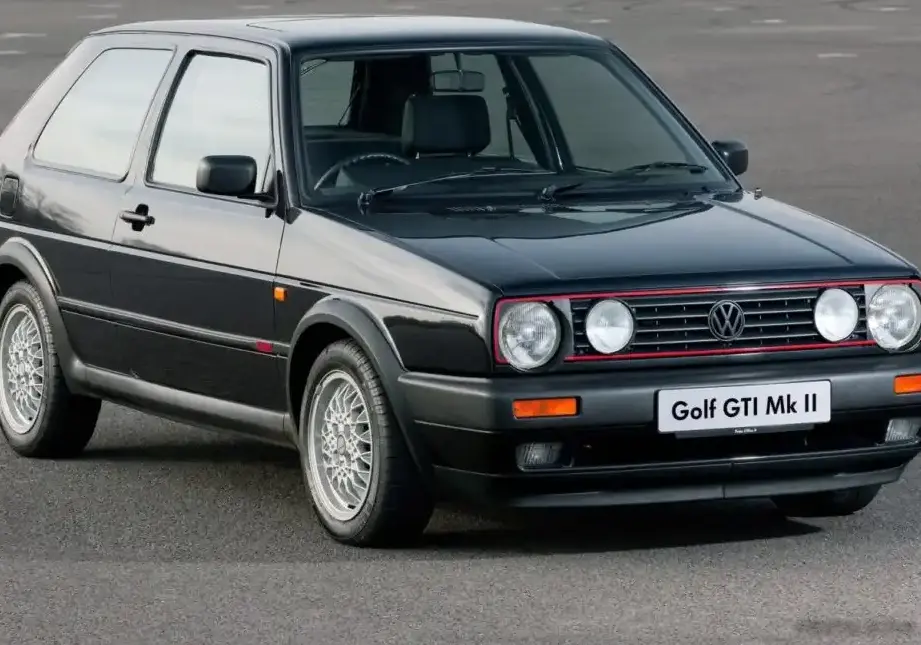
The Volkswagen Golf Mk2, produced from 1983 to 1992, represented a significant evolution of the original Golf, offering improved aerodynamics, a more refined interior, and a wider range of engine options. The 1987 facelift brought subtle but important changes to the exterior styling and interior appointments. Within the Mk2 range, the 1.8 GTI 8V, introduced in 1987 and continuing through 1991, occupied a sweet spot for many buyers, offering a blend of performance and practicality. This variant aimed to deliver the GTI experience at a more accessible price point than the more powerful 16-valve versions.
Technical Specifications
| Brand | Volkswagen |
| Model | Golf |
| Generation | Golf II (3-door, facelift 1987) |
| Type (Engine) | 1.8 GTI 8V (107 Hp) |
| Start of production | 1987 |
| End of production | 1991 |
| Powertrain Architecture | Internal Combustion engine |
| Body type | Hatchback |
| Seats | 5 |
| Doors | 3 |
| Fuel consumption (urban) | 10.7 l/100 km (22 US mpg, 26.4 UK mpg, 9.3 km/l) |
| Fuel consumption (extra urban) | 6.4 l/100 km (36.8 US mpg, 44.1 UK mpg, 15.6 km/l) |
| Fuel Type | Petrol (Gasoline) |
| Acceleration 0 – 100 km/h | 10.3 sec |
| Acceleration 0 – 62 mph | 10.3 sec |
| Acceleration 0 – 60 mph | 9.8 sec |
| Maximum speed | 186 km/h (115.58 mph) |
| Weight-to-power ratio | 8.9 kg/Hp, 112.6 Hp/tonne |
| Weight-to-torque ratio | 6.1 kg/Nm, 165.3 Nm/tonne |
| Power | 107 Hp @ 5400 rpm |
| Power per litre | 60.1 Hp/l |
| Torque | 157 Nm @ 3800 rpm (115.8 lb.-ft. @ 3800 rpm) |
| Engine layout | Front, Transverse |
| Engine Model/Code | PF |
| Engine displacement | 1781 cm3 (108.68 cu. in.) |
| Number of cylinders | 4 |
| Engine configuration | Inline |
| Cylinder Bore | 81 mm (3.19 in.) |
| Piston Stroke | 86.4 mm (3.4 in.) |
| Compression ratio | 10:1 |
| Number of valves per cylinder | 2 |
| Fuel injection system | Multi-port manifold injection |
| Engine aspiration | Naturally aspirated engine |
| Valvetrain | SOHC |
| Engine oil capacity | 4 l (4.23 US qt | 3.52 UK qt) |
| Coolant capacity | 6.3 l (6.66 US qt | 5.54 UK qt) |
| Kerb Weight | 950 kg (2094.39 lbs.) |
| Max. weight | 1465 kg (3229.77 lbs.) |
| Max load | 515 kg (1135.38 lbs.) |
| Trunk (boot) space – minimum | 345 l (12.18 cu. ft.) |
| Trunk (boot) space – maximum | 1145 l (40.44 cu. ft.) |
| Fuel tank capacity | 55 l (14.53 US gal | 12.1 UK gal) |
| Permitted trailer load with brakes (12%) | 1200 kg (2645.55 lbs.) |
| Permitted trailer load without brakes | 490 kg (1080.27 lbs.) |
| Length | 4040 mm (159.06 in.) |
| Width | 1680 mm (66.14 in.) |
| Height | 1405 mm (55.31 in.) |
| Wheelbase | 2475 mm (97.44 in.) |
| Front track | 1427 mm (56.18 in.) |
| Rear track | 1422 mm (55.98 in.) |
| Drag coefficient (Cd) | 0.34 |
| Minimum turning circle | 10.5 m (34.45 ft.) |
| Drivetrain Architecture | Front wheel drive |
| Number of gears and type of gearbox | 5 gears, manual transmission |
| Front suspension | Independent type McPherson, Transverse stabilizer |
| Rear suspension | Transverse stabilizer, Elastic beam |
| Front brakes | Ventilated discs |
| Rear brakes | Disc |
| Steering type | Steering rack and pinion |
| Tires size | 185/60 R14; 195/50 R15 |
| Wheel rims size | 6J x 14; 6.5J x 15 |
INTRODUCTION
The Volkswagen Golf Mk2 1.8 GTI 8V, produced from 1987 to 1991, was a key variant in the second-generation Golf lineup. Positioned as a more affordable entry point into the GTI world, it offered a compelling combination of performance, fuel efficiency, and practicality. The “8V” designation refers to the eight valves per cylinder in the engine, distinguishing it from the more potent 16-valve GTI models. This 3-door hatchback aimed to appeal to buyers who wanted the GTI badge and sporty styling without the higher price tag and increased running costs of the 16V.
Powertrain & Engine Architecture
At the heart of the 1.8 GTI 8V lay the PF engine code, a 1781cc inline-four cylinder engine. This engine utilized a Bosch multi-port fuel injection system, providing precise fuel delivery for improved efficiency and performance. The single overhead camshaft (SOHC) design kept the engine relatively simple and reliable. The 8-valve configuration, while less sophisticated than the 16-valve head, offered a broad torque curve, making the engine responsive in everyday driving situations. The engine produced 107 horsepower at 5400 rpm and 157 Nm (115.8 lb-ft) of torque at 3800 rpm. The engine was transversely mounted, driving the front wheels. The transmission was a 5-speed manual, although a 3-speed automatic was also available, albeit less common and impacting performance.
Driving Characteristics
The 1.8 GTI 8V offered a noticeably more engaging driving experience than the base Golf models. While not as brutally quick as the 16V GTI, it provided ample power for spirited driving on both city streets and winding roads. Acceleration from 0 to 60 mph took around 9.8 seconds, and it could reach a top speed of 115.58 mph. The 5-speed manual transmission allowed drivers to keep the engine in its sweet spot, maximizing power delivery. The automatic transmission, while offering convenience, resulted in slower acceleration and a less direct connection to the engine. The suspension, featuring McPherson struts at the front and an elastic beam rear axle, provided a comfortable ride while maintaining reasonable handling characteristics. The steering, a rack and pinion system, was direct and responsive.
Equipment & Trim Levels
The 1.8 GTI 8V came reasonably well-equipped for its time. Standard features typically included a sports steering wheel, upgraded cloth upholstery, a basic stereo system, and a rev counter. The interior featured a more sporty design than the base Golf, with a black interior scheme being common. Optional extras included power windows, central locking, a sunroof, and upgraded audio systems. The exterior styling was distinguished by GTI-specific bumpers, side skirts, and a rear spoiler. Wheel options included 14-inch or 15-inch alloy wheels.
Chassis & Braking
The Golf Mk2 GTI 8V utilized a front-wheel-drive layout. The front suspension employed independent McPherson struts with a transverse stabilizer bar, while the rear suspension featured a torsion beam axle. Braking duties were handled by ventilated discs at the front and discs at the rear, providing adequate stopping power for the vehicle’s weight and performance. The steering system was a rack and pinion setup, offering precise and responsive steering feel.
Market Reception & Comparison
The 1.8 GTI 8V was generally well-received by automotive critics. It was praised for its blend of performance, practicality, and affordability. Compared to the more expensive 16V GTI, the 8V offered a more accessible entry point into the GTI experience. It also offered better fuel economy than the 16V, making it a more sensible choice for daily driving. Compared to the diesel models, the 1.8 GTI 8V provided significantly more performance, albeit at the cost of fuel efficiency. The automatic transmission version was often criticized for its sluggish performance and reduced driving engagement.
Legacy
The Volkswagen Golf Mk2 1.8 GTI 8V has become a popular classic car among enthusiasts. The PF engine is known for its reliability and relative simplicity, making it easier to maintain than the more complex 16V engine. Parts availability is generally good, and the car’s robust construction ensures that many examples are still on the road today. While not as highly sought after as the 16V GTI, the 8V offers a compelling combination of performance, affordability, and classic Volkswagen charm, making it a rewarding ownership experience for those seeking a taste of 1980s hot hatch history.