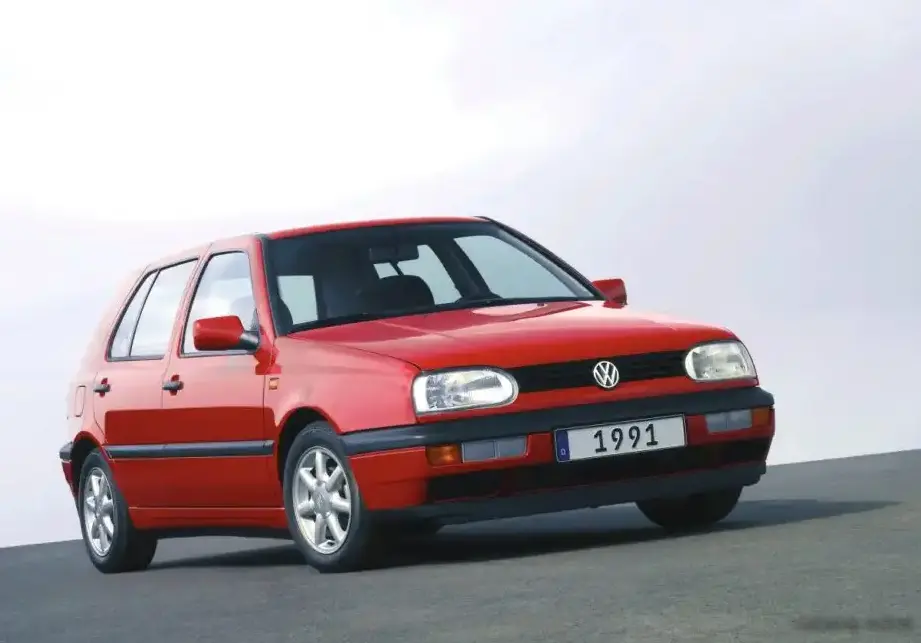
The Volkswagen Golf Mk3 1.4, producing 55 horsepower, was an entry-level variant of the Golf III, manufactured between 1991 and 1994. Positioned as the most affordable option in the Mk3 Golf lineup, it served as a practical and economical choice for first-time buyers and those prioritizing fuel efficiency. This model was a key part of Volkswagen’s strategy to offer a broad range of Golf configurations, catering to diverse customer needs within the competitive C-segment hatchback market. It was built on the A2 platform, a carryover from the Mk2 Golf, but with significant advancements in body design, interior space, and safety features.
Technical Specifications
| Brand | Volkswagen |
| Model | Golf |
| Generation | Golf III |
| Type (Engine) | 1.4 (55 Hp) |
| Start of production | 1991 |
| End of production | 1994 |
| Powertrain Architecture | Internal Combustion engine |
| Body type | Hatchback |
| Seats | 5 |
| Doors | 3-5 |
| Fuel consumption (urban) | 8 l/100 km (29.4 US mpg) |
| Fuel consumption (extra urban) | 5 l/100 km (47 US mpg) |
| Fuel consumption (combined) | 6.5 l/100 km (36.2 US mpg) |
| Fuel Type | Petrol (Gasoline) |
| Acceleration 0 – 100 km/h | 16.2 sec |
| Acceleration 0 – 62 mph | 16.2 sec |
| Acceleration 0 – 60 mph | 15.4 sec |
| Maximum speed | 165 km/h (102.53 mph) |
| Weight-to-power ratio | 18.7 kg/Hp |
| Weight-to-torque ratio | 8.9 kg/Nm |
| Power | 55 Hp @ 5200 rpm |
| Power per litre | 39.5 Hp/l |
| Torque | 116 Nm @ 2800 rpm (85.56 lb.-ft. @ 2800 rpm) |
| Engine layout | Front, Transverse |
| Engine Model/Code | AEX, ABD |
| Engine displacement | 1391 cm3 (84.88 cu. in.) |
| Number of cylinders | 4 |
| Engine configuration | Inline |
| Cylinder Bore | 75 mm (2.95 in.) |
| Piston Stroke | 78.7 mm (3.1 in.) |
| Compression ratio | 9:1 |
| Number of valves per cylinder | 2 |
| Fuel injection system | Single-point injection |
| Engine aspiration | Naturally aspirated engine |
| Valvetrain | OHC |
| Engine oil capacity | 3.4 l (3.59 US qt | 2.99 UK qt) |
| Coolant capacity | 5.6 l (5.92 US qt | 4.93 UK qt) |
| Kerb Weight | 1030 kg (2270.76 lbs.) |
| Max. weight | 1505 kg (3317.96 lbs.) |
| Max load | 475 kg (1047.2 lbs.) |
| Trunk (boot) space – minimum | 330 l (11.65 cu. ft.) |
| Trunk (boot) space – maximum | 687 l (24.26 cu. ft.) |
| Fuel tank capacity | 50 l (13.21 US gal | 11 UK gal) |
| Length | 4020 mm (158.27 in.) |
| Width | 1695 mm (66.73 in.) |
| Height | 1425 mm (56.1 in.) |
| Wheelbase | 2475 mm (97.44 in.) |
| Front track | 1478 mm (58.19 in.) |
| Rear track | 1448 mm (57.01 in.) |
| Drivetrain Architecture | Front wheel drive |
| Number of gears | 5 gears, manual transmission |
| Front suspension | Independent type McPherson |
| Rear suspension | Semi-dependent beam with stabilizer |
| Front brakes | Disc |
| Rear brakes | Drum |
| Steering type | Steering rack and pinion |
| Tires size | 175/70 R13 |
| Wheel rims size | 13 |
INTRODUCTION
The Volkswagen Golf Mk3 1.4 (55 hp) was introduced in 1991 as the base model of the third-generation Golf. It represented a significant step forward from the Mk2 Golf, boasting a more refined interior, improved aerodynamics, and enhanced safety features. The 1.4-liter engine, designated with engine codes AEX and ABD, was specifically tuned for economy and accessibility, making the Mk3 Golf available to a wider range of buyers. This variant was primarily sold in Europe, where smaller displacement engines were favored due to tax regulations and fuel costs. It was available in both 3-door and 5-door hatchback configurations.
Powertrain & Engine Architecture
The heart of the Golf Mk3 1.4 was a 1391cc inline four-cylinder engine. This engine utilized a single-point fuel injection system (SPI), a relatively simple and cost-effective technology for the time. The SPI system delivered fuel into the intake manifold, rather than directly into the cylinders as seen in more advanced multi-point injection systems. The engine featured an overhead camshaft (OHC) valvetrain with two valves per cylinder. The AEX and ABD engine codes represent minor variations in the engine management system and emissions control equipment. The engine produced 55 horsepower at 5200 rpm and 85.56 lb-ft of torque at 2800 rpm. The engine was transversely mounted, driving the front wheels. The standard transmission was a five-speed manual gearbox, designed for smooth and efficient operation. While an automatic transmission was available on some Mk3 Golf models, it was not typically paired with the 1.4-liter engine due to the limited power output.
Driving Characteristics
The Golf Mk3 1.4 55hp was not designed for performance. Acceleration was leisurely, taking approximately 16.2 seconds to reach 62 mph (100 km/h). The engine felt strained at higher speeds, and overtaking required careful planning. However, the engine was surprisingly flexible at lower speeds, providing adequate power for urban driving. The five-speed manual transmission allowed drivers to keep the engine in its optimal power band. The gear ratios were relatively long, prioritizing fuel economy over acceleration. Compared to the more powerful Golf variants, such as the 1.8 and VR6 models, the 1.4 felt significantly underpowered. The handling was typical of a front-wheel-drive hatchback, with predictable but not particularly sporty characteristics. The suspension was tuned for comfort, providing a relatively smooth ride over uneven surfaces.
Equipment & Trim Levels
The Golf Mk3 1.4 was typically equipped with basic but functional features. Standard equipment included power steering, central locking, and a basic stereo system. Interior upholstery was typically cloth, with a simple dashboard layout. Optional extras included power windows, a sunroof, and upgraded stereo systems. The trim level was generally considered the entry-level specification, lacking the more luxurious features found in higher-spec Golf models. The focus was on providing a practical and affordable vehicle, rather than a premium experience.
Chassis & Braking
The Golf Mk3 1.4 utilized an independent McPherson strut suspension at the front and a semi-dependent torsion beam suspension at the rear. The torsion beam suspension was a cost-effective solution that provided adequate ride comfort and handling for the vehicle’s weight class. The front brakes were disc brakes, while the rear brakes were drum brakes. This configuration was typical for entry-level models of the time. The steering was a rack-and-pinion system, providing precise and responsive steering feel. The standard tire size was 175/70 R13, mounted on 13-inch steel wheels.
Market Reception & Comparison
The Golf Mk3 1.4 was generally well-received as an affordable and economical hatchback. Critics praised its practicality, fuel efficiency, and comfortable ride. However, the engine’s lack of power was a common criticism. Compared to the 1.8-liter and VR6 models, the 1.4 offered significantly less performance. The 1.9 TDI diesel variant provided better fuel economy and more torque, making it a popular alternative for those covering long distances. The 1.4 was often seen as a sensible choice for first-time buyers or those prioritizing running costs over driving excitement.
Legacy
The Golf Mk3 1.4, while not the most sought-after variant, remains a relatively common sight on European roads today. The AEX and ABD engines are generally considered reliable, although they are prone to age-related issues such as oil leaks and corrosion. Parts availability is good, and maintenance costs are relatively low. The 1.4-liter engine’s simplicity makes it relatively easy to repair. In the used car market, the Golf Mk3 1.4 represents an affordable entry point into classic Volkswagen ownership. Its enduring popularity is a testament to the Golf’s reputation for practicality, reliability, and enduring design.