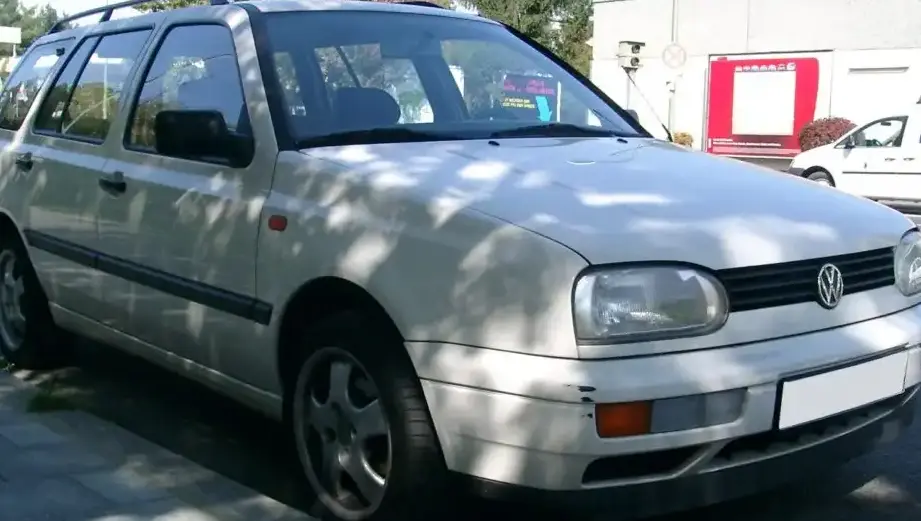
The Volkswagen Golf III Variant 1.9 TD, produced between 1993 and 1999, represents a practical and fuel-efficient offering within the broader Golf Mk3 range. Positioned as a station wagon (estate) variant, it catered to buyers needing increased cargo capacity without sacrificing the Golf’s inherent usability. This specific 75 horsepower diesel model, powered by the AAZ engine, was a common sight in European markets, prized for its economy and durability. It occupied a mid-range position in the Golf III Variant lineup, slotting below the more powerful gasoline engines and the higher-output TDI variants, but above the base-level petrol models.
Technical Specifications
| Brand | Volkswagen |
| Model | Golf |
| Generation | Golf III Variant |
| Type (Engine) | 1.9 TD (75 Hp) |
| Start of production | 1993 |
| End of production | 1999 |
| Powertrain Architecture | Internal Combustion engine |
| Body type | Station wagon (estate) |
| Seats | 5 |
| Doors | 5 |
| Fuel consumption (combined) | 6.4 l/100 km (36.8 US mpg, 44.1 UK mpg, 15.6 km/l) |
| Fuel Type | Diesel |
| Acceleration 0 – 100 km/h | 15.9 sec |
| Acceleration 0 – 62 mph | 15.9 sec |
| Acceleration 0 – 60 mph | 15.1 sec |
| Maximum speed | 163 km/h (101.28 mph) |
| Weight-to-power ratio | 16.6 kg/Hp (60.2 Hp/tonne) |
| Weight-to-torque ratio | 8.9 kg/Nm (112.4 Nm/tonne) |
| Power | 75 Hp @ 4400 rpm |
| Power per litre | 39.6 Hp/l |
| Torque | 140 Nm @ 2400 rpm (103.26 lb.-ft. @ 2400 rpm) |
| Engine layout | Front, Transverse |
| Engine Model/Code | AAZ |
| Engine displacement | 1896 cm3 (115.7 cu. in.) |
| Number of cylinders | 4 |
| Engine configuration | Inline |
| Cylinder Bore | 79.5 mm (3.13 in.) |
| Piston Stroke | 95.5 mm (3.76 in.) |
| Compression ratio | 22.5:1 |
| Number of valves per cylinder | 2 |
| Fuel injection system | Precombustion chamber injection |
| Engine aspiration | Turbocharger |
| Valvetrain | OHC |
| Engine oil capacity | 4.3 l (4.54 US qt | 3.78 UK qt) |
| Coolant | 6.3 l (6.66 US qt | 5.54 UK qt) |
| Kerb Weight | 1245 kg (2744.76 lbs.) |
| Max. weight | 1670 kg (3681.72 lbs.) |
| Max load | 425 kg (936.96 lbs.) |
| Trunk (boot) space – minimum | 466 l (16.46 cu. ft.) |
| Trunk (boot) space – maximum | 1425 l (50.32 cu. ft.) |
| Fuel tank capacity | 60 l (15.85 US gal | 13.2 UK gal) |
| Length | 4340 mm (170.87 in.) |
| Width | 1695 mm (66.73 in.) |
| Height | 1430 mm (56.3 in.) |
| Wheelbase | 2475 mm (97.44 in.) |
| Front track | 1478 mm (58.19 in.) |
| Rear (Back) track | 1462 mm (57.56 in.) |
| Drivetrain Architecture | The Internal combustion engine (ICE) drives the front wheels of the vehicle. |
| Drive wheel | Front wheel drive |
| Number of gears and type of gearbox | 5 gears, manual transmission |
| Front suspension | Wishbone |
| Rear suspension | Suspension with traction connecting levers |
| Front brakes | Disc |
| Rear brakes | Drum |
| Assisting systems | ABS (Anti-lock braking system) |
| Steering type | Steering rack and pinion |
| Power steering | Hydraulic Steering |
| Tires size | 185/60 R14 |
| Wheel rims size | 14 |
Powertrain & Engine Architecture
The heart of the Golf III Variant 1.9 TD is the AAZ engine, a 1.9-liter, inline-four cylinder diesel. This engine utilizes a precombustion chamber injection system, a common design for diesels of that era. Unlike direct injection systems, precombustion chambers improve combustion efficiency and reduce engine noise, though at the cost of some power. The AAZ is turbocharged, boosting output to 75 horsepower and 140 Nm (103 lb-ft) of torque. The turbocharger, while relatively small by modern standards, significantly improved low-end torque, making the vehicle more tractable for everyday driving. The engine features a single overhead camshaft (OHC) valvetrain, operating two valves per cylinder. The five-speed manual transmission was the standard offering, chosen for its efficiency and cost-effectiveness. While an automatic transmission was available on some Golf III variants, it was less common with the 1.9 TD engine due to the torque characteristics of the diesel and the desire for maximum fuel economy.
Driving Characteristics
The 1.9 TD with a manual transmission offered a pragmatic driving experience. Acceleration was modest, with a 0-60 mph time of around 15.1 seconds. However, the engine’s strong low-end torque made it feel more responsive in everyday driving situations, such as overtaking or climbing hills. The gear ratios were well-suited to maximizing fuel economy, with a relatively tall fifth gear for highway cruising. Compared to the more powerful gasoline engines in the Golf III range, the 1.9 TD prioritized fuel efficiency and durability over outright performance. The automatic transmission, when equipped, further emphasized ease of use but at the expense of responsiveness and fuel economy. The automatic’s torque converter sapped some of the engine’s power, resulting in even slower acceleration.
Equipment & Trim Levels
The Golf III Variant 1.9 TD typically came with a fairly basic level of equipment, reflecting its position as a value-oriented model. Standard features generally included power steering, central locking, and a basic stereo system. Interior upholstery was typically cloth, with a durable and practical design. Optional extras included power windows, sunroof, alloy wheels, and upgraded audio systems. Trim levels varied slightly depending on the market, but generally followed a progressive structure, with higher trims adding more comfort and convenience features. The Variant body style itself added practicality with its larger cargo area, featuring a split-folding rear seat for increased versatility.
Chassis & Braking
The Golf III Variant 1.9 TD utilized a relatively simple but effective chassis design. Front suspension consisted of independent wishbones, providing a comfortable ride and decent handling. The rear suspension employed a torsion beam setup, which was cost-effective and space-efficient. Braking was typically accomplished with front disc brakes and rear drum brakes. ABS (Anti-lock Braking System) was often included as standard equipment, enhancing safety. The suspension was tuned for comfort and practicality, rather than outright sportiness. Stabilizer bars were fitted to reduce body roll during cornering, but the overall handling characteristics were geared towards everyday usability.
Market Reception & Comparison
The Golf III Variant 1.9 TD was well-received in European markets as a practical and economical family car. Critics praised its fuel efficiency, durability, and spacious interior. However, it was often criticized for its modest performance and somewhat agricultural engine noise. Compared to the gasoline-powered Golf III variants, the 1.9 TD offered significantly better fuel economy but less power. Compared to the later TDI models, the 1.9 TD lacked the refinement and performance of direct injection technology. However, the AAZ engine was known for its robustness and relatively simple maintenance requirements.
Legacy
The Volkswagen Golf III Variant 1.9 TD, particularly the AAZ-powered version, has developed a reputation for reliability and longevity. Many examples are still on the road today, testament to the engine’s durability. In the used car market, these models are often sought after by buyers looking for a practical, economical, and relatively simple-to-maintain vehicle. While not a performance icon, the Golf III Variant 1.9 TD remains a popular choice for those prioritizing fuel efficiency, practicality, and long-term reliability. Parts availability is generally good, and the engine’s relatively simple design makes it accessible to amateur mechanics.