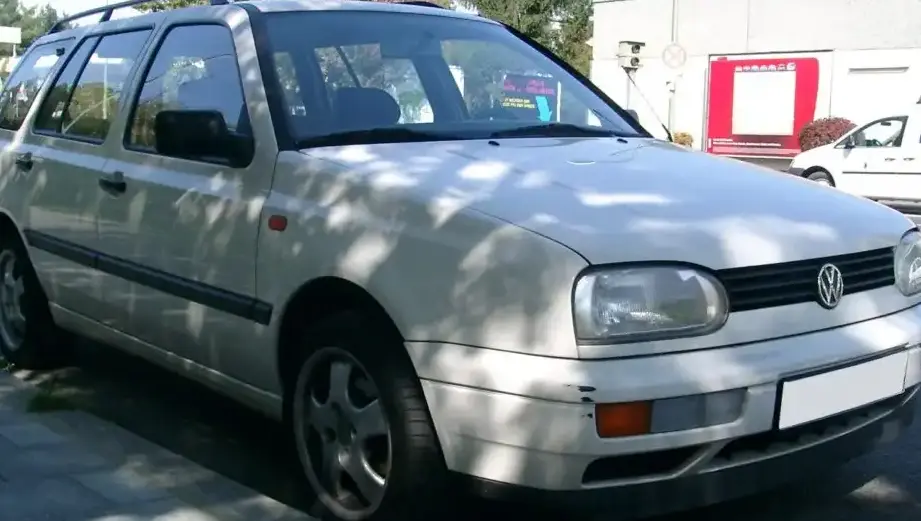
The Volkswagen Golf III Variant 2.0, producing 115 horsepower, was a popular iteration of the Golf III estate (wagon) model, manufactured between 1993 and 1999. Positioned as a mid-range offering within the Golf III Variant lineup, it provided a balance between performance, practicality, and affordability. This model played a significant role in solidifying the Golf’s reputation as a versatile and reliable family vehicle in the European market, where station wagons held a larger share of the automotive landscape than in the United States. The Golf III itself, built on the A3 platform (also known as the 1HX0/A3 platform), represented a substantial evolution over its predecessor, offering improved refinement, safety features, and a more modern design.
Technical Specifications
| Brand | Volkswagen |
| Model | Golf |
| Generation | Golf III Variant |
| Type (Engine) | 2.0 (115 Hp) |
| Start of production | 1993 |
| End of production | 1999 |
| Powertrain Architecture | Internal Combustion engine |
| Body type | Station wagon (estate) |
| Seats | 5 |
| Doors | 5 |
| Fuel consumption (urban) | 10.5 l/100 km (22.4 US mpg, 26.9 UK mpg, 9.5 km/l) |
| Fuel consumption (combined) | 7.9 l/100 km (29.8 US mpg, 35.8 UK mpg, 12.7 km/l) |
| Fuel Type | Petrol (Gasoline) |
| Acceleration 0 – 100 km/h | 10.8 sec |
| Acceleration 0 – 62 mph | 10.8 sec |
| Acceleration 0 – 60 mph | 10.3 sec |
| Maximum speed | 193 km/h (119.92 mph) |
| Weight-to-power ratio | 10.8 kg/Hp, 92.4 Hp/tonne |
| Weight-to-torque ratio | 7.3 kg/Nm, 136.5 Nm/tonne |
| Power | 115 Hp @ 5200 rpm |
| Power per litre | 58 Hp/l |
| Torque | 170 Nm @ 2400 rpm (125.39 lb.-ft. @ 2400 rpm) |
| Engine layout | Front, Transverse |
| Engine Model/Code | 2E, ADY, AGG |
| Engine displacement | 1984 cm3 (121.07 cu. in.) |
| Number of cylinders | 4 |
| Engine configuration | Inline |
| Cylinder Bore | 82.5 mm (3.25 in.) |
| Piston Stroke | 92.8 mm (3.65 in.) |
| Compression ratio | 10:1 |
| Number of valves per cylinder | 2 |
| Fuel injection system | Multi-port manifold injection |
| Engine aspiration | Naturally aspirated engine |
| Valvetrain | OHC |
| Engine oil capacity | 3.8 l (4.02 US qt | 3.34 UK qt) |
| Coolant | 5.5 l (5.81 US qt | 4.84 UK qt) |
| Kerb Weight | 1245 kg (2744.76 lbs.) |
| Max. weight | 1670 kg (3681.72 lbs.) |
| Max load | 425 kg (936.96 lbs.) |
| Trunk (boot) space – minimum | 466 l (16.46 cu. ft.) |
| Trunk (boot) space – maximum | 1425 l (50.32 cu. ft.) |
| Fuel tank capacity | 60 l (15.85 US gal | 13.2 UK gal) |
| Length | 4340 mm (170.87 in.) |
| Width | 1695 mm (66.73 in.) |
| Height | 1430 mm (56.3 in.) |
| Wheelbase | 2475 mm (97.44 in.) |
| Front track | 1478 mm (58.19 in.) |
| Rear (Back) track | 1465 mm (57.68 in.) |
| Drivetrain Architecture | The Internal combustion engine (ICE) drives the front wheels of the vehicle. |
| Drive wheel | Front wheel drive |
| Number of gears and type of gearbox | 5 gears, manual transmission |
| Front suspension | Wishbone |
| Rear suspension | Suspension with traction connecting levers |
| Front brakes | Ventilated discs |
| Rear brakes | Drum |
| Assisting systems | ABS (Anti-lock braking system) |
| Steering type | Steering rack and pinion |
| Power steering | Hydraulic Steering |
| Tires size | 195/60 R14 |
| Wheel rims size | 14 |
Powertrain & Engine Architecture
The Golf III Variant 2.0 utilized various iterations of Volkswagen’s inline-four cylinder engine, most commonly the 2E, ADY, or AGG engine codes. These engines featured a cast iron block and an aluminum cylinder head, employing a single overhead camshaft (OHC) design with two valves per cylinder. Fuel delivery was managed by a Bosch multi-port fuel injection system, providing a balance between efficiency and performance. The 2.0-liter engine produced 115 horsepower at 5200 rpm and 170 Nm (125 lb-ft) of torque at 2400 rpm. The engine’s relatively low compression ratio of 10:1 allowed it to run reliably on readily available gasoline grades. The standard transmission was a five-speed manual, though a four-speed automatic transmission was also offered, impacting performance and fuel economy. The automatic transmission, while providing convenience, typically resulted in slightly slower acceleration and increased fuel consumption compared to the manual counterpart.
Driving Characteristics
The 2.0-liter engine in the Golf III Variant provided adequate, though not exhilarating, performance. Acceleration from 0 to 60 mph took approximately 10.3 seconds, and the top speed was around 119.92 mph. The engine’s torque curve was relatively flat, offering decent pulling power in everyday driving situations. However, compared to the more powerful VR6 variants or even the turbocharged diesel models, the 2.0-liter felt somewhat underpowered, especially when fully loaded with passengers and cargo. The five-speed manual transmission allowed drivers to make the most of the engine’s power band, while the four-speed automatic, while smooth, resulted in noticeable gear changes and a less engaging driving experience. The suspension, tuned for comfort, provided a reasonably compliant ride, though it wasn’t particularly sporty.
Equipment & Trim Levels
The Golf III Variant 2.0 typically came equipped with features such as power steering, central locking, and electric front windows. Interior upholstery was generally cloth, with options for upgraded materials available. Depending on the market and optional packages, features like air conditioning, a sunroof, and alloy wheels could be added. The dashboard layout was functional and straightforward, typical of Volkswagen’s design philosophy at the time. Higher trim levels offered additional features such as upgraded audio systems and more luxurious interior appointments. The 2.0 variant often served as a stepping stone between the base models and the more premium trims, offering a good balance of features and price.
Chassis & Braking
The Golf III Variant featured an independent front suspension with wishbones and a semi-independent rear suspension utilizing trailing arms and coil springs. The braking system consisted of ventilated disc brakes on the front wheels and drum brakes on the rear. Anti-lock Braking System (ABS) was often included as standard equipment, enhancing safety. The chassis was relatively lightweight, contributing to the car’s nimble handling. Stabilizer bars were fitted to both the front and rear axles to reduce body roll during cornering. The suspension setup was geared towards providing a comfortable ride rather than outright sporty handling.
Market Reception & Comparison
The Golf III Variant 2.0 was generally well-received by automotive critics as a practical and reliable family vehicle. It offered a good compromise between performance, fuel economy, and price. Compared to the more expensive VR6 models, the 2.0-liter variant was more affordable to purchase and maintain. However, it lacked the VR6’s exhilarating performance. The 1.9 TDI diesel variants offered superior fuel economy but were often more expensive and could be noisier. The 2.0-liter engine was considered a solid all-rounder, suitable for everyday commuting and family trips. Fuel economy was respectable, averaging around 29.8 US mpg in combined driving.
Legacy
The Golf III Variant 2.0 has proven to be a durable and reliable vehicle, with many examples still on the road today. The 2.0-liter engine, while not particularly high-tech, is known for its longevity and relatively simple maintenance requirements. Parts availability remains good, making it a relatively affordable classic to own and maintain. In the used car market, the Golf III Variant 2.0 is often sought after by enthusiasts looking for a practical and reliable estate car with a classic Volkswagen pedigree. Its enduring popularity is a testament to the Golf’s timeless design and engineering.