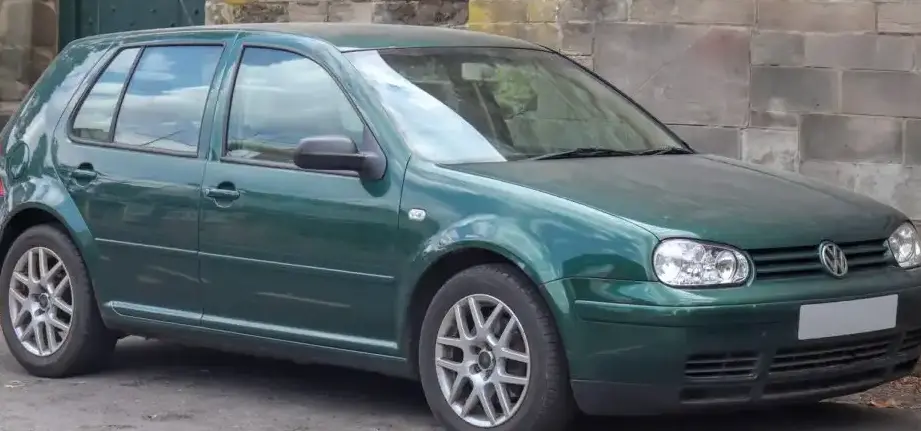
The Volkswagen Golf IV 1.8 (125 hp) Automatic, produced between 1997 and 2000, represented a key entry point into the fourth generation of Volkswagen’s iconic hatchback. Positioned within the Golf Mk IV range (chassis codes 1HX0 for 3-door and 1H5 for 5-door), this variant aimed to provide a balance of affordability, practicality, and Volkswagen’s renowned build quality. It served as a more accessible alternative to the higher-performance GTI and TDI models, appealing to buyers prioritizing comfort and ease of use over outright speed or fuel economy. The Golf IV itself was a significant step forward for Volkswagen, solidifying its reputation for refinement and technological innovation in the compact class.
Technical Specifications
| Brand | Volkswagen |
| Model | Golf |
| Generation | Golf IV |
| Type (Engine) | 1.8 (125 Hp) Automatic |
| Start of production | 1997 |
| End of production | 2000 |
| Powertrain Architecture | Internal Combustion engine |
| Body type | Hatchback |
| Seats | 5 |
| Doors | 3-5 |
| Fuel consumption (urban) | 11.9 l/100 km (19.8 US mpg) |
| Fuel consumption (extra urban) | 6.6 l/100 km (35.6 US mpg) |
| Fuel Type | Petrol (Gasoline) |
| Acceleration 0 – 100 km/h | 11.9 sec |
| Acceleration 0 – 62 mph | 11.9 sec |
| Acceleration 0 – 60 mph | 11.3 sec |
| Maximum speed | 198 km/h (123.03 mph) |
| Weight-to-power ratio | 9.6 kg/Hp |
| Weight-to-torque ratio | 7 kg/Nm |
| Power | 125 Hp @ 6000 rpm |
| Power per litre | 70.2 Hp/l |
| Torque | 170 Nm @ 4200 rpm (125.39 lb.-ft. @ 4200 rpm) |
| Engine layout | Front, Transverse |
| Engine Model/Code | AGN |
| Engine displacement | 1781 cm3 (108.68 cu. in.) |
| Number of cylinders | 4 |
| Engine configuration | Inline |
| Cylinder Bore | 81 mm (3.19 in.) |
| Piston Stroke | 86.4 mm (3.4 in.) |
| Compression ratio | 10.3:1 |
| Number of valves per cylinder | 5 |
| Fuel injection system | Multi-port manifold injection |
| Engine aspiration | Naturally aspirated engine |
| Valvetrain | DOHC |
| Engine oil capacity | 4.5 l (4.76 US qt | 3.96 UK qt) |
| Coolant capacity | 5 l (5.28 US qt | 4.4 UK qt) |
| Kerb Weight | 1195 kg (2634.52 lbs.) |
| Max. weight | 1695 kg (3736.84 lbs.) |
| Max load | 500 kg (1102.31 lbs.) |
| Trunk (boot) space – minimum | 330 l (11.65 cu. ft.) |
| Trunk (boot) space – maximum | 1184 l (41.81 cu. ft.) |
| Fuel tank capacity | 55 l (14.53 US gal | 12.1 UK gal) |
| Length | 4149 mm (163.35 in.) |
| Width | 1735 mm (68.31 in.) |
| Height | 1439 mm (56.65 in.) |
| Wheelbase | 2511 mm (98.86 in.) |
| Front track | 1513 mm (59.57 in.) |
| Rear track | 1494 mm (58.82 in.) |
| Drivetrain Architecture | Front wheel drive |
| Number of gears | 4 |
| Gearbox type | Automatic transmission |
| Front suspension | Wishbone |
| Rear suspension | Coil spring |
| Front brakes | Ventilated discs |
| Rear brakes | Disc |
| Assisting systems | ABS (Anti-lock braking system) |
| Steering type | Steering rack and pinion |
| Power steering | Hydraulic |
| Tires size | 195/65 VR 15 |
| Wheel rims size | 6J x 15 |
INTRODUCTION
The Golf IV 1.8 Automatic was a mainstay of the fourth-generation Golf lineup, produced from 1997 to 2000. It represented a significant evolution of the Golf formula, building upon the success of the Mk III while introducing a more refined interior, improved safety features, and updated engine technology. The 1.8-liter engine, designated AGN, was a common choice for European markets, offering a balance between performance and fuel efficiency. In the US market, the Golf IV was offered with different engine options, but the 1.8L engine was a popular choice. The automatic transmission option further broadened its appeal to drivers seeking a comfortable and convenient driving experience.
Powertrain & Engine Architecture
The heart of the Golf IV 1.8 Automatic is the 1781cc, inline-four cylinder AGN engine. This engine featured a cast iron block with an aluminum cylinder head, incorporating a dual overhead camshaft (DOHC) valvetrain with five valves per cylinder (three intake, two exhaust). This configuration, while not as advanced as some contemporary engines, provided a good compromise between performance and cost. Fuel delivery was handled by a multi-port fuel injection system, ensuring precise fuel metering for optimal combustion. The AGN engine was known for its relative reliability, although regular maintenance was crucial. The four-speed automatic transmission, typically the 5HP19, was a conventional hydraulic automatic, offering smooth shifts but lacking the efficiency of more modern transmissions. It was chosen for its reliability and cost-effectiveness, rather than sporting performance.
Driving Characteristics
The Golf IV 1.8 Automatic delivered a comfortable, if not particularly exhilarating, driving experience. With 125 horsepower and 170 Nm (125 lb-ft) of torque, acceleration was adequate for everyday driving, with a 0-60 mph time of around 11.3 seconds. The automatic transmission, while smooth, did detract from the engine’s responsiveness. Gear ratios were optimized for fuel economy and cruising comfort, rather than aggressive acceleration. Compared to the manual transmission version of the same engine, the automatic felt noticeably slower. The higher-output GTI models, with their turbocharged engines, offered significantly more performance. Similarly, the TDI diesel variants provided superior fuel economy and low-end torque. The automatic transmission did offer a more relaxed driving experience, particularly in urban traffic.
Equipment & Trim Levels
The Golf IV 1.8 Automatic typically came equipped with a reasonable level of standard features. These included power windows, central locking, power steering, and an anti-lock braking system (ABS). Interior upholstery was typically cloth, with a relatively simple dashboard layout. Optional extras included air conditioning, alloy wheels, a sunroof, and a CD stereo system. Trim levels varied depending on the market, but generally, the 1.8 Automatic occupied a mid-range position in the Golf IV lineup. It offered more features than the base models but lacked the sporty enhancements found on the GTI.
Chassis & Braking
The Golf IV utilized a MacPherson strut front suspension and a multi-link rear suspension, providing a comfortable and controlled ride. The suspension was tuned for everyday use, prioritizing comfort over outright handling. Braking duties were handled by ventilated discs at the front and solid discs at the rear. ABS was standard, enhancing braking performance and stability. The chassis was relatively lightweight, contributing to the car’s nimble handling characteristics. Stabilizer bars were fitted front and rear, helping to reduce body roll during cornering.
Market Reception & Comparison
The Golf IV 1.8 Automatic was generally well-received by automotive critics. It was praised for its build quality, comfortable ride, and practical interior. However, some critics noted that the automatic transmission detracted from the engine’s performance. Compared to the manual transmission version, the automatic offered less driver engagement. The TDI models were often favored by those prioritizing fuel economy, while the GTI appealed to drivers seeking a more sporty experience. In terms of reliability, the Golf IV 1.8 Automatic proved to be a relatively dependable vehicle, although regular maintenance was essential to prevent issues such as oil leaks and sensor failures.
Legacy
The Golf IV 1.8 Automatic remains a popular choice in the used car market today, particularly for buyers seeking an affordable and reliable hatchback. The AGN engine is known for its durability, and parts availability is generally good. However, potential buyers should be aware of common issues such as coolant leaks from the radiator and failing sensors. The automatic transmission, while generally reliable, may require servicing or rebuilding after high mileage. Overall, the Golf IV 1.8 Automatic represents a solid and well-rounded package, offering a blend of practicality, comfort, and Volkswagen’s renowned build quality. It continues to be a testament to the enduring appeal of the Golf nameplate.