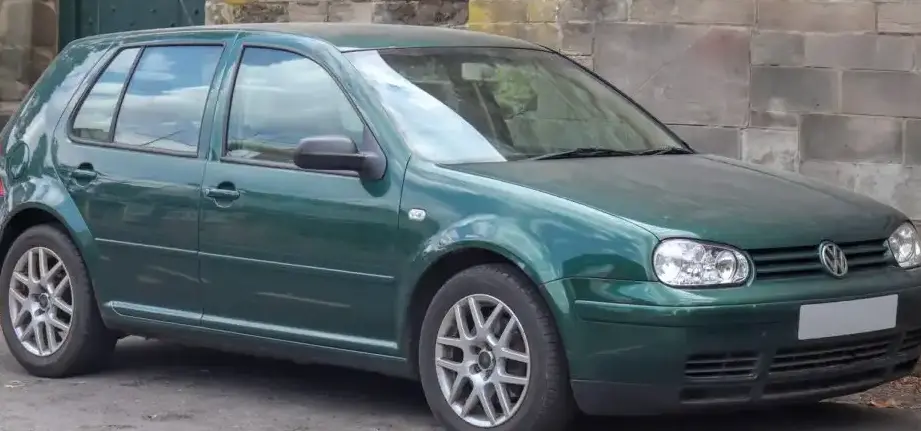
The Volkswagen Golf IV 2.0, equipped with a 115 horsepower engine and automatic transmission, was a mainstay of the fourth-generation Golf lineup produced between 1998 and 2003. Representing a significant evolution of the Golf platform (the 1HX0/A3 platform carried over with refinements), this variant aimed to provide a comfortable and accessible entry point into the Golf range, balancing fuel efficiency with adequate performance for everyday driving. It was positioned as a mid-range offering, slotting below the more powerful 1.8T and VR6 models, but above the base 1.4 and 1.6 liter options.
Technical Specifications
| Brand | Volkswagen |
| Model | Golf |
| Generation | Golf IV |
| Type (Engine) | 2.0 (115 Hp) Automatic |
| Start of production | 1998 |
| End of production | 2003 |
| Powertrain Architecture | Internal Combustion engine |
| Body type | Hatchback |
| Seats | 5 |
| Doors | 3-5 |
| Fuel consumption (urban) | 12.8 l/100 km (18.4 US mpg, 22.1 UK mpg, 7.8 km/l) |
| Fuel consumption (extra urban) | 6.7 l/100 km (35.1 US mpg, 42.2 UK mpg, 14.9 km/l) |
| Fuel consumption (combined) | 8.9 l/100 km (26.4 US mpg, 31.7 UK mpg, 11.2 km/l) |
| Fuel Type | Petrol (Gasoline) |
| Acceleration 0 – 100 km/h | 11.9 sec |
| Acceleration 0 – 62 mph | 11.9 sec |
| Acceleration 0 – 60 mph | 11.3 sec |
| Maximum speed | 192 km/h (119.3 mph) |
| Weight-to-power ratio | 10.2 kg/Hp, 98.3 Hp/tonne |
| Weight-to-torque ratio | 6.9 kg/Nm, 145.3 Nm/tonne |
| Power | 115 Hp @ 5200 rpm |
| Power per litre | 58 Hp/l |
| Torque | 170 Nm @ 2400 rpm (125.39 lb.-ft. @ 2400 rpm) |
| Engine layout | Front, Transverse |
| Engine Model/Code | APK, AQY, AZJ |
| Engine displacement | 1984 cm3 (121.07 cu. in.) |
| Number of cylinders | 4 |
| Engine configuration | Inline |
| Cylinder Bore | 82.5 mm (3.25 in.) |
| Piston Stroke | 92.8 mm (3.65 in.) |
| Compression ratio | 10:1 |
| Number of valves per cylinder | 2 |
| Fuel injection system | Multi-port manifold injection |
| Engine aspiration | Naturally aspirated engine |
| Valvetrain | OHC |
| Engine oil capacity | 4 l (4.23 US qt | 3.52 UK qt) |
| Coolant | 5.5 l (5.81 US qt | 4.84 UK qt) |
| Kerb Weight | 1170 kg (2579.41 lbs.) |
| Max. weight | 1715 kg (3780.93 lbs.) |
| Max load | 545 kg (1201.52 lbs.) |
| Trunk (boot) space – minimum | 330 l (11.65 cu. ft.) |
| Trunk (boot) space – maximum | 1185 l (41.85 cu. ft.) |
| Fuel tank capacity | 55 l (14.53 US gal | 12.1 UK gal) |
| Length | 4149 mm (163.35 in.) |
| Width | 1735 mm (68.31 in.) |
| Height | 1439 mm (56.65 in.) |
| Wheelbase | 2511 mm (98.86 in.) |
| Front track | 1513 mm (59.57 in.) |
| Rear (Back) track | 1494 mm (58.82 in.) |
| Drivetrain Architecture | The Internal combustion engine (ICE) drives the front wheels of the vehicle. |
| Drive wheel | Front wheel drive |
| Number of gears and type of gearbox | 4 gears, automatic transmission |
| Front suspension | Wishbone |
| Rear suspension | Coil spring |
| Front brakes | Ventilated discs |
| Rear brakes | Disc |
| Assisting systems | ABS (Anti-lock braking system) |
| Steering type | Steering rack and pinion |
| Power steering | Hydraulic Steering |
| Tires size | 195/65 R15 |
| Wheel rims size | 6J x 15 |
Powertrain & Engine Architecture
The Golf IV 2.0 Automatic utilized various iterations of the Volkswagen Group’s inline-four cylinder engine, typically identified by engine codes APK, AQY, or AZJ. These engines featured a cast iron block with an aluminum cylinder head, employing a single overhead camshaft (OHC) design with two valves per cylinder. Fuel delivery was managed by a multi-port fuel injection system, providing adequate, though not exceptional, combustion control. The 2.0-liter engine produced 115 horsepower at 5200 rpm and 170 Nm (125 lb-ft) of torque at 2400 rpm. The automatic transmission was generally a four-speed unit, designed for smooth operation and ease of use. While not known for its sportiness, this transmission was reliable and well-suited to the engine’s characteristics.
Driving Characteristics
The 2.0-liter automatic Golf IV offered a comfortable, if not particularly exhilarating, driving experience. Acceleration from 0-60 mph took around 11.3 seconds, and top speed was approximately 119 mph. The automatic transmission, while providing convenience, did detract from the engine’s available power, resulting in a noticeable difference in performance compared to the five-speed manual versions. Gear ratios were optimized for fuel economy and smooth cruising rather than rapid acceleration. The engine felt relatively strained during quick overtaking maneuvers, requiring a downshift to access more power. Overall, the driving experience was geared towards practicality and ease of use, making it a suitable choice for daily commuting and longer journeys.
Equipment & Trim Levels
The 2.0 Automatic trim level typically included standard features such as power windows, central locking, power steering, and an AM/FM radio. Air conditioning was often standard, but could be optional depending on the specific market and package. Interior upholstery was usually cloth, with options for upgraded materials available. Dashboard configuration was consistent with other Golf IV models, featuring a functional and straightforward design. Optional extras included alloy wheels, a sunroof, and upgraded audio systems. Safety features such as ABS were standard, contributing to the Golf IV’s respectable safety rating.
Chassis & Braking
The Golf IV 2.0 Automatic utilized a front independent suspension with wishbones and a rear coil spring suspension. This setup provided a comfortable ride quality, absorbing bumps and irregularities in the road surface effectively. Braking consisted of ventilated discs on the front wheels and solid discs on the rear. ABS (Anti-lock Braking System) was standard, enhancing braking performance and stability, particularly in adverse conditions. The chassis was designed to provide a balance between handling and comfort, offering predictable and stable handling characteristics.
Market Reception & Comparison
The Golf IV 2.0 Automatic received generally positive reviews, praised for its practicality, reliability, and comfortable ride. Critics noted that the automatic transmission dulled the engine’s performance somewhat, and that the 1.8T models offered a more engaging driving experience. However, the 2.0 Automatic was considered a good value for money, offering a well-rounded package for everyday use. Fuel economy was respectable, averaging around 26.4 US mpg in combined driving. Compared to the 1.8T, the 2.0 Automatic was less prone to turbocharger issues, potentially leading to lower long-term maintenance costs. The 1.9 TDI diesel version offered superior fuel economy but at the expense of refinement and performance.
Legacy
The Golf IV 2.0 Automatic has proven to be a relatively reliable and durable vehicle. The engine, while not particularly powerful, is known for its longevity when properly maintained. The automatic transmission, while not the most advanced, has also demonstrated good reliability. Today, these vehicles are readily available on the used car market at affordable prices. They remain popular choices for first-time car buyers and those seeking a practical and dependable hatchback. However, potential buyers should be aware of age-related issues such as corrosion and wear and tear on suspension components. Overall, the Golf IV 2.0 Automatic represents a solid and dependable example of Volkswagen’s enduring Golf legacy.