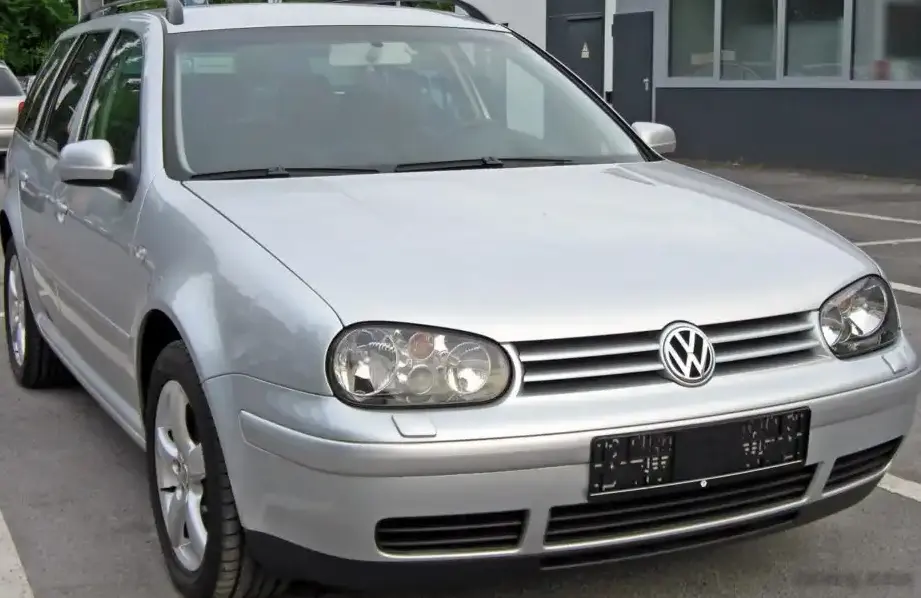
The Volkswagen Golf IV Variant 1.6, producing 101 horsepower, was a station wagon (estate) model offered between April 1999 and August 2000. It occupied an entry-level position within the fourth-generation Golf (Mk IV) lineup, specifically the Variant body style. Built on the 1HX0/A3 platform, this model aimed to provide practical family transport with reasonable fuel economy. It was primarily marketed in Europe, where the station wagon body style remained popular, offering a more affordable and efficient alternative to the higher-performance Golf variants.
Technical Specifications
| Brand | Volkswagen |
| Model | Golf |
| Generation | Golf IV Variant |
| Type (Engine) | 1.6 (101 Hp) |
| Start of production | April, 1999 |
| End of production | August, 2000 |
| Powertrain Architecture | Internal Combustion engine |
| Body type | Station wagon (estate) |
| Seats | 5 |
| Doors | 5 |
| Fuel consumption (urban) | 11.1 l/100 km (21.2 US mpg) |
| Fuel consumption (extra urban) | 6.5 l/100 km (36.2 US mpg) |
| Fuel Type | Petrol (Gasoline) |
| Acceleration 0 – 100 km/h | 11.9 sec |
| Acceleration 0 – 62 mph | 11.9 sec |
| Acceleration 0 – 60 mph | 11.3 sec |
| Maximum speed | 185 km/h (114.95 mph) |
| Weight-to-power ratio | 11 kg/Hp |
| Weight-to-torque ratio | 7.7 kg/Nm |
| Power | 101 Hp @ 5600 rpm |
| Torque | 145 Nm @ 3800 rpm (106.95 lb.-ft. @ 3800 rpm) |
| Engine layout | Front, Transverse |
| Engine Model/Code | AEH, APF |
| Engine displacement | 1595 cm3 (97.33 cu. in.) |
| Number of cylinders | 4 |
| Engine configuration | Inline |
| Cylinder Bore | 81 mm (3.19 in.) |
| Piston Stroke | 77.4 mm (3.05 in.) |
| Compression ratio | 10.3:1 |
| Number of valves per cylinder | 2 |
| Fuel injection system | Multi-port manifold injection |
| Engine aspiration | Naturally aspirated engine |
| Valvetrain | OHC |
| Engine oil capacity | 4.5 l (4.76 US qt | 3.96 UK qt) |
| Coolant capacity | 5 l (5.28 US qt | 4.4 UK qt) |
| Kerb Weight | 1115 kg (2458.15 lbs.) |
| Max. weight | 1625 kg (3582.51 lbs.) |
| Max load | 510 kg (1124.36 lbs.) |
| Trunk (boot) space – minimum | 465 l (16.42 cu. ft.) |
| Trunk (boot) space – maximum | 1425 l (50.32 cu. ft.) |
| Fuel tank capacity | 55 l (14.53 US gal | 12.1 UK gal) |
| Length | 4340 mm (170.87 in.) |
| Width | 1695 mm (66.73 in.) |
| Height | 1430 mm (56.3 in.) |
| Wheelbase | 2475 mm (97.44 in.) |
| Front track | 1480 mm (58.27 in.) |
| Rear track | 1465 mm (57.68 in.) |
| Drivetrain Architecture | Front wheel drive |
| Number of gears | 5 gears, manual transmission |
| Front suspension | Coil spring |
| Rear suspension | Suspension with traction connecting levers |
| Front brakes | Ventilated discs |
| Rear brakes | Drum |
| Assisting systems | ABS (Anti-lock braking system) |
| Steering type | Steering rack and pinion |
| Power steering | Hydraulic Steering |
| Tires size | 195/60 R14 |
| Wheel rims size | 6J x 14 |
Powertrain & Engine Architecture
The Golf IV Variant 1.6 utilized either the AEH or APF engine code, both representing 1.6-liter inline-four cylinder gasoline engines. These engines were part of Volkswagen’s EA827 family, known for their relatively simple design and durability. The engine featured a single overhead camshaft (OHC) operating two valves per cylinder. Fuel delivery was managed by a multi-port fuel injection system, providing adequate, though not exceptional, combustion control. The 1.6-liter engine produced 101 horsepower at 5600 rpm and 145 Nm (106.95 lb-ft) of torque at 3800 rpm. This power was delivered through a five-speed manual transmission, the standard configuration for this variant. While an automatic transmission was available as an option, it impacted performance and fuel economy.
Driving Characteristics
The 1.6-liter engine, paired with the five-speed manual transmission, provided adequate performance for everyday driving. Acceleration from 0 to 60 mph took approximately 11.3 seconds, and the top speed was around 115 mph. Compared to the more powerful Golf variants, such as those equipped with the 1.8-liter turbocharged engine or the VR6, the 1.6 felt noticeably slower. However, the 1.6 offered a more relaxed driving experience, with a focus on fuel efficiency. The gear ratios were tuned for economy, meaning the engine needed to be revved to access its full potential. The automatic transmission option further dulled performance, increasing shift times and reducing responsiveness.
Equipment & Trim Levels
The Golf IV Variant 1.6 typically came with a modest level of standard equipment. This included central locking, power windows, and a basic audio system. Interior upholstery was typically cloth, and the dashboard featured a functional, if somewhat plain, design. Optional extras included alloy wheels, air conditioning, and an upgraded audio system. The 1.6 variant was often seen as a base model, appealing to buyers prioritizing practicality and affordability over luxury features. Higher trim levels, such as the Comfort or Trendline, added more features but also increased the price.
Chassis & Braking
The Golf IV Variant 1.6 featured a MacPherson strut front suspension and a torsion beam rear suspension. This setup provided a comfortable ride, although it wasn’t particularly sporty. The front brakes were ventilated discs, offering good stopping power, while the rear brakes were drums, a cost-saving measure common on base models. ABS (Anti-lock Braking System) was standard, enhancing safety. The suspension was tuned to prioritize ride comfort over handling precision, making it well-suited for everyday driving and carrying passengers or cargo.
Market Reception & Comparison
The Golf IV Variant 1.6 was generally well-received as an affordable and practical family car. Critics noted its reasonable fuel economy and spacious interior. However, the engine’s lack of power was a common criticism, particularly when compared to the more potent Golf variants. The 1.8-liter engine offered a significant performance boost, while the VR6 provided a more luxurious and sporty experience. The 1.9 TDI diesel variant was praised for its excellent fuel economy and strong torque. The 1.6-liter model appealed to buyers who prioritized affordability and fuel efficiency over outright performance.
Legacy
The Golf IV Variant 1.6, while not the most exciting Golf variant, proved to be a reliable and durable vehicle. The EA827 engine is known for its longevity, and with proper maintenance, these engines can continue to operate reliably for many years. In the used car market, these models are often sought after by buyers looking for an affordable and practical station wagon. While not a collector’s item, the Golf IV Variant 1.6 remains a popular choice for those seeking a dependable and economical vehicle.