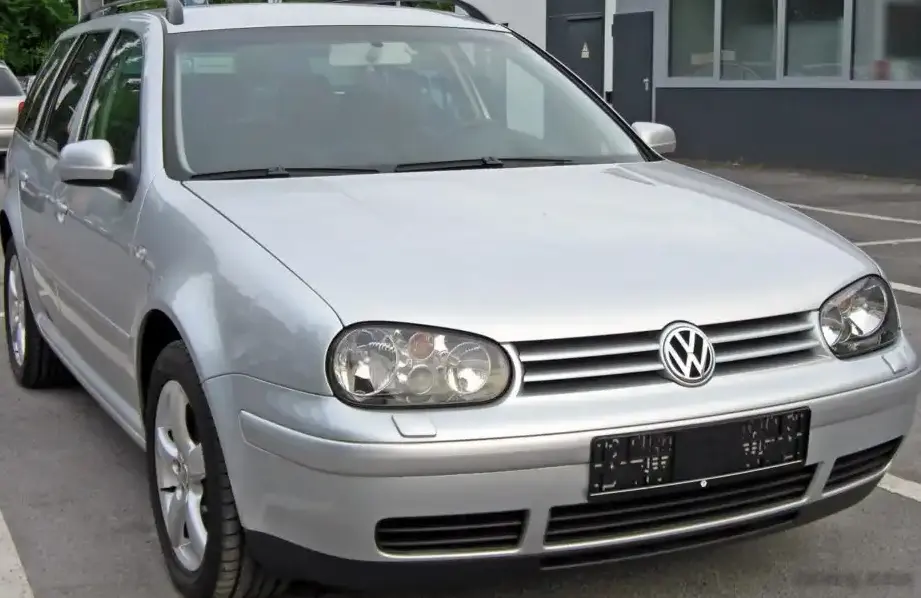
The Volkswagen Golf IV Variant 1.6 16V, produced from 2000 to June 2006, represented a practical and accessible entry point into the fourth-generation Golf family. Positioned as the base engine option for the Variant (estate) body style, it catered to buyers prioritizing fuel efficiency and affordability over outright performance. This model occupied a significant space in the European market, where compact wagons were – and continue to be – highly popular. It was part of the Golf Mk IV (1HX0/A3 platform) generation, known for its refinement and build quality compared to its predecessor.
Technical Specifications
| Brand | Volkswagen |
| Model | Golf |
| Generation | Golf IV Variant |
| Type (Engine) | 1.6 16V (105 Hp) |
| Start of production | 2000 |
| End of production | June, 2006 |
| Powertrain Architecture | Internal Combustion engine |
| Body type | Station wagon (estate) |
| Seats | 5 |
| Doors | 5 |
| Fuel consumption (urban) | 10.9 l/100 km (21.6 US mpg) |
| Fuel consumption (extra urban) | 6.5 l/100 km (36.2 US mpg) |
| Fuel Type | Petrol (Gasoline) |
| Acceleration 0 – 100 km/h | 11 sec |
| Acceleration 0 – 62 mph | 11 sec |
| Acceleration 0 – 60 mph | 10.5 sec |
| Maximum speed | 192 km/h (119.3 mph) |
| Weight-to-power ratio | 11.7 kg/Hp |
| Weight-to-torque ratio | 8.3 kg/Nm |
| Power | 105 Hp @ 5700 rpm |
| Torque | 148 Nm @ 4500 rpm (109.16 lb.-ft. @ 4500 rpm) |
| Engine layout | Front, Transverse |
| Engine Model/Code | AZD, ATN, AUS, BCB |
| Engine displacement | 1598 cm3 (97.52 cu. in.) |
| Number of cylinders | 4 |
| Engine configuration | Inline |
| Cylinder Bore | 76.5 mm (3.01 in.) |
| Piston Stroke | 86.9 mm (3.42 in.) |
| Compression ratio | 11:1 |
| Number of valves per cylinder | 4 |
| Fuel injection system | Multi-port manifold injection |
| Engine aspiration | Naturally aspirated engine |
| Valvetrain | DOHC |
| Engine oil capacity | 3.5 l (3.7 US qt | 3.08 UK qt) |
| Coolant capacity | 6 l (6.34 US qt | 5.28 UK qt) |
| Kerb Weight | 1225 kg (2700.66 lbs.) |
| Max. weight | 1750 kg (3858.09 lbs.) |
| Max load | 525 kg (1157.43 lbs.) |
| Trunk (boot) space – minimum | 460 l (16.24 cu. ft.) |
| Trunk (boot) space – maximum | 1425 l (50.32 cu. ft.) |
| Fuel tank capacity | 55 l (14.53 US gal | 12.1 UK gal) |
| Length | 4340 mm (170.87 in.) |
| Width | 1695 mm (66.73 in.) |
| Height | 1430 mm (56.3 in.) |
| Wheelbase | 2515 mm (99.02 in.) |
| Front track | 1513 mm (59.57 in.) |
| Rear track | 1494 mm (58.82 in.) |
| Drivetrain Architecture | Front wheel drive |
| Number of gears | 5 |
| Gearbox type | Manual transmission |
| Front suspension | Coil spring |
| Rear suspension | Suspension with traction connecting levers |
| Front brakes | Disc |
| Rear brakes | Disc |
| Assisting systems | ABS (Anti-lock braking system) |
| Steering type | Steering rack and pinion |
| Power steering | Hydraulic Steering |
| Tires size | 195/65 R15 |
| Wheel rims size | 15 |
Powertrain & Engine Architecture
The Golf IV Variant 1.6 16V utilized engines from the EA827 family, specifically the AZD, ATN, AUS, and BCB engine codes. These were 1.6-liter, inline-four cylinder engines featuring a dual overhead camshaft (DOHC) valvetrain with four valves per cylinder. The 16-valve configuration contributed to improved breathing and a broader powerband compared to older 8-valve designs. Fuel delivery was managed by a multi-port fuel injection system, providing precise fuel metering for optimal combustion. The engine’s 11:1 compression ratio was relatively high for the time, aiding in efficiency and power output. The engine was transversely mounted, driving the front wheels. The five-speed manual transmission was the standard offering, providing a balance between fuel economy and drivability.
Driving Characteristics
With 105 horsepower and 148 Nm (109 lb-ft) of torque, the 1.6 16V Golf Variant wasn’t designed for rapid acceleration. Zero to 60 mph took around 10.5 seconds, and top speed was approximately 119 mph. The engine felt relatively strained at higher speeds or when fully loaded. However, in everyday driving conditions, it provided adequate performance for commuting and general transportation. The five-speed manual transmission allowed drivers to keep the engine in its optimal power range, but the gear ratios were spaced to prioritize fuel economy rather than spirited driving. Compared to the more powerful 1.8T or VR6 variants, the 1.6 felt noticeably slower, but it offered a smoother and more predictable driving experience. The manual transmission provided a more engaging driving experience than the optional four-speed automatic, which further diminished performance.
Equipment & Trim Levels
The 1.6 16V Golf Variant typically came with a modest level of standard equipment. This included central locking, power windows, power steering, and an anti-lock braking system (ABS). Interior upholstery was typically cloth, with a functional but basic dashboard layout. Optional extras included air conditioning, alloy wheels, a sunroof, and upgraded audio systems. Trim levels varied slightly depending on the market, but generally, the 1.6 represented the entry-level offering. Higher trim levels, such as the Comfort or Trendline, added more features and cosmetic enhancements.
Chassis & Braking
The Golf IV Variant’s chassis featured independent suspension at the front, utilizing coil springs and MacPherson struts. The rear suspension employed a torsion beam setup, which was a cost-effective solution that provided reasonable ride comfort and handling. Brakes were disc brakes on all four wheels, providing adequate stopping power for the vehicle’s weight and performance. The steering was rack and pinion with hydraulic power assistance, offering precise and responsive steering feel. The 1.6 variant typically came equipped with 15-inch steel wheels with hubcaps, although alloy wheels were available as an option.
Market Reception & Comparison
The Golf IV Variant 1.6 16V was generally well-received as a practical and affordable family car. Critics praised its spacious interior, comfortable ride, and good build quality. However, the engine’s lack of power was often cited as a drawback. Compared to the 1.8T and VR6 variants, the 1.6 offered significantly lower performance but also better fuel economy. The 1.9 TDI diesel variant provided similar fuel economy with more torque, making it a popular alternative for those covering long distances. The 1.6’s simplicity and relatively low maintenance costs made it an attractive option for budget-conscious buyers.
Legacy
The EA827 engine family, including the 1.6 16V, proved to be relatively reliable, although regular maintenance is crucial. Common issues include oil leaks, particularly from the valve cover gasket, and occasional problems with the cooling system. Today, the Golf IV Variant 1.6 16V can be found on the used car market at very affordable prices. It remains a popular choice for first-time car buyers or those seeking a practical and economical estate car. While not a performance icon, it represents a solid and dependable example of Volkswagen engineering from the early 2000s.