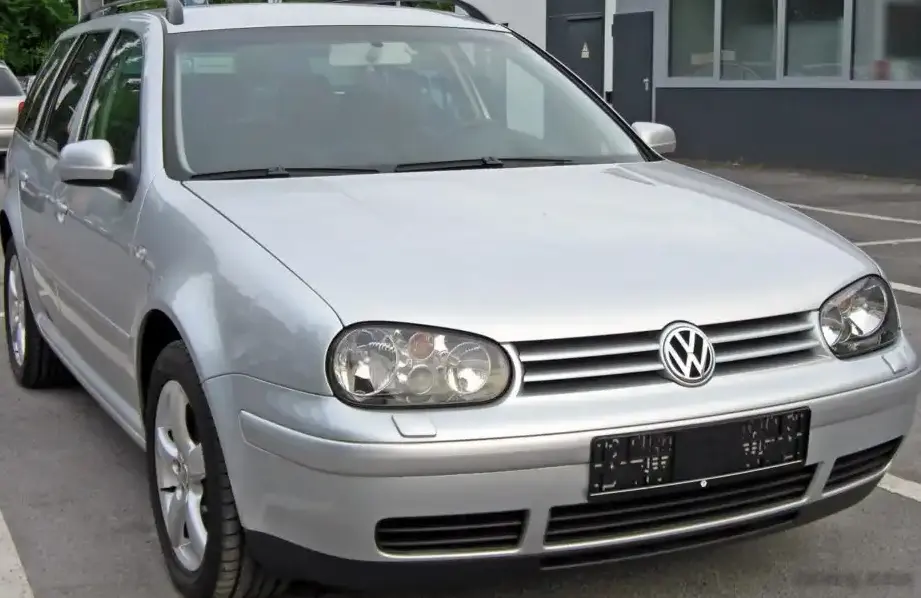
The Volkswagen Golf IV Variant 1.9 TDI (130 hp) was a popular iteration of the fourth-generation Golf estate, produced between April 2001 and May 2006. Positioned as a practical and fuel-efficient option within the Golf IV lineup, it catered to buyers seeking the versatility of a station wagon with the renowned economy of Volkswagen’s direct-injection diesel technology. This variant occupied a middle ground in the Golf IV range, offering a balance between performance and running costs, slotting below the more powerful petrol engines and above the base-level diesel models. It was built on the 1HX0/A3 platform, sharing its underpinnings with other Volkswagen Group vehicles like the Audi A3, SEAT Leon, and Skoda Octavia.
Technical Specifications
| Brand | Volkswagen |
| Model | Golf |
| Generation | Golf IV Variant |
| Type (Engine) | 1.9 TDI (130 Hp) |
| Start of production | April, 2001 |
| End of production | May, 2006 |
| Powertrain Architecture | Internal Combustion engine |
| Body type | Station wagon (estate) |
| Seats | 5 |
| Doors | 5 |
| Fuel Type | Diesel |
| Acceleration 0 – 100 km/h | 10.5 sec |
| Acceleration 0 – 62 mph | 10.5 sec |
| Acceleration 0 – 60 mph | 10 sec |
| Maximum speed | 205 km/h (127.38 mph) |
| Weight-to-power ratio | 10.4 kg/Hp, 96 Hp/tonne |
| Weight-to-torque ratio | 4.4 kg/Nm, 229 Nm/tonne |
| Power | 130 Hp @ 4000 rpm |
| Power per litre | 68.6 Hp/l |
| Torque | 310 Nm @ 1900 rpm (228.64 lb.-ft. @ 1900 rpm) |
| Engine layout | Front, Transverse |
| Engine Model/Code | ASZ |
| Engine displacement | 1896 cm3 (115.7 cu. in.) |
| Number of cylinders | 4 |
| Engine configuration | Inline |
| Cylinder Bore | 79.5 mm (3.13 in.) |
| Piston Stroke | 95.5 mm (3.76 in.) |
| Compression ratio | 19:1 |
| Number of valves per cylinder | 2 |
| Fuel injection system | Pump-nozzle (Unit Injector) |
| Engine aspiration | Turbocharger, Intercooler |
| Valvetrain | OHC |
| Engine oil capacity | 4.5 l (4.76 US qt | 3.96 UK qt) |
| Coolant | 6 l (6.34 US qt | 5.28 UK qt) |
| Kerb Weight | 1354 kg (2985.06 lbs) |
| Max. weight | 1920 kg (4232.88 lbs) |
| Max load | 566 kg (1247.82 lbs) |
| Trunk (boot) space – minimum | 460 l (16.24 cu. ft.) |
| Trunk (boot) space – maximum | 1470 l (51.91 cu. ft.) |
| Fuel tank capacity | 55 l (14.53 US gal | 12.1 UK gal) |
| Length | 4397 mm (173.11 in.) |
| Width | 1735 mm (68.31 in.) |
| Height | 1485 mm (58.46 in.) |
| Wheelbase | 2515 mm (99.02 in.) |
| Front track | 1513 mm (59.57 in.) |
| Rear (Back) track | 1494 mm (58.82 in.) |
| Drivetrain Architecture | The Internal combustion engine (ICE) drives the front wheels of the vehicle. |
| Drive wheel | Front wheel drive |
| Number of gears and type of gearbox | 6 gears, manual transmission |
| Front suspension | Spring Strut |
| Rear suspension | Coil spring |
| Front brakes | Ventilated discs |
| Rear brakes | Disc |
| Assisting systems | ABS (Anti-lock braking system) |
| Steering type | Steering rack and pinion |
| Power steering | Hydraulic Steering |
| Tires size | 195/65 R15 V |
| Wheel rims size | 6J x 15 |
Powertrain & Engine Architecture
At the heart of the Golf IV Variant 1.9 TDI (130 hp) lies the ASZ engine code, a 1.9-liter inline-four cylinder diesel engine. This engine was a further refinement of Volkswagen’s well-regarded TDI series, known for its robust construction and fuel efficiency. The ASZ featured a pump-nozzle (unit injector) fuel injection system, a technology that allowed for precise fuel delivery and optimized combustion. This system, while complex, contributed to the engine’s strong torque output and relatively low emissions for its time. The engine also incorporated a turbocharger with an intercooler, boosting power output to 130 horsepower and 310 Nm (228.64 lb-ft) of torque. The six-speed manual transmission was standard, providing a good balance of acceleration and fuel economy. The engine’s overhead camshaft (OHC) configuration simplified the valvetrain, contributing to its reliability. The ASZ engine was a direct evolution of earlier 1.9 TDI engines, benefitting from improvements in turbocharger technology and fuel injection mapping.
Driving Characteristics
The 1.9 TDI (130 hp) Golf IV Variant offered a distinctly different driving experience compared to its petrol-powered siblings. While not as outright quick as the 1.8T or VR6 models, it provided ample torque from low engine speeds, making it a relaxed and effortless cruiser. The six-speed manual transmission allowed drivers to keep the engine in its optimal power band, resulting in strong acceleration in everyday driving situations. The gear ratios were well-chosen for both highway cruising and city driving. Compared to the 100 hp version of the 1.9 TDI, the 130 hp variant offered a noticeable improvement in performance, particularly when fully loaded or tackling inclines. However, it didn’t possess the sporty character of the higher-output petrol engines. The steering was precise, and the suspension provided a comfortable ride, even on rough roads. The increased torque also made overtaking maneuvers easier and safer.
Equipment & Trim Levels
The Golf IV Variant 1.9 TDI (130 hp) typically came equipped with a reasonable level of standard features. These included central locking, electric front windows, power steering, and an anti-lock braking system (ABS). Interior upholstery was usually cloth, with a functional and durable design. Optional extras included alloy wheels, a sunroof, climate control, and a CD stereo system. Trim levels varied depending on the market, but generally, this variant was positioned as a mid-range offering, bridging the gap between the basic models and the more luxurious trims. Higher trim levels might include features like automatic climate control, upgraded audio systems, and leather upholstery. The Golf IV Variant’s interior was known for its ergonomic design and build quality.
Chassis & Braking
The Golf IV Variant’s chassis was a well-engineered platform, providing a comfortable ride and predictable handling. The front suspension utilized a spring strut setup, while the rear employed a coil spring arrangement. The braking system featured ventilated discs on the front wheels and solid discs on the rear, providing adequate stopping power for the vehicle’s weight. The 1.9 TDI models generally had a slightly heavier front end compared to the petrol versions, which could be noticeable during spirited driving. Stabilizer bars were fitted to both the front and rear axles to reduce body roll. The suspension tuning prioritized comfort and stability over outright sportiness, making it a suitable platform for long-distance driving and carrying passengers or cargo.
Market Reception & Comparison
The Golf IV Variant 1.9 TDI (130 hp) was well-received by automotive critics and buyers alike. It was praised for its fuel efficiency, practicality, and comfortable ride. Compared to the petrol-powered Golf IVs, the TDI offered significantly better fuel economy, making it an attractive option for high-mileage drivers. Against other diesel estate cars of the time, the Golf IV Variant stood out for its refined engine, well-appointed interior, and overall build quality. However, some critics noted that the TDI engine could be slightly noisy compared to its petrol counterparts. The 1.9 TDI offered a compelling alternative to larger, more expensive estate cars, providing a good balance of space, economy, and practicality.
Legacy
The 1.9 TDI engine, particularly the ASZ variant, has earned a reputation for its durability and reliability. Many examples have surpassed 200,000 miles with proper maintenance. In the used car market today, the Golf IV Variant 1.9 TDI (130 hp) remains a popular choice for buyers seeking a practical, economical, and reliable estate car. While age and mileage are factors to consider, well-maintained examples can still provide years of dependable service. The engine’s robust construction and readily available parts contribute to its continued appeal. The Golf IV TDI’s enduring popularity is a testament to Volkswagen’s engineering prowess and the engine’s inherent reliability. It remains a sought-after vehicle for those prioritizing fuel efficiency and practicality.