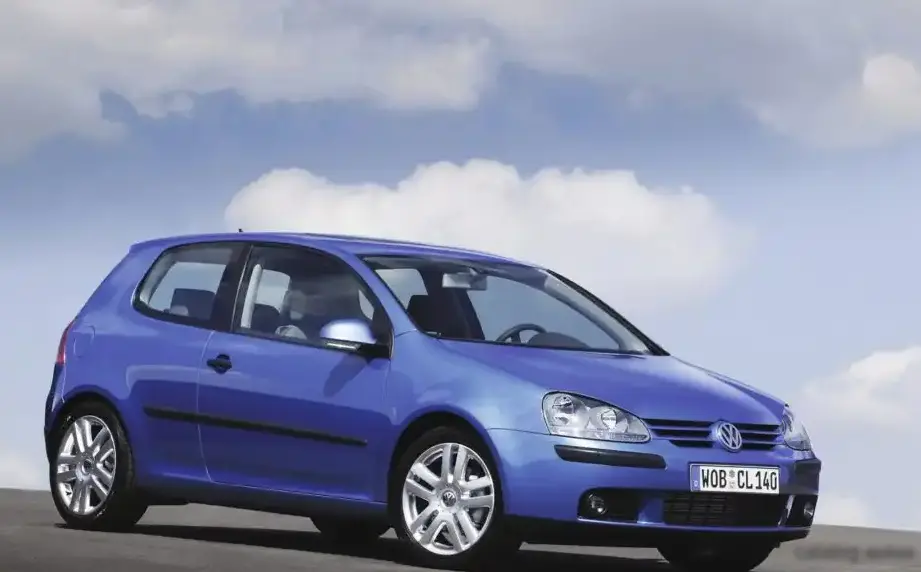
The Volkswagen Golf Mk5, produced between 2003 and 2009, represented a significant leap forward for the iconic hatchback. The 3-door variant, introduced as a more sporty and youthful option, offered a compelling package for European buyers. Among the various engine and transmission combinations available, the 1.9 TDI (105 hp) with a Direct-Shift Gearbox (DSG) – offered from 2006 to 2008 – occupied a crucial position as a fuel-efficient, practical, and relatively affordable choice within the Golf V lineup. This variant aimed to balance everyday usability with the performance benefits of a diesel engine and the convenience of an automatic transmission.
Technical Specifications
| Brand | Volkswagen |
| Model | Golf |
| Generation | Golf V (3-door) |
| Type (Engine) | 1.9 TDI (105 Hp) DPF DSG |
| Start of production | 2006 |
| End of production | 2008 |
| Powertrain Architecture | Internal Combustion engine |
| Body type | Hatchback |
| Seats | 5 |
| Doors | 3 |
| Fuel consumption (urban) | 7.7 l/100 km (30.5 US mpg, 36.7 UK mpg, 13 km/l) |
| Fuel consumption (extra urban) | 5 l/100 km (47 US mpg, 56.5 UK mpg, 20 km/l) |
| Fuel consumption (combined) | 5.9 l/100 km (39.9 US mpg, 47.9 UK mpg, 16.9 km/l) |
| CO2 emissions | 156 g/km |
| Fuel Type | Diesel |
| Acceleration 0 – 100 km/h | 11.2 sec |
| Acceleration 0 – 62 mph | 11.2 sec |
| Acceleration 0 – 60 mph | 10.6 sec |
| Maximum speed | 185 km/h (114.95 mph) |
| Emission standard | Euro 4 |
| Weight-to-power ratio | 12.4 kg/Hp, 80.7 Hp/tonne |
| Weight-to-torque ratio | 5.2 kg/Nm, 192.2 Nm/tonne |
| Power | 105 Hp @ 4000 rpm |
| Power per litre | 55.4 Hp/l |
| Torque | 250 Nm @ 1900 rpm (184.39 lb.-ft. @ 1900 rpm) |
| Engine layout | Front, Transverse |
| Engine Model/Code | EA188 / BLS |
| Engine displacement | 1896 cm3 (115.7 cu. in.) |
| Number of cylinders | 4 |
| Engine configuration | Inline |
| Cylinder Bore | 79.5 mm (3.13 in.) |
| Piston Stroke | 95.5 mm (3.76 in.) |
| Compression ratio | 19:1 |
| Number of valves per cylinder | 2 |
| Fuel injection system | Pump-nozzle (Unit Injector) |
| Engine aspiration | Turbocharger, Intercooler |
| Valvetrain | SOHC |
| Engine oil capacity | 4.3 l (4.54 US qt | 3.78 UK qt) |
| Coolant | 8 l (8.45 US qt | 7.04 UK qt) |
| Kerb Weight | 1301 kg (2868.21 lbs.) |
| Max. weight | 1920 kg (4232.88 lbs.) |
| Max load | 619 kg (1364.66 lbs.) |
| Trunk (boot) space – minimum | 350 l (12.36 cu. ft.) |
| Trunk (boot) space – maximum | 1305 l (46.09 cu. ft.) |
| Fuel tank capacity | 55 l (14.53 US gal | 12.1 UK gal) |
| Max. roof load | 75 kg (165.35 lbs.) |
| Permitted trailer load with brakes (8%) | 1700 kg (3747.86 lbs.) |
| Permitted trailer load with brakes (12%) | 1400 kg (3086.47 lbs.) |
| Permitted trailer load without brakes | 680 kg (1499.14 lbs.) |
| Permitted towbar download | 75 kg (165.35 lbs.) |
| Length | 4204 mm (165.51 in.) |
| Width | 1759 mm (69.25 in.) |
| Width including mirrors | 2010 mm (79.13 in.) |
| Height | 1485 mm (58.46 in.) |
| Wheelbase | 2578 mm (101.5 in.) |
| Front track | 1539 mm (60.59 in.) |
| Rear track | 1528 mm (60.16 in.) |
| Front overhang | 880 mm (34.65 in.) |
| Rear overhang | 746 mm (29.37 in.) |
| Minimum turning circle | 10.9 m (35.76 ft.) |
| Front suspension | Independent, McPherson with coil spring and anti-roll bar |
| Rear suspension | Independent multi-link spring suspension with stabilizer |
| Front brakes | Ventilated discs |
| Rear brakes | Disc |
| Gearbox | 6 gears, automatic transmission DSG |
INTRODUCTION
The Golf Mk5 1.9 TDI 105 hp DSG, produced from 2006-2008, was a popular choice in the European market. Positioned as a mid-range offering, it slotted between the lower-powered base models and the more expensive, higher-performance variants like the GTI. Built on the 1HX0/A3 platform, this Golf aimed to provide a balance of economy, practicality, and driving enjoyment. The inclusion of the DSG transmission was a key selling point, offering smoother gear changes and improved fuel efficiency compared to a traditional automatic.
Powertrain & Engine Architecture
At the heart of this Golf variant lies the EA188 engine family, specifically the 1.9-liter (1896 cc) inline-four cylinder diesel engine, designated BLS. This engine utilized a pump-nozzle (unit injector) fuel injection system, a technology known for its precision and efficiency. A turbocharger with an intercooler was employed to boost power output, delivering 105 horsepower at 4000 rpm and 250 Nm (184 lb-ft) of torque at a low 1900 rpm. The engine featured a single overhead camshaft (SOHC) valvetrain with two valves per cylinder. The DSG (Direct-Shift Gearbox) is a six-speed dual-clutch transmission. It operates like two manual gearboxes in one, allowing for quick and seamless gear changes without the torque interruption of a traditional automatic. This contributes to both improved acceleration and fuel economy.
Driving Characteristics
The 1.9 TDI 105 hp DSG offered a comfortable and refined driving experience. While not overtly sporty, the engine provided ample torque for everyday driving situations, making overtaking and merging onto highways relatively effortless. The DSG transmission contributed to smooth acceleration and minimized gear hunting. Compared to the manual transmission versions, the DSG offered greater convenience, particularly in urban traffic. However, it didn’t quite match the responsiveness of the manual, and the higher-output TDI variants (like the 140 hp or 170 hp models) provided significantly more exhilarating performance. The gear ratios were tuned for fuel efficiency and everyday usability, rather than outright speed.
Equipment & Trim Levels
The Golf Mk5 1.9 TDI 105 hp DSG typically came equipped with a reasonable level of standard features. These included power windows, central locking, air conditioning, and an integrated radio/CD player. Interior upholstery was generally cloth, with options for upgraded materials available. Trim levels varied depending on the market, but common options included alloy wheels, a multi-function steering wheel, and parking sensors. Higher trim levels might also include features like automatic climate control, rain-sensing wipers, and a more advanced audio system.
Chassis & Braking
The Golf Mk5 featured an independent suspension setup on both the front and rear axles. The front utilized a McPherson strut design with coil springs and an anti-roll bar, while the rear employed a multi-link suspension system, also with a stabilizer bar. This configuration provided a good balance of ride comfort and handling. Braking duties were handled by ventilated discs on the front wheels and solid discs on the rear. Anti-lock Braking System (ABS) was standard, enhancing safety and control during emergency braking situations.
Market Reception & Comparison
The Golf Mk5 1.9 TDI 105 hp DSG was generally well-received by automotive critics. It was praised for its fuel efficiency, comfortable ride, and the convenience of the DSG transmission. However, some reviewers noted that the engine lacked the outright performance of the more powerful TDI variants. Compared to the 1.6-liter gasoline models, the 1.9 TDI offered significantly better fuel economy and torque, making it a more practical choice for long-distance driving. Against the higher-powered TDI models, it represented a more affordable entry point into the Golf range, albeit with a compromise in performance.
Legacy
The 1.9 TDI engine, particularly in its BLS guise, proved to be a robust and reliable unit. While diesel engines are inherently more complex than their gasoline counterparts, the EA188 series generally held up well over time. The DSG transmission, while requiring more diligent maintenance (regular fluid changes are crucial), also proved to be durable. Today, these Golfs can be found in the used car market at relatively affordable prices. They remain a popular choice for those seeking a fuel-efficient, practical, and reasonably reliable hatchback. However, potential buyers should be aware of the importance of maintaining the DSG transmission and checking for signs of wear and tear on the turbocharger.