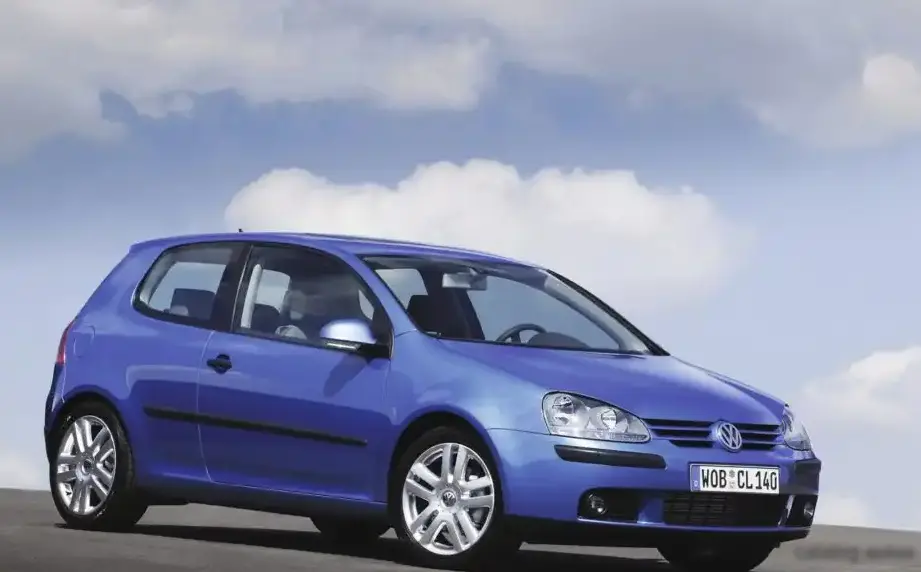
The Volkswagen Golf Mk5, produced from late 2003 through 2009, represented a significant leap forward for Volkswagen’s iconic hatchback. Introduced as a 3-door and 5-door variant, the Mk5 Golf (internally designated the 1HX0/A3 platform) aimed to address criticisms of its predecessor with improved build quality, refinement, and technology. Among the engine options available, the 1.9 TDI with 105 horsepower and a 6-speed manual transmission occupied an important position as a fuel-efficient and practical choice, particularly in European markets. This variant was offered from January 2004 to August 2008.
Technical Specifications
| Brand | Volkswagen |
| Model | Golf |
| Generation | Golf V (3-door) |
| Type (Engine) | 1.9 TDI (105 Hp) Manual 6-speed |
| Start of production | January, 2004 |
| End of production | August, 2008 |
| Powertrain Architecture | Internal Combustion engine |
| Body type | Hatchback |
| Seats | 5 |
| Doors | 3 |
| Fuel consumption (urban) | 6.8-7 l/100 km (34.6 – 33.6 US mpg, 41.5 – 40.4 UK mpg, 14.7 – 14.3 km/l) |
| Fuel consumption (extra urban) | 4.4-4.7 l/100 km (53.5 – 50 US mpg, 64.2 – 60.1 UK mpg, 22.7 – 21.3 km/l) |
| Fuel consumption (combined) | 5.2-5.5 l/100 km (45.2 – 42.8 US mpg, 54.3 – 51.4 UK mpg, 19.2 – 18.2 km/l) |
| CO2 emissions | 140-149 g/km |
| Fuel Type | Diesel |
| Acceleration 0 – 100 km/h | 11.1 sec |
| Acceleration 0 – 62 mph | 11.1 sec |
| Acceleration 0 – 60 mph | 10.5 sec |
| Maximum speed | 187 km/h (116.2 mph) |
| Emission standard | Euro 4 |
| Weight-to-power ratio | 11.9 kg/Hp, 83.9 Hp/tonne |
| Weight-to-torque ratio | 5 kg/Nm, 199.8 Nm/tonne |
| Power | 105 Hp @ 4000 rpm |
| Power per litre | 55.4 Hp/l |
| Torque | 250 Nm @ 1900 rpm (184.39 lb.-ft. @ 1900 rpm) |
| Engine layout | Front, Transverse |
| Engine Model/Code | EA188 / BJB, BKC, BXE |
| Engine displacement | 1896 cm3 (115.7 cu. in.) |
| Number of cylinders | 4 |
| Engine configuration | Inline |
| Cylinder Bore | 79.5 mm (3.13 in.) |
| Piston Stroke | 95.5 mm (3.76 in.) |
| Compression ratio | 19:1 |
| Number of valves per cylinder | 2 |
| Fuel injection system | Pump-nozzle (Unit Injector) |
| Engine aspiration | Turbocharger, Intercooler |
| Valvetrain | SOHC |
| Engine oil capacity | 3.8 l (4.02 US qt | 3.34 UK qt) |
| Coolant | 8 l (8.45 US qt | 7.04 UK qt) |
| Kerb Weight | 1251-1425 kg (2757.98 – 3141.59 lbs.) |
| Max. weight | 1850 kg (4078.55 lbs.) |
| Max load | 425-599 kg (936.96 – 1320.57 lbs.) |
| Trunk (boot) space – minimum | 350 l (12.36 cu. ft.) |
| Trunk (boot) space – maximum | 1305 l (46.09 cu. ft.) |
| Fuel tank capacity | 55 l (14.53 US gal | 12.1 UK gal) |
| Max. roof load | 75 kg (165.35 lbs.) |
| Permitted trailer load with brakes (8%) | 1700 kg (3747.86 lbs.) |
| Permitted trailer load with brakes (12%) | 1400 kg (3086.47 lbs.) |
| Permitted trailer load without brakes | 660 kg (1455.05 lbs.) |
| Permitted towbar download | 75 kg (165.35 lbs.) |
| Length | 4204 mm (165.51 in.) |
| Width | 1759 mm (69.25 in.) |
| Width including mirrors | 2010 mm (79.13 in.) |
| Height | 1485 mm (58.46 in.) |
| Wheelbase | 2578 mm (101.5 in.) |
| Front track | 1539 mm (60.59 in.) |
| Rear track | 1528 mm (60.16 in.) |
| Front overhang | 880 mm (34.65 in.) |
| Rear overhang | 746 mm (29.37 in.) |
| Minimum turning circle | 10.9 m (35.76 ft.) |
| Front suspension | Independent, type McPherson with coil spring and anti-roll bar |
| Rear suspension | Independent multi-link spring suspension with stabilizer |
| Front brakes | Ventilated discs |
| Rear brakes | Disc |
| Assisting systems | ABS (Anti-lock braking system) |
| Steering type | Steering rack and pinion |
| Power steering | Electric |
| Tires size | 195/65 R15; 205/55 R16; 225/45 R17 |
| Wheel rims size | 6J x 15; 6.5J x 15; 6.5J x 16; 7J x 17 |
| Drivetrain | Front wheel drive |
| Number of gears and type of gearbox | 6 gears, manual transmission |
INTRODUCTION
The Golf Mk5 1.9 TDI 105 hp represented a sweet spot in the lineup for buyers prioritizing fuel economy and practicality. Positioned below the more powerful TDI variants (like the 170 hp version) and the petrol-powered models, it served as an entry-level diesel option. It was a popular choice in Europe, where diesel fuel was more affordable and government incentives favored lower-emission vehicles. The 3-door body style further appealed to those seeking a sportier aesthetic and slightly reduced weight compared to the 5-door model.
Powertrain & Engine Architecture
At the heart of this Golf variant lies the Volkswagen EA188 engine family, specifically the 1.9-liter inline-four cylinder diesel engine. Engine codes commonly associated with this output are BJB, BKC, and BXE. This engine utilized a pump-nozzle (unit injector) fuel injection system, a technology known for its precision and efficiency. The engine featured a single overhead camshaft (SOHC) operating two valves per cylinder. A turbocharger with an intercooler was employed to boost power and torque, delivering 250 Nm (184.39 lb-ft) of torque at a relatively low 1900 rpm. The 6-speed manual transmission provided a good balance between fuel efficiency and driver control. The transmission’s gear ratios were optimized for both city driving and highway cruising, allowing the engine to operate within its peak efficiency range.
Driving Characteristics
The 105 hp 1.9 TDI Golf Mk5 wasn’t designed for outright speed. Acceleration from 0-60 mph took around 10.5 seconds, and top speed was limited to 116.2 mph. However, the engine’s strong low-end torque made it feel surprisingly responsive in everyday driving situations. The 6-speed gearbox allowed for comfortable highway cruising, while the relatively short gearing provided adequate acceleration for merging and overtaking. Compared to the more powerful TDI variants, this version felt less stressed at higher speeds, potentially contributing to improved long-term reliability. Compared to the petrol engines, the TDI offered significantly better fuel economy and a more relaxed driving experience, albeit with slightly more engine noise and vibration.
Equipment & Trim Levels
The Golf Mk5 1.9 TDI 105 hp typically came equipped with a reasonable level of standard features. These included central locking, electric front windows, power steering, and an ABS anti-lock braking system. Interior upholstery was typically cloth, with a functional and straightforward dashboard layout. Optional extras included alloy wheels, air conditioning, a CD stereo system, and parking sensors. Higher trim levels, such as ‘Trendline’ or ‘Comfortline’, added features like climate control, upgraded upholstery, and additional safety equipment.
Chassis & Braking
The Golf Mk5 featured an independent suspension setup, with McPherson struts at the front and a multi-link system at the rear. This provided a good balance between ride comfort and handling. The front brakes were ventilated discs, while the rear brakes were solid discs. The suspension was tuned to prioritize comfort and stability, rather than outright sportiness. Stabilizer bars were fitted to both the front and rear axles to reduce body roll during cornering. The weight distribution was generally well-balanced, contributing to predictable handling characteristics.
Market Reception & Comparison
The Golf Mk5 1.9 TDI 105 hp was generally well-received by automotive critics. It was praised for its fuel efficiency, practicality, and comfortable ride. However, some reviewers noted that the engine could feel underpowered when fully loaded or driving uphill. Compared to the 170 hp TDI variant, this version offered significantly lower running costs but lacked the same level of performance. Against petrol-powered Golfs, the TDI provided superior fuel economy and torque, making it a more appealing option for drivers covering long distances. Reliability was generally good, although the pump-nozzle injection system could be prone to issues if not properly maintained.
Legacy
The 1.9 TDI engine, in various iterations, proved to be a remarkably durable and reliable powerplant. The Golf Mk5 1.9 TDI 105 hp continues to be a popular choice in the used car market, particularly for those seeking an affordable and fuel-efficient hatchback. While modern diesel technology has advanced significantly, the Mk5 TDI remains a capable and practical vehicle. Regular maintenance, including oil changes and fuel filter replacements, is crucial to ensure the longevity of the pump-nozzle injection system. The Golf Mk5 1.9 TDI represents a significant chapter in Volkswagen’s history, demonstrating the brand’s commitment to producing high-quality, efficient, and reliable vehicles.