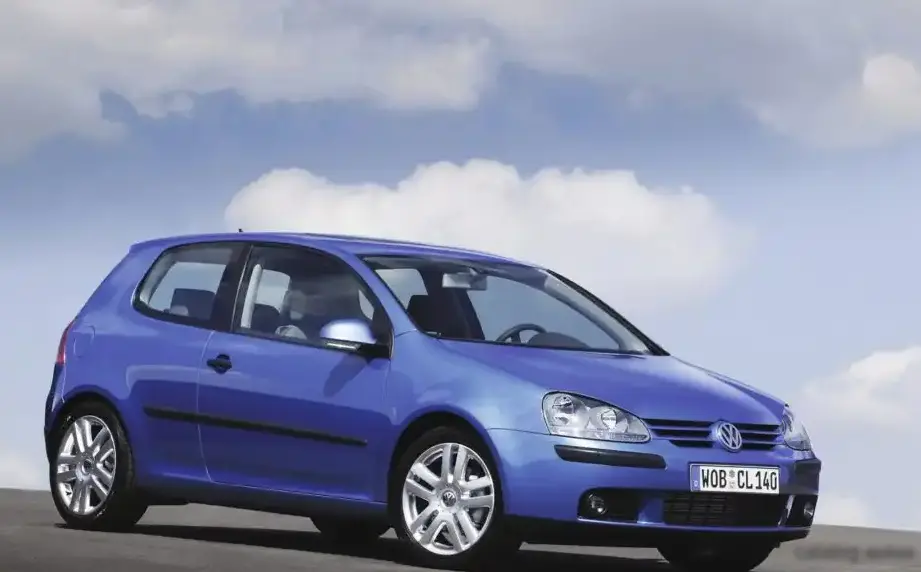
The Volkswagen Golf V, produced from late 2003 through 2009, represented a significant evolution for Volkswagen’s iconic hatchback. The three-door variant, particularly the 2.0 TDI 8V (140 hp) model with a manual transmission, occupied a key position in the European market as a fuel-efficient and practical choice for drivers seeking a balance between performance and economy. Introduced in December 2004 and continuing through 2008, this specific configuration aimed to provide a more refined driving experience than the base petrol engines while remaining more accessible than the higher-performance GTI or diesel variants. It was built on the A5 platform (internally designated 1HX0 for the three-door).
Technical Specifications
| Brand | Volkswagen |
| Model | Golf |
| Generation | Golf V (3-door) |
| Type (Engine) | 2.0 TDI 8V (140 Hp) DPF |
| Start of production | December, 2004 |
| End of production | 2008 |
| Powertrain Architecture | Internal Combustion engine |
| Body type | Hatchback |
| Seats | 5 |
| Doors | 3 |
| Fuel consumption (urban) | 6.9-7.1 l/100 km (34.1 – 33.1 US mpg, 40.9 – 39.8 UK mpg, 14.5 – 14.1 km/l) |
| Fuel consumption (extra urban) | 4.7-4.9 l/100 km (50 – 48 US mpg, 60.1 – 57.6 UK mpg, 21.3 – 20.4 km/l) |
| Fuel consumption (combined) | 5.5-5.7 l/100 km (42.8 – 41.3 US mpg, 51.4 – 49.6 UK mpg, 18.2 – 17.5 km/l) |
| CO2 emissions | 149-154 g/km |
| Fuel Type | Diesel |
| Acceleration 0 – 100 km/h | 9.3 sec |
| Acceleration 0 – 62 mph | 9.3 sec |
| Acceleration 0 – 60 mph | 8.8 sec |
| Maximum speed | 205 km/h (127.38 mph) |
| Emission standard | Euro 4 |
| Weight-to-power ratio | 9.2 kg/Hp, 109.3 Hp/tonne |
| Weight-to-torque ratio | 4 kg/Nm, 249.8 Nm/tonne |
| Power | 140 Hp @ 4000 rpm |
| Power per litre | 71.1 Hp/l |
| Torque | 320 Nm @ 1750-2500 rpm (236.02 lb.-ft. @ 1750-2500 rpm) |
| Engine layout | Front, Transverse |
| Engine Model/Code | EA188 / BMM |
| Engine displacement | 1968 cm3 (120.09 cu. in.) |
| Number of cylinders | 4 |
| Engine configuration | Inline |
| Cylinder Bore | 81 mm (3.19 in.) |
| Piston Stroke | 95.5 mm (3.76 in.) |
| Compression ratio | 18.5:1 |
| Number of valves per cylinder | 2 |
| Fuel injection system | Pump-nozzle (Unit Injector) |
| Engine aspiration | Turbocharger, Intercooler |
| Valvetrain | SOHC |
| Engine oil capacity | 3.8 l (4.02 US qt | 3.34 UK qt) |
| Coolant capacity | 8 l (8.45 US qt | 7.04 UK qt) |
| Kerb Weight | 1281-1451 kg (2824.12 – 3198.91 lbs.) |
| Max. weight | 1870 kg (4122.64 lbs.) |
| Max load | 419-589 kg (923.74 – 1298.52 lbs.) |
| Trunk (boot) space – minimum | 350 l (12.36 cu. ft.) |
| Trunk (boot) space – maximum | 1305 l (46.09 cu. ft.) |
| Fuel tank capacity | 55 l (14.53 US gal | 12.1 UK gal) |
| Max. roof load | 75 kg (165.35 lbs.) |
| Permitted trailer load with brakes (8%) | 1700 kg (3747.86 lbs.) |
| Permitted trailer load with brakes (12%) | 1500 kg (3306.93 lbs.) |
| Permitted trailer load without brakes | 670 kg (1477.1 lbs.) |
| Permitted towbar download | 75 kg (165.35 lbs.) |
| Length | 4204 mm (165.51 in.) |
| Width | 1759 mm (69.25 in.) |
| Width including mirrors | 2010 mm (79.13 in.) |
| Height | 1485 mm (58.46 in.) |
| Wheelbase | 2578 mm (101.5 in.) |
| Front track | 1539 mm (60.59 in.) |
| Rear track | 1528 mm (60.16 in.) |
| Front overhang | 880 mm (34.65 in.) |
| Rear overhang | 746 mm (29.37 in.) |
| Minimum turning circle | 10.9 m (35.76 ft.) |
| Drivetrain Architecture | The Internal combustion engine (ICE) drives the front wheels. |
| Drive wheel | Front wheel drive |
| Number of gears | 6 gears, manual transmission |
| Front suspension | Independent, type McPherson with coil spring and anti-roll bar |
| Rear suspension | Independent multi-link spring suspension with stabilizer |
| Front brakes | Ventilated discs |
| Rear brakes | Disc |
| Assisting systems | ABS (Anti-lock braking system) |
| Steering type | Steering rack and pinion |
| Power steering | Electric Steering |
| Tires size | 195/65 R15; 205/55 R16; 225/45 R17 |
| Wheel rims size | 6J x 15; 6.5J x 15; 6.5J x 16; 7J x 17 |
INTRODUCTION
The Golf V 2.0 TDI 8V, produced between 2004 and 2008, was a mainstay of the Volkswagen lineup in Europe. It represented a move towards more efficient diesel technology, offering a compelling alternative to petrol-powered models. This three-door hatchback was positioned as a practical and economical choice for individuals and small families, offering a good balance between running costs and everyday usability. The “8V” designation refers to the eight valves per cylinder in the engine, while the “DPF” indicates the inclusion of a diesel particulate filter to meet increasingly stringent emissions regulations. This variant sat below the more powerful TDI models (like the 170hp version) and above the entry-level petrol engines in terms of both price and performance.
Powertrain & Engine Architecture
At the heart of the Golf V 2.0 TDI was the EA188 engine family, specifically the BMM code. This 1968cc inline-four cylinder diesel engine utilized pump-nozzle (unit injector) technology for precise fuel delivery. This system, while effective, was known for being more mechanically complex than later common-rail diesel systems. The engine featured a single overhead camshaft (SOHC) operating two valves per cylinder. A turbocharger with an intercooler was employed to boost power and torque, delivering 140 horsepower at 4000 rpm and a substantial 320 Nm (236 lb-ft) of torque between 1750 and 2500 rpm. The engine’s high compression ratio of 18.5:1 contributed to its efficiency. The standard transmission was a six-speed manual gearbox, providing a good spread of ratios for both fuel economy and performance.
Driving Characteristics
The 2.0 TDI 8V offered a distinctly different driving experience compared to the higher-output TDI variants or the petrol-powered Golfs. While not overtly sporty, the engine provided ample torque for everyday driving, making overtaking and merging onto highways relatively effortless. The six-speed manual transmission allowed drivers to keep the engine in its optimal power band. Acceleration from 0-100 km/h (0-62 mph) took around 9.3 seconds, which was respectable for a diesel hatchback of this era. The focus was more on fuel efficiency and relaxed cruising than outright performance. The gear ratios were tuned for economy, with a relatively long final drive. Compared to the 170hp TDI, the 140hp version felt less responsive at higher engine speeds, but offered better fuel economy.
Equipment & Trim Levels
The Golf V 2.0 TDI 8V was typically equipped with a reasonable level of standard features. This included central locking, electric front windows, power steering, and an ABS anti-lock braking system. Interior upholstery was usually cloth, with a functional and durable design. Depending on the specific market and optional packages, features like air conditioning, alloy wheels, a CD stereo system, and front fog lights were available. Higher trim levels, such as ‘Trendline’ or ‘Comfortline’, added additional features like climate control, upgraded upholstery, and parking sensors. The dashboard layout was typical of the Golf V, with a clear and straightforward instrument cluster.
Chassis & Braking
The Golf V utilized an independent suspension setup, with a McPherson strut front suspension and a multi-link rear suspension. This provided a good balance between ride comfort and handling. Stabilizer bars were fitted to both the front and rear axles to reduce body roll during cornering. The braking system consisted of ventilated discs on the front wheels and solid discs on the rear. ABS was standard, providing enhanced braking performance in emergency situations. The suspension tuning was geared towards comfort and everyday usability, rather than outright sportiness. The weight distribution was relatively balanced, contributing to predictable handling characteristics.
Market Reception & Comparison
The Golf V 2.0 TDI 8V was generally well-received by automotive critics. It was praised for its fuel efficiency, comfortable ride, and practical interior. However, some reviewers noted that the engine could be somewhat noisy and that the pump-nozzle fuel injection system was more prone to issues than later common-rail systems. Compared to the more powerful TDI variants, the 140hp version offered a more affordable entry point into the diesel Golf range, but at the expense of some performance. Fuel economy was a key selling point, with combined figures ranging from 5.5 to 5.7 liters per 100 kilometers (42.8 to 41.3 US mpg).
Legacy
The Golf V 2.0 TDI 8V remains a relatively common sight on European roads today. While the pump-nozzle fuel injection system can require specialized maintenance, the engine is generally considered to be durable if properly cared for. These models are often sought after as affordable and economical used cars. The Golf V’s reputation for reliability and practicality has helped to maintain its value in the used car market. However, potential buyers should be aware of the potential for issues with the DPF (diesel particulate filter) and the fuel injection system, and ensure that regular maintenance has been performed.