Technical Specifications
| Brand | Volkswagen |
| Model | Golf |
| Generation | Golf V (3-door) |
| Type (Engine) | GTI 2.0 TFSI (200 Hp) DSG |
| Start of production | 2004 |
| End of production | 2008 |
| Powertrain Architecture | Internal Combustion engine |
| Body type | Hatchback |
| Seats | 5 |
| Doors | 3 |
| Fuel consumption (urban) | 10.7-11 l/100 km (22 – 21.4 US mpg) |
| Fuel consumption (extra urban) | 6.2-6.3 l/100 km (37.9 – 37.3 US mpg) |
| Fuel consumption (combined) | 7.9-8.2 l/100 km (29.8 – 28.7 US mpg) |
| CO2 emissions | 190-197 g/km |
| Fuel Type | Petrol (Gasoline) |
| Acceleration 0 – 100 km/h | 6.9 sec |
| Acceleration 0 – 62 mph | 6.9 sec |
| Acceleration 0 – 60 mph | 6.6 sec |
| Maximum speed | 233 km/h (144.78 mph) |
| Emission standard | Euro 4 |
| Weight-to-power ratio | 6.7 kg/Hp |
| Weight-to-torque ratio | 4.8 kg/Nm |
| Power | 200 Hp @ 5100 rpm |
| Torque | 280 Nm @ 1800-5000 rpm (206.52 lb.-ft. @ 1800-5000 rpm) |
| Engine layout | Front, Transverse |
| Engine Model/Code | BWA |
| Engine displacement | 1984 cm3 (121.07 cu. in.) |
| Number of cylinders | 4 |
| Engine configuration | Inline |
| Cylinder Bore | 82.5 mm (3.25 in.) |
| Piston Stroke | 92.8 mm (3.65 in.) |
| Compression ratio | 10.3:1 |
| Number of valves per cylinder | 4 |
| Fuel injection system | Direct injection |
| Engine aspiration | Turbocharger, Intercooler |
| Valvetrain | DOHC |
| Engine oil capacity | 4.6 l (4.86 US qt | 4.05 UK qt) |
| Coolant | 8 l (8.45 US qt | 7.04 UK qt) |
| Kerb Weight | 1347-1447 kg (2969.63 – 3190.09 lbs.) |
| Max. weight | 1880 kg (4144.69 lbs.) |
| Max load | 433-533 kg (954.6 – 1175.06 lbs.) |
| Trunk (boot) space – minimum | 350 l (12.36 cu. ft.) |
| Trunk (boot) space – maximum | 1305 l (46.09 cu. ft.) |
| Fuel tank capacity | 55 l (14.53 US gal | 12.1 UK gal) |
| Max. roof load | 75 kg (165.35 lbs.) |
| Permitted trailer load with brakes (8%) | 1700 kg (3747.86 lbs.) |
| Permitted trailer load with brakes (12%) | 1400 kg (3086.47 lbs.) |
| Permitted trailer load without brakes | 710 kg (1565.28 lbs.) |
| Permitted towbar download | 75 kg (165.35 lbs.) |
| Length | 4216 mm (165.98 in.) |
| Width | 1759 mm (69.25 in.) |
| Width including mirrors | 2010 mm (79.13 in.) |
| Height | 1469 mm (57.83 in.) |
| Wheelbase | 2578 mm (101.5 in.) |
| Front track | 1534 mm (60.39 in.) |
| Rear track | 1516 mm (59.69 in.) |
| Minimum turning circle | 10.9 m (35.76 ft.) |
| Drivetrain Architecture | Front wheel drive |
| Number of gears and type of gearbox | 6 gears, automatic transmission DSG |
| Front suspension | Independent, type McPherson with coil spring and anti-roll bar |
| Rear suspension | Independent multi-link spring suspension with stabilizer |
| Front brakes | Ventilated discs |
| Rear brakes | Disc |
| Assisting systems | ABS (Anti-lock braking system) |
| Steering type | Steering rack and pinion |
| Power steering | Electric Steering |
| Tires size | 225/45 R17; 225/40 R18 |
| Wheel rims size | 7.5J X 17; 7.5J x 18 |
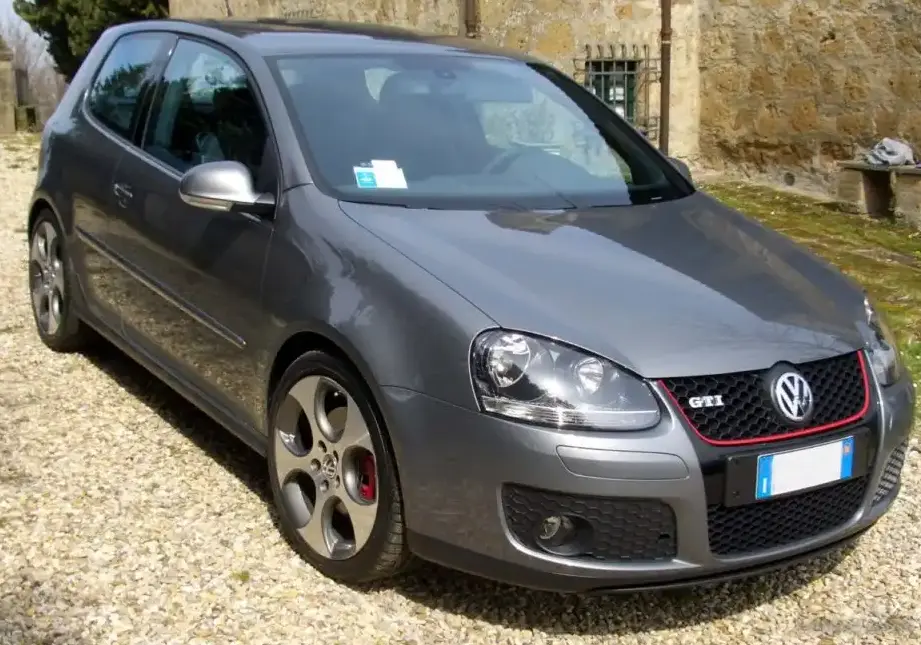
The Golf V GTI 2.0 TFSI DSG, launched in 2004, was a pivotal model in the Golf lineage. Built on the A5 platform (internally designated 1HX0/A3), it represented a move towards more sophisticated engine technology and transmission options. The GTI variant, in particular, was designed to appeal to drivers seeking a sporty and refined hatchback experience. The 2.0 TFSI engine, coupled with the DSG gearbox, offered a compelling combination of performance and efficiency, making it a popular choice in Europe and a relatively rare sight in the United States.
Powertrain & Engine Architecture
At the heart of the Golf V GTI was the 2.0-liter turbocharged four-cylinder engine, identified by the engine code BWA. This engine featured direct fuel injection (FSI), a technology that allowed for precise fuel delivery and improved combustion efficiency. The engine produced 200 horsepower at 5,100 rpm and 280 Nm (206.52 lb-ft) of torque between 1,800 and 5,000 rpm. The turbocharger, combined with an intercooler, boosted power output significantly. The engine utilized a double overhead camshaft (DOHC) valvetrain with four valves per cylinder.
The DSG (Direct-Shift Gearbox) was a crucial component of this variant. This six-speed automatic transmission offered the convenience of an automatic with the efficiency and responsiveness of a manual. It essentially consisted of two separate manual gearboxes within one housing, allowing for incredibly fast and smooth gear changes. The DSG’s programming was tuned for performance, holding gears longer and downshifting quickly to maximize acceleration.
Driving Characteristics
The 2.0 TFSI DSG Golf V GTI delivered a noticeably different driving experience compared to lower-powered Golf models or even the earlier GTI iterations. The turbocharger provided a surge of power in the mid-range, making overtaking and highway merging effortless. While not as raw or visceral as a manual transmission, the DSG offered incredibly quick shifts, contributing to a 0-60 mph time of around 6.6 seconds and a top speed of 144.78 mph. The automatic transmission smoothed out power delivery, making it more accessible for everyday driving. Compared to the later, more powerful GTI editions, this 200 hp version offered a more balanced and manageable power output, appealing to drivers who prioritized usability alongside performance.
Equipment & Trim Levels
The GTI trim level came standard with a number of features designed to enhance both the driving experience and the overall comfort. These included sport seats upholstered in the classic GTI plaid fabric, a leather-wrapped steering wheel, and aluminum pedal caps. Standard exterior features included a unique GTI front bumper with a honeycomb grille, side skirts, and a rear spoiler. Optional extras included sunroof, upgraded audio systems, and parking sensors. The interior dashboard featured a distinctive GTI-specific instrument cluster with red accents.
Chassis & Braking
The Golf V GTI featured an independent suspension system on both the front and rear axles. The front suspension utilized McPherson struts with coil springs and an anti-roll bar, while the rear employed a multi-link setup, also with a stabilizer bar. This configuration provided a good balance between ride comfort and handling precision. Braking duties were handled by ventilated discs on the front wheels and solid discs on the rear. ABS (Anti-lock Braking System) was standard, enhancing safety and control during hard braking situations.
Market Reception & Comparison
The Golf V GTI 2.0 TFSI DSG was generally well-received by automotive critics. It was praised for its strong performance, refined handling, and comfortable interior. However, some reviewers noted that the DSG transmission, while quick, lacked the engagement of a traditional manual gearbox. Compared to other Golf V variants, such as the base models with smaller engines, the GTI offered a significant performance upgrade. Against competitors like the Ford Focus ST and Opel/Vauxhall Astra OPC, the Golf GTI was often seen as a more well-rounded and refined option, though some rivals offered a more aggressive driving experience.
Legacy
The BWA engine and DSG transmission combination proved to be relatively reliable, although preventative maintenance is crucial. Common issues include carbon buildup on the intake valves (a characteristic of direct injection engines) and potential wear and tear on the DSG’s mechatronic unit. Today, the Golf V GTI 2.0 TFSI DSG holds a respectable position in the used car market. Its blend of performance, practicality, and relatively modern features makes it an appealing option for enthusiasts seeking an affordable hot hatch. The model is often viewed as a sweet spot in the Golf GTI lineage, offering a good balance between classic GTI character and contemporary technology.