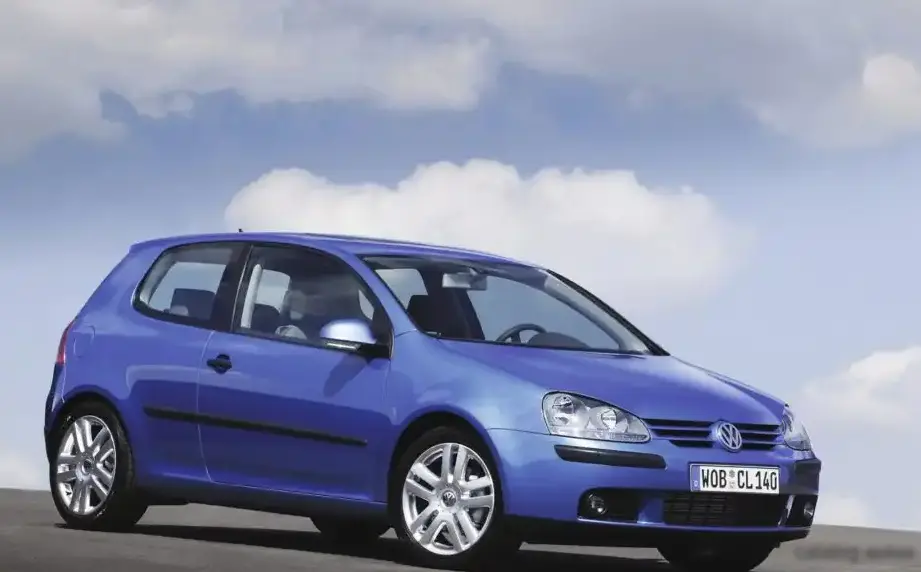
The Volkswagen Golf V R32, produced between 2005 and 2008, represents the high-performance pinnacle of the Golf Mk5 range. Available exclusively as a 3-door hatchback, the R32 distinguished itself with a potent 3.2-liter VR6 engine, a sophisticated 4MOTION all-wheel-drive system, and the availability of Volkswagen’s Direct-Shift Gearbox (DSG) automatic transmission. This variant was positioned as the premium, enthusiast-focused offering within the Golf V lineup, catering to drivers seeking a blend of everyday practicality and exhilarating performance. It served as the flagship model, sitting above trims like the GTI and the standard Golf models in terms of both price and capability.
Technical Specifications
| Brand | Volkswagen |
| Model | Golf |
| Generation | Golf V (3-door) |
| Type (Engine) | R32 3.2 V6 (250 Hp) 4MOTION DSG |
| Start of production | 2005 |
| End of production | 2008 |
| Powertrain Architecture | Internal Combustion engine |
| Body type | Hatchback |
| Seats | 5 |
| Doors | 3 |
| Fuel consumption (economy) – urban (NEDC) | 13.1-13.2 l/100 km (18 – 17.8 US mpg, 21.6 – 21.4 UK mpg, 7.6 – 7.6 km/l) |
| Fuel consumption (economy) – extra urban (NEDC) | 7.7-7.8 l/100 km (30.5 – 30.2 US mpg, 36.7 – 36.2 UK mpg, 13 – 12.8 km/l) |
| Fuel consumption (economy) – combined (NEDC) | 9.7-9.8 l/100 km (24.2 – 24 US mpg, 29.1 – 28.8 UK mpg, 10.3 – 10.2 km/l) |
| CO2 emissions (NEDC) | 231-235 g/km |
| Fuel Type | Petrol (Gasoline) |
| Acceleration 0 – 100 km/h | 6.2 sec |
| Acceleration 0 – 62 mph | 6.2 sec |
| Acceleration 0 – 60 mph | 5.9 sec |
| Maximum speed | 248 km/h (154.1 mph) |
| Emission standard | Euro 4 |
| Weight-to-power ratio | 6.2 kg/Hp, 162.5 Hp/tonne |
| Weight-to-torque ratio | 4.8 kg/Nm, 208.1 Nm/tonne |
| Power | 250 Hp @ 6300 rpm |
| Torque | 320 Nm @ 2800-3000 rpm (236.02 lb.-ft. @ 2800-3000 rpm) |
| Engine layout | Front, Transverse |
| Engine Model/Code | BUB, CBRA |
| Engine displacement | 3189 cm3 (194.6 cu. in.) |
| Number of cylinders | 6 |
| Engine configuration | VR-engine |
| Cylinder Bore | 84 mm (3.31 in.) |
| Piston Stroke | 95.9 mm (3.78 in.) |
| Compression ratio | 10.9:1 |
| Number of valves per cylinder | 4 |
| Fuel injection system | Multi-port manifold injection |
| Engine aspiration | Naturally aspirated engine |
| Valvetrain | DOHC |
| Engine oil capacity | 5.5 l (5.81 US qt | 4.84 UK qt) |
| Coolant | 9 l (9.51 US qt | 7.92 UK qt) |
| Kerb Weight | 1538-1617 kg (3390.71 – 3564.87 lbs.) |
| Max. weight | 2070 kg (4563.57 lbs.) |
| Max load | 453-532 kg (998.69 – 1172.86 lbs.) |
| Trunk (boot) space – minimum | 275 l (9.71 cu. ft.) |
| Trunk (boot) space – maximum | 1230 l (43.44 cu. ft.) |
| Fuel tank capacity | 60 l (15.85 US gal | 13.2 UK gal) |
| Max. roof load | 75 kg (165.35 lbs.) |
| Length | 4246 mm (167.17 in.) |
| Width | 1759 mm (69.25 in.) |
| Width including mirrors | 2010 mm (79.13 in.) |
| Height | 1465 mm (57.68 in.) |
| Wheelbase | 2578 mm (101.5 in.) |
| Front track | 1535 mm (60.43 in.) |
| Rear (Back) track | 1515 mm (59.65 in.) |
| Minimum turning circle | 10.9 m (35.76 ft.) |
| Drivetrain Architecture | All wheel drive (4×4). ICE drives front wheels, rear driven by clutch. |
| Drive wheel | All wheel drive (4×4) |
| Number of gears and type of gearbox | 6 gears, automatic transmission DSG |
| Front suspension | Independent, McPherson with coil spring and anti-roll bar |
| Rear suspension | Independent multi-link spring suspension with stabilizer |
| Front brakes | Ventilated discs |
| Rear brakes | Disc |
| Assisting systems | ABS (Anti-lock braking system) |
| Steering type | Steering rack and pinion |
| Power steering | Electric Steering |
| Tires size | 225/40 R18 |
| Wheel rims size | 7.5J x 18 |
INTRODUCTION
The Volkswagen Golf V R32, launched in 2005, was the performance flagship of the Mk5 Golf range. Built until 2008, it represented a significant step up in both power and handling compared to the Golf GTI. The R32 was conceived as a more focused, driver-oriented machine, leveraging Volkswagen’s 4MOTION all-wheel-drive system and a unique VR6 engine configuration. It was primarily sold in Europe, though limited numbers found their way to other markets. The “R32” designation harkens back to Volkswagen’s earlier high-performance Golf models, continuing a tradition of potent, all-weather performance.
Powertrain & Engine Architecture
The heart of the Golf V R32 is the 3.2-liter VR6 engine, identified by engine codes BUB and CBRA. This engine is a narrow-angle V6, meaning the cylinder banks are very closely spaced, resulting in a more compact engine than a traditional V6. It features multi-port fuel injection and a double overhead camshaft (DOHC) valvetrain. The VR6 produces 250 horsepower at 6300 rpm and 320 Nm (236 lb-ft) of torque between 2800 and 3000 rpm. The engine’s unique firing order contributes to a distinctive exhaust note. The R32 was primarily offered with Volkswagen’s 6-speed DSG (Direct-Shift Gearbox) dual-clutch automatic transmission. This transmission provides incredibly fast and smooth gear changes, enhancing both acceleration and driving enjoyment. A 6-speed manual transmission was available in some markets, but the DSG was the more common choice.
Driving Characteristics
The Golf V R32 delivers a noticeably different driving experience compared to other Golf V variants. The 3.2-liter VR6 provides strong, linear power delivery throughout the rev range, making it responsive in various driving situations. The DSG transmission contributes to quick acceleration, with 0-60 mph times around 5.9 seconds. The 4MOTION all-wheel-drive system provides excellent traction, particularly in inclement weather or on challenging road surfaces. Compared to the front-wheel-drive GTI, the R32 exhibits significantly reduced understeer and a more neutral handling balance. The gear ratios in the DSG transmission are optimized for performance, allowing the engine to stay within its power band during acceleration. While not as overtly aggressive as some dedicated sports cars, the R32 offers a refined and engaging driving experience.
Equipment & Trim Levels
The R32 came generously equipped as standard. Interior features typically included sport seats upholstered in a unique “Kevlar” fabric, a leather-wrapped steering wheel, and aluminum pedal caps. The dashboard featured distinctive R32 badging and a sportier appearance than lower trims. Standard equipment also included automatic climate control, a premium audio system, and alloy wheels. Optional extras included navigation systems, sunroofs, and bi-xenon headlights. The overall interior ambiance was focused on providing a sporty yet comfortable environment.
Chassis & Braking
The R32’s chassis was specifically tuned to handle the increased power and all-wheel-drive system. It featured a stiffer suspension setup compared to standard Golf V models, with upgraded shock absorbers and springs. The front suspension utilized a McPherson strut design, while the rear employed a multi-link setup. Braking duties were handled by ventilated disc brakes on all four wheels, providing ample stopping power. The R32 also benefited from ABS (Anti-lock Braking System) as standard equipment. Stabilizer bars were thicker than those found on lower trims, further reducing body roll during cornering.
Market Reception & Comparison
The Golf V R32 was generally well-received by automotive critics. It was praised for its potent engine, all-wheel-drive traction, and refined driving experience. However, some reviewers noted its relatively high price compared to the GTI and other performance hatchbacks. Compared to the Golf GTI, the R32 offered significantly more power and all-wheel drive, but at a higher cost and with slightly increased weight. The R32’s fuel economy was also lower than that of the GTI, reflecting the larger engine displacement. Compared to other all-wheel-drive performance cars of the era, such as the Subaru Impreza WRX, the R32 offered a more refined and comfortable driving experience, but with slightly less outright performance.
Legacy
The Golf V R32 remains a sought-after vehicle among enthusiasts today. Its combination of performance, practicality, and all-weather capability has made it a popular choice in the used car market. The VR6 engine, while known for requiring regular maintenance, is generally considered reliable when properly cared for. The DSG transmission, if maintained with regular fluid changes, is also relatively durable. However, potential buyers should be aware of the potential for oil leaks and other age-related issues common to European performance cars of this era. The Golf V R32 represents a high point in Volkswagen’s performance heritage, offering a unique and engaging driving experience that continues to appeal to enthusiasts.