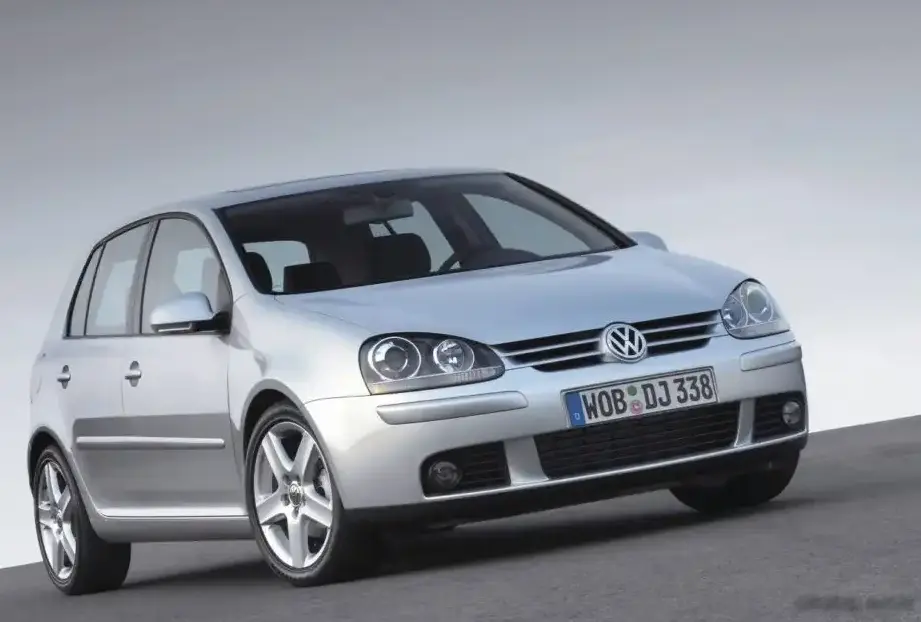
The Volkswagen Golf V, produced from 2003 to 2008, represented a significant evolution for Volkswagen’s iconic hatchback. Within the Golf V range, the 1.6-liter (102 hp) automatic variant occupied an important position as an entry-level offering, particularly in European markets. This model aimed to provide accessible Golf ownership with a focus on comfort and ease of use, rather than outright performance. It was positioned below the more powerful 1.9 TDI diesel and 2.0 FSI petrol variants, and above the base 1.4-liter engine option. The Golf V chassis code is 1HX0/A3.
Technical Specifications
| Brand | Volkswagen |
| Model | Golf |
| Generation | Golf V (5-door) |
| Type (Engine) | 1.6 (102 Hp) Automatic |
| Start of production | 2003 |
| End of production | 2008 |
| Powertrain Architecture | Internal Combustion engine |
| Body type | Hatchback |
| Seats | 5 |
| Doors | 5 |
| Fuel consumption (urban) | 11.3-11.4 l/100 km (20.8 – 20.6 US mpg) |
| Fuel consumption (extra urban) | 6.4-6.5 l/100 km (36.8 – 36.2 US mpg) |
| Fuel consumption (combined) | 8.2-8.3 l/100 km (28.7 – 28.3 US mpg) |
| CO2 emissions | 197-199 g/km |
| Fuel Type | Petrol (Gasoline) |
| Acceleration 0 – 100 km/h | 12.5 sec |
| Acceleration 0 – 62 mph | 12.5 sec |
| Acceleration 0 – 60 mph | 11.9 sec |
| Maximum speed | 181 km/h (112.47 mph) |
| Emission standard | Euro 4 |
| Weight-to-power ratio | 12.2 kg/Hp |
| Weight-to-torque ratio | 8.4 kg/Nm |
| Power | 102 Hp @ 5600 rpm |
| Torque | 148 Nm @ 3800 rpm (109.16 lb.-ft. @ 3800 rpm) |
| Engine layout | Front, Transverse |
| Engine Model/Code | BGU, BSE, BSF |
| Engine displacement | 1595 cm3 (97.33 cu. in.) |
| Number of cylinders | 4 |
| Engine configuration | Inline |
| Cylinder Bore | 81 mm (3.19 in.) |
| Piston Stroke | 77.4 mm (3.05 in.) |
| Compression ratio | 10.5:1 |
| Number of valves per cylinder | 2 |
| Fuel injection system | Multi-port manifold injection |
| Engine aspiration | Naturally aspirated |
| Valvetrain | SOHC |
| Engine oil capacity | 4.5 l (4.76 US qt | 3.96 UK qt) |
| Coolant capacity | 8 l (8.45 US qt | 7.04 UK qt) |
| Kerb Weight | 1246 kg (2746.96 lbs.) |
| Max. weight | 1790 kg (3946.27 lbs.) |
| Max load | 544 kg (1199.31 lbs.) |
| Trunk (boot) space – minimum | 350 l (12.36 cu. ft.) |
| Trunk (boot) space – maximum | 1305 l (46.09 cu. ft.) |
| Fuel tank capacity | 55 l (14.53 US gal | 12.1 UK gal) |
| Max. roof load | 75 kg (165.35 lbs.) |
| Permitted trailer load with brakes (8%) | 1500 kg (3306.93 lbs.) |
| Permitted trailer load with brakes (12%) | 1200 kg (2645.55 lbs.) |
| Permitted trailer load without brakes | 640 kg (1410.96 lbs.) |
| Permitted towbar download | 75 kg (165.35 lbs.) |
| Length | 4204 mm (165.51 in.) |
| Width | 1759 mm (69.25 in.) |
| Width including mirrors | 2010 mm (79.13 in.) |
| Height | 1485 mm (58.46 in.) |
| Wheelbase | 2578 mm (101.5 in.) |
| Front track | 1539 mm (60.59 in.) |
| Rear track | 1528 mm (60.16 in.) |
| Front overhang | 880 mm (34.65 in.) |
| Rear overhang | 746 mm (29.37 in.) |
| Minimum turning circle | 10.9 m (35.76 ft.) |
| Drivetrain | Front wheel drive |
| Number of gears | 6 |
| Gearbox type | Automatic transmission |
| Front suspension | Independent, McPherson with coil spring and anti-roll bar |
| Rear suspension | Independent multi-link with stabilizer |
| Front brakes | Ventilated discs |
| Rear brakes | Disc |
| Assisting systems | ABS |
| Steering type | Steering rack and pinion |
| Power steering | Electric |
| Tires size | 195/65 R15; 205/55 R16; 225/45 R17 |
| Wheel rims size | 6J x 15; 6.5J x 15; 6.5J x 16; 7J x 17 |
INTRODUCTION
The Volkswagen Golf V, launched in 2003, marked a significant step forward for the Golf lineage. It moved the compact hatchback into a more refined and sophisticated territory, addressing criticisms of the previous generation’s build quality and ride comfort. The 1.6-liter automatic variant, powered by engine codes BGU, BSE, or BSF, was a key component of this strategy, offering a balance of affordability and usability. This version was particularly popular in Europe, where smaller displacement engines and automatic transmissions were favored by buyers seeking a comfortable daily driver.
Powertrain & Engine Architecture
The heart of this Golf V variant is the 1.6-liter inline-four cylinder petrol engine. This engine, part of Volkswagen’s EA827 family, utilizes a naturally aspirated configuration with a single overhead camshaft (SOHC) operating two valves per cylinder. Fuel delivery is managed by a multi-port fuel injection system, providing adequate, though not exceptional, performance. The engine produces 102 horsepower at 5600 rpm and 148 Nm (109.16 lb-ft) of torque at 3800 rpm. The engine’s relatively simple design contributes to its generally good reliability. Paired with this engine is a six-speed automatic transmission. This transmission, while offering smooth shifts, isn’t known for its sportiness or particularly quick response. It prioritizes comfort and ease of driving over dynamic performance.
Driving Characteristics
The 1.6-liter automatic Golf V delivers a comfortable, if uninspiring, driving experience. Acceleration from 0-60 mph takes around 11.9 seconds, and top speed is limited to 112.47 mph. The automatic transmission’s gear ratios are tuned for fuel efficiency and smooth cruising, rather than aggressive acceleration. Compared to the manual transmission version of the same engine, the automatic suffers a slight performance penalty due to the transmission’s inherent losses. It also feels noticeably slower than the more powerful Golf V variants, such as the 2.0 FSI or the 1.9 TDI. However, for everyday commuting and urban driving, the 1.6-liter automatic provides sufficient power and a relaxed driving experience.
Equipment & Trim Levels
The 1.6-liter automatic Golf V typically came equipped with a reasonable level of standard features. These generally included central locking, electric front windows, power steering, and an ABS anti-lock braking system. Interior upholstery was typically cloth, and the dashboard featured a functional, if somewhat understated, design. Optional extras included alloy wheels, air conditioning, a CD stereo system, and parking sensors. Higher trim levels, such as Trendline or Comfortline, added features like climate control, upgraded upholstery, and additional safety equipment.
Chassis & Braking
The Golf V’s chassis features independent suspension all around – a McPherson strut setup at the front and a multi-link arrangement at the rear. This provides a good balance of ride comfort and handling. The 1.6-liter automatic variant typically used ventilated disc brakes at the front and solid disc brakes at the rear. The braking system is adequate for the car’s performance, but it isn’t particularly powerful. Stabilizer bars are fitted to both the front and rear axles to reduce body roll during cornering.
Market Reception & Comparison
The 1.6-liter automatic Golf V was generally well-received as a practical and affordable option. Critics praised its comfortable ride and ease of use, but noted its lack of outright performance. Compared to the 1.9 TDI, the 1.6-liter petrol engine offered less torque and lower fuel economy. However, the petrol engine was quieter and smoother, and it didn’t require the more expensive diesel fuel. Against the 2.0 FSI, the 1.6-liter was significantly less powerful, but also more affordable to purchase and insure. The automatic transmission was seen as a positive for drivers prioritizing convenience, but it was criticized by some for its lack of responsiveness.
Legacy
The 1.6-liter automatic Golf V has proven to be a relatively reliable vehicle, with the engine and transmission generally holding up well over time. However, like all cars of this age, it is susceptible to wear and tear. Common issues include oil leaks, worn suspension components, and electrical problems. In the used car market, the 1.6-liter automatic Golf V remains a popular choice for budget-conscious buyers seeking a practical and dependable hatchback. Its affordability, combined with Volkswagen’s reputation for build quality, makes it a compelling option for those looking for a used car that won’t break the bank.