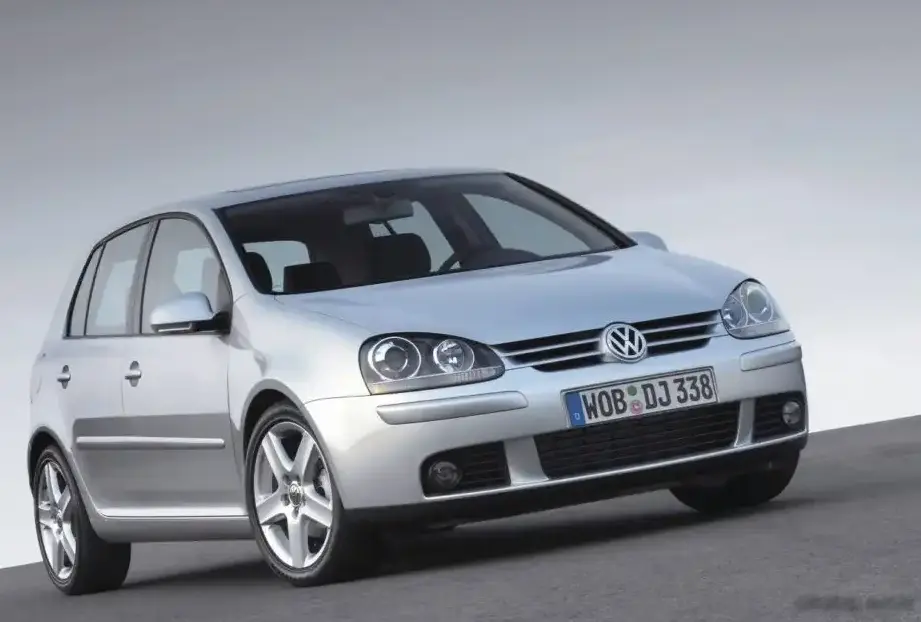
The Volkswagen Golf V, produced from 2003 to 2009, represented a significant leap forward for the iconic hatchback. The 5-door variant, in particular, became a mainstay in the European market, offering a practical and refined option for families and commuters. Among the engine options available, the 2.0 FSI (150 hp) stood out as a compelling mid-range choice, balancing performance with reasonable fuel economy. This version was sold from 2004-2008 and utilized Volkswagen’s direct injection technology to deliver a more responsive driving experience than lower-spec engines. It occupied a position between the more economical 1.6L and 1.4L models and the performance-oriented GTI.
Technical Specifications
| Brand | Volkswagen |
| Model | Golf |
| Generation | Golf V (5-door) |
| Type (Engine) | 2.0 FSI (150 Hp) |
| Start of production | 2004 |
| End of production | 2008 |
| Powertrain Architecture | Internal Combustion engine |
| Body type | Hatchback |
| Seats | 5 |
| Doors | 5 |
| Fuel consumption (urban) | 10.6-11 l/100 km (22.2 – 21.4 US mpg) |
| Fuel consumption (extra urban) | 5.9-6.3 l/100 km (39.9 – 37.3 US mpg) |
| Fuel consumption (combined) | 7.6-8 l/100 km (30.9 – 29.4 US mpg) |
| CO2 emissions | 182-192 g/km |
| Fuel Type | Petrol (Gasoline) |
| Acceleration 0 – 100 km/h | 8.8 sec |
| Acceleration 0 – 62 mph | 8.8 sec |
| Acceleration 0 – 60 mph | 8.4 sec |
| Maximum speed | 209 km/h (129.87 mph) |
| Emission standard | Euro 4 |
| Weight-to-power ratio | 8.5 kg/Hp |
| Weight-to-torque ratio | 6.4 kg/Nm |
| Power | 150 Hp @ 6000 rpm |
| Torque | 200 Nm @ 3500 rpm (147.51 lb.-ft. @ 3500 rpm) |
| Engine layout | Front, Transverse |
| Engine Model/Code | AXW, BLR, BLX, BLY, BVX, BVY, BVZ |
| Engine displacement | 1984 cm3 (121.07 cu. in.) |
| Number of cylinders | 4 |
| Engine configuration | Inline |
| Cylinder Bore | 82.5 mm (3.25 in.) |
| Piston Stroke | 92.8 mm (3.65 in.) |
| Compression ratio | 11.5:1 |
| Number of valves per cylinder | 4 |
| Fuel injection system | Direct injection |
| Engine aspiration | Naturally aspirated |
| Valvetrain | DOHC |
| Engine oil capacity | 4.6 l (4.86 US qt | 4.05 UK qt) |
| Coolant capacity | 8 l (8.45 US qt | 7.04 UK qt) |
| Kerb Weight | 1277 kg (2815.3 lbs.) |
| Max. weight | 1810 kg (3990.37 lbs.) |
| Max load | 533 kg (1175.06 lbs.) |
| Trunk (boot) space – minimum | 350 l (12.36 cu. ft.) |
| Trunk (boot) space – maximum | 1305 l (46.09 cu. ft.) |
| Fuel tank capacity | 55 l (14.53 US gal | 12.1 UK gal) |
| Max. roof load | 75 kg (165.35 lbs.) |
| Permitted trailer load (8%) | 1700 kg (3747.86 lbs.) |
| Permitted trailer load (12%) | 1400 kg (3086.47 lbs.) |
| Permitted trailer load (unbraked) | 650 kg (1433 lbs.) |
| Permitted towbar download | 75 kg (165.35 lbs.) |
| Length | 4204 mm (165.51 in.) |
| Width | 1759 mm (69.25 in.) |
| Width including mirrors | 2010 mm (79.13 in.) |
| Height | 1485 mm (58.46 in.) |
| Wheelbase | 2578 mm (101.5 in.) |
| Front track | 1539 mm (60.59 in.) |
| Rear track | 1528 mm (60.16 in.) |
| Front overhang | 880 mm (34.65 in.) |
| Rear overhang | 746 mm (29.37 in.) |
| Minimum turning circle | 10.9 m (35.76 ft.) |
| Front suspension | Independent, McPherson with coil spring and anti-roll bar |
| Rear suspension | Independent multi-link with stabilizer |
| Front brakes | Ventilated discs |
| Rear brakes | Disc |
| Steering type | Steering rack and pinion |
| Power steering | Electric |
| Tires size | 195/65 R15; 205/55 R16; 225/45 R17 |
| Wheel rims size | 6.5J x 15; 6.5J x 16; 7J x 17 |
INTRODUCTION
The Volkswagen Golf V, launched in 2003, marked a significant evolution for Volkswagen’s best-selling model. Built on the A5 platform (internally designated 1HX0), the Golf V aimed to improve upon the already successful Golf IV in terms of refinement, safety, and technology. The 5-door body style quickly became the most popular configuration, offering increased practicality for families. The 2.0 FSI engine, introduced as part of the Golf V range, was a key component in appealing to a broader customer base seeking a balance between performance and economy. This engine was available throughout the production run of the Golf V, from 2004 to 2008.
Powertrain & Engine Architecture
The 2.0 FSI engine, identified by engine codes such as AXW, BLR, BLX, BLY, BVX, BVY, and BVZ, is a naturally aspirated, inline-four cylinder gasoline engine. “FSI” stands for Fuel Stratified Injection, Volkswagen’s direct injection technology. Unlike traditional port fuel injection, FSI injects fuel directly into the combustion chamber, allowing for more precise fuel control, increased compression ratios, and improved thermal efficiency. This engine utilizes a sophisticated Bosch Motronic engine control unit (ECU) to manage fuel delivery and ignition timing. The valvetrain features a dual overhead camshaft (DOHC) design with four valves per cylinder, optimizing airflow for increased power output. The 2.0 FSI was typically paired with a six-speed automatic transmission, offering smooth and efficient gear changes. This transmission was designed to work in harmony with the engine’s torque curve, providing adequate acceleration and comfortable cruising.
Driving Characteristics
The 2.0 FSI automatic Golf V offered a refined and comfortable driving experience. While not as overtly sporty as the GTI, the 150 hp engine provided sufficient power for everyday driving and overtaking maneuvers. The six-speed automatic transmission, while not offering the engagement of a manual gearbox, provided smooth shifts and helped to maximize fuel efficiency. Acceleration from 0-60 mph took approximately 8.4 seconds, and the car had a top speed of around 130 mph. The automatic transmission’s gear ratios were tuned for a balance between acceleration and fuel economy, with taller gearing in higher gears for relaxed highway cruising. Compared to the 1.6L and 1.4L models, the 2.0 FSI offered noticeably more power and responsiveness. However, it didn’t quite match the performance of the GTI or the diesel-powered TDI variants.
Equipment & Trim Levels
The 2.0 FSI automatic typically came equipped as a mid-range trim level. Standard features included air conditioning, power windows, power mirrors, a CD stereo system, and alloy wheels. Higher trim levels offered options such as leather upholstery, a sunroof, automatic climate control, and a premium sound system. Safety features included ABS brakes, front and side airbags, and a seatbelt pre-tensioner system. The interior was generally well-appointed, with a focus on practicality and ergonomics. The dashboard layout was clean and functional, with easy-to-read gauges and intuitive controls.
Chassis & Braking
The Golf V utilized an independent suspension system on both the front and rear axles. The front suspension featured a McPherson strut design with a coil spring and anti-roll bar, while the rear suspension employed a multi-link setup, also with a stabilizer bar. This suspension configuration provided a comfortable ride and good handling characteristics. The 2.0 FSI models were typically equipped with ventilated disc brakes on the front wheels and solid disc brakes on the rear. ABS (Anti-lock Braking System) was standard, enhancing braking performance and stability, especially in adverse conditions.
Market Reception & Comparison
The 2.0 FSI automatic Golf V was generally well-received by automotive critics. It was praised for its refined engine, comfortable ride, and practical interior. However, some critics noted that the automatic transmission could feel slightly sluggish at times. Compared to the 1.6L and 1.4L models, the 2.0 FSI offered a significant improvement in performance, but at a slightly higher price point. The TDI models offered even better fuel economy, but were more expensive to purchase initially. The GTI provided a more engaging driving experience, but was aimed at a different segment of the market.
Legacy
The 2.0 FSI engine, while generally reliable, has been known to exhibit some issues with carbon buildup on the intake valves over time, a common characteristic of direct injection engines. Regular servicing and the use of quality fuel can help to mitigate this issue. Today, the Golf V 2.0 FSI automatic remains a popular choice in the used car market, offering a good balance of practicality, comfort, and performance. Its relatively simple mechanical design and readily available parts make it a relatively affordable car to maintain. The Golf V, and particularly the 2.0 FSI variant, cemented the Golf’s reputation as a versatile and dependable hatchback, continuing a legacy that spans decades.