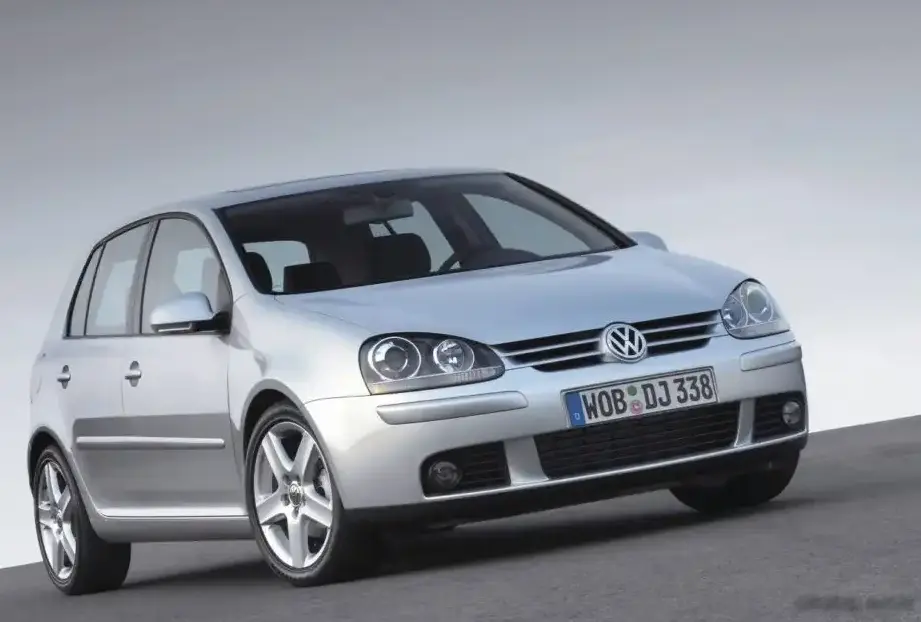
The Volkswagen Golf V, produced from 2003 to 2009, represented a significant leap forward for the iconic hatchback. The 2.0 FSI (150 hp) Automatic variant, available from 2004 to 2008, occupied a mid-range position within the Golf V lineup, offering a blend of performance and convenience aimed at buyers seeking a more refined driving experience than the base models, but without the expense of the high-performance GTI or diesel options. This version was particularly popular in European markets, where automatic transmissions were gaining acceptance, and offered a compelling alternative to competitors like the Ford Focus and Opel Astra.
Technical Specifications
| Brand | Volkswagen |
| Model | Golf |
| Generation | Golf V (5-door) |
| Type (Engine) | 2.0 FSI (150 Hp) Automatic |
| Start of production | 2004 |
| End of production | 2008 |
| Powertrain Architecture | Internal Combustion engine |
| Body type | Hatchback |
| Seats | 5 |
| Doors | 5 |
| Fuel consumption (urban) | 11.7-12 l/100 km (20.1 – 19.6 US mpg) |
| Fuel consumption (extra urban) | 6.3-6.6 l/100 km (37.3 – 35.6 US mpg) |
| Fuel consumption (combined) | 8.3-8.6 l/100 km (28.3 – 27.4 US mpg) |
| CO2 emissions | 199-206 g/km |
| Fuel Type | Petrol (Gasoline) |
| Acceleration 0 – 100 km/h | 9.5 sec |
| Acceleration 0 – 62 mph | 9.5 sec |
| Acceleration 0 – 60 mph | 9 sec |
| Maximum speed | 205 km/h (127.38 mph) |
| Emission standard | Euro 4 |
| Weight-to-power ratio | 8.7 kg/Hp |
| Weight-to-torque ratio | 6.6 kg/Nm |
| Power | 150 Hp @ 6000 rpm |
| Torque | 200 Nm @ 3500 rpm (147.51 lb.-ft. @ 3500 rpm) |
| Engine layout | Front, Transverse |
| Engine Model/Code | AXW, BLR, BLX, BLY, BVX, BVY, BVZ |
| Engine displacement | 1984 cm3 (121.07 cu. in.) |
| Number of cylinders | 4 |
| Engine configuration | Inline |
| Cylinder Bore | 82.5 mm (3.25 in.) |
| Piston Stroke | 92.8 mm (3.65 in.) |
| Compression ratio | 11.5:1 |
| Number of valves per cylinder | 4 |
| Fuel injection system | Direct injection |
| Engine aspiration | Naturally aspirated |
| Valvetrain | DOHC |
| Engine oil capacity | 4.6 l (4.86 US qt | 4.05 UK qt) |
| Coolant capacity | 8 l (8.45 US qt | 7.04 UK qt) |
| Kerb Weight | 1312 kg (2892.46 lbs.) |
| Max. weight | 1840 kg (4056.51 lbs.) |
| Max load | 528 kg (1164.04 lbs.) |
| Trunk (boot) space – minimum | 350 l (12.36 cu. ft.) |
| Trunk (boot) space – maximum | 1305 l (46.09 cu. ft.) |
| Fuel tank capacity | 55 l (14.53 US gal | 12.1 UK gal) |
| Max. roof load | 75 kg (165.35 lbs.) |
| Permitted trailer load with brakes (8%) | 1700 kg (3747.86 lbs.) |
| Permitted trailer load with brakes (12%) | 1400 kg (3086.47 lbs.) |
| Permitted trailer load without brakes | 670 kg (1477.1 lbs.) |
| Permitted towbar download | 75 kg (165.35 lbs.) |
| Length | 4204 mm (165.51 in.) |
| Width | 1759 mm (69.25 in.) |
| Width including mirrors | 2010 mm (79.13 in.) |
| Height | 1485 mm (58.46 in.) |
| Wheelbase | 2578 mm (101.5 in.) |
| Front track | 1539 mm (60.59 in.) |
| Rear track | 1528 mm (60.16 in.) |
| Front overhang | 880 mm (34.65 in.) |
| Rear overhang | 746 mm (29.37 in.) |
| Minimum turning circle | 10.9 m (35.76 ft.) |
| Drivetrain Architecture | Front wheel drive |
| Number of gears and type of gearbox | 6 gears, automatic transmission |
INTRODUCTION
The Golf V, launched in 2003, represented a significant evolution of Volkswagen’s best-selling model. Built on the A5 platform (internally designated 1HX0), it offered increased refinement, improved safety features, and a more sophisticated interior compared to its predecessor. The 2.0 FSI Automatic, introduced mid-cycle, provided a compelling option for buyers prioritizing comfort and ease of use. It slotted between the more economical 1.6L and 1.4L models and the sportier, higher-output 2.0L GTI, appealing to a broad customer base.
Powertrain & Engine Architecture
The heart of the Golf V 2.0 FSI Automatic is the 1984cc inline-four cylinder engine, identified by engine codes such as AXW, BLR, BLX, BLY, BVX, BVY, and BVZ. “FSI” stands for Fuel Stratified Injection, a direct injection system developed by Volkswagen. This system injects fuel directly into the combustion chamber, allowing for more precise fuel control, improved combustion efficiency, and increased power output compared to traditional port fuel injection. The engine features a double overhead camshaft (DOHC) valvetrain with four valves per cylinder, optimizing airflow for enhanced performance. The 6-speed automatic transmission, typically a 6F24A or similar unit, was chosen for its smooth shifting and ability to complement the engine’s torque curve. This transmission featured a torque converter and electronic control for optimized gear selection.
Driving Characteristics
The 150 hp and 200 Nm (147.51 lb-ft) of torque delivered by the 2.0 FSI engine, coupled with the six-speed automatic, provided a comfortable and capable driving experience. Acceleration from 0-60 mph took approximately 9.5 seconds, and the car reached a top speed of 205 km/h (127.38 mph). While not as quick as the GTI, the 2.0 FSI Automatic offered sufficient power for everyday driving and highway cruising. The automatic transmission, while smooth, could sometimes feel hesitant during quick overtaking maneuvers. The gear ratios were tuned for fuel efficiency and relaxed cruising, rather than outright performance. Compared to the manual transmission versions of the same engine, the automatic typically resulted in a slight decrease in fuel economy and a marginally slower 0-60 mph time.
Equipment & Trim Levels
The Golf V 2.0 FSI Automatic typically came equipped with a respectable level of standard features. These included air conditioning, power windows, power mirrors, central locking, and an integrated audio system. Higher trim levels, such as Comfortline and Highline, added features like alloy wheels, a multi-function steering wheel, cruise control, automatic climate control, and upgraded upholstery. Optional extras included a sunroof, parking sensors, and a navigation system. Interior upholstery was typically cloth, with leather options available on higher trims. The dashboard layout was clean and functional, with a focus on ergonomics.
Chassis & Braking
The Golf V utilized an independent suspension system, with McPherson struts at the front and a multi-link setup at the rear. This configuration provided a good balance between ride comfort and handling. Stabilizer bars were fitted to both axles to reduce body roll during cornering. Braking duties were handled by ventilated discs at the front and solid discs at the rear. Anti-lock Braking System (ABS) was standard, enhancing safety and control during emergency braking situations. The chassis was designed to accommodate the increased weight of the engine and transmission, while maintaining the Golf’s characteristic nimble handling.
Market Reception & Comparison
The Golf V 2.0 FSI Automatic received generally positive reviews from automotive critics. It was praised for its refined engine, comfortable ride, and well-appointed interior. However, some critics noted that the automatic transmission could feel sluggish at times, and the fuel economy wasn’t class-leading. Compared to the 1.6L and 1.4L models, the 2.0 FSI Automatic offered significantly more performance. Compared to the GTI, it lacked the same level of sporting prowess but provided a more relaxed and refined driving experience. The 2.0 TDI diesel variant offered superior fuel economy, but at the expense of some refinement and engine noise.
Legacy
The Golf V 2.0 FSI Automatic has proven to be a relatively reliable vehicle, although some common issues have emerged over time. These include potential problems with the coil packs, fuel injectors, and the automatic transmission’s mechatronic unit. Regular maintenance, including oil changes and fluid flushes, is crucial for ensuring long-term reliability. Today, the Golf V 2.0 FSI Automatic remains a popular choice in the used car market, offering a good balance of practicality, comfort, and performance at an affordable price. Its direct injection engine and relatively modern features make it a compelling option for buyers seeking a well-rounded and reliable hatchback.