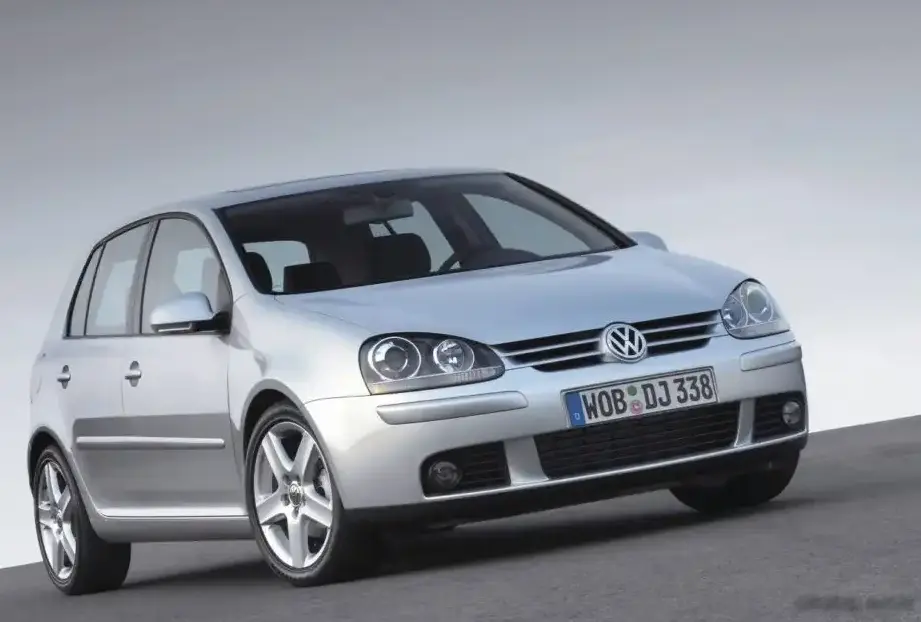
The Volkswagen Golf V, produced from late 2003 through 2009, represented a significant evolution for Volkswagen’s iconic hatchback. The 5-door variant, in particular, became a mainstay in the European market, offering a practical and refined option for families and commuters. Among the various engine and transmission combinations offered, the 2.0 TDI 8V (140 hp) with a six-speed manual transmission occupied a middle ground, balancing fuel efficiency with respectable performance. Production of this specific configuration ran from December 2004 to 2008, becoming a popular choice for those seeking a diesel-powered Golf with a bit more punch than the base models.
Technical Specifications
| Brand | Volkswagen |
| Model | Golf |
| Generation | Golf V (5-door) |
| Type (Engine) | 2.0 TDI 8V (140 Hp) DPF |
| Start of production | December, 2004 |
| End of production | 2008 |
| Powertrain Architecture | Internal Combustion engine |
| Body type | Hatchback |
| Seats | 5 |
| Doors | 5 |
| Fuel consumption (urban) | 6.9-7.1 l/100 km (34.1 – 33.1 US mpg, 40.9 – 39.8 UK mpg, 14.5 – 14.1 km/l) |
| Fuel consumption (extra urban) | 4.7-4.9 l/100 km (50 – 48 US mpg, 60.1 – 57.6 UK mpg, 21.3 – 20.4 km/l) |
| Fuel consumption (combined) | 5.5-5.7 l/100 km (42.8 – 41.3 US mpg, 51.4 – 49.6 UK mpg, 18.2 – 17.5 km/l) |
| CO2 emissions | 149-154 g/km |
| Fuel Type | Diesel |
| Acceleration 0 – 100 km/h | 9.3 sec |
| Acceleration 0 – 62 mph | 9.3 sec |
| Acceleration 0 – 60 mph | 8.8 sec |
| Maximum speed | 205 km/h (127.38 mph) |
| Emission standard | Euro 4 |
| Weight-to-power ratio | 9.4 kg/Hp, 106.4 Hp/tonne |
| Weight-to-torque ratio | 4.1 kg/Nm, 243.2 Nm/tonne |
| Power | 140 Hp @ 4000 rpm |
| Torque | 320 Nm @ 1750-2500 rpm (236.02 lb.-ft. @ 1750-2500 rpm) |
| Engine layout | Front, Transverse |
| Engine Model/Code | EA188 / BMM |
| Engine displacement | 1968 cm3 (120.09 cu. in.) |
| Number of cylinders | 4 |
| Engine configuration | Inline |
| Cylinder Bore | 81 mm (3.19 in.) |
| Piston Stroke | 95.5 mm (3.76 in.) |
| Compression ratio | 18.5:1 |
| Number of valves per cylinder | 2 |
| Fuel injection system | Pump-nozzle (Unit Injector) |
| Engine aspiration | Turbocharger, Intercooler |
| Valvetrain | SOHC |
| Engine oil capacity | 3.8 l (4.02 US qt | 3.34 UK qt) |
| Coolant capacity | 8 l (8.45 US qt | 7.04 UK qt) |
| Kerb Weight | 1316 kg (2901.28 lbs.) |
| Max. weight | 1870 kg (4122.64 lbs.) |
| Max load | 554 kg (1221.36 lbs.) |
| Trunk (boot) space – minimum | 350 l (12.36 cu. ft.) |
| Trunk (boot) space – maximum | 1305 l (46.09 cu. ft.) |
| Fuel tank capacity | 55 l (14.53 US gal | 12.1 UK gal) |
| Max. roof load | 75 kg (165.35 lbs.) |
| Permitted trailer load with brakes (8%) | 1700 kg (3747.86 lbs.) |
| Permitted trailer load with brakes (12%) | 1500 kg (3306.93 lbs.) |
| Permitted trailer load without brakes | 670 kg (1477.1 lbs.) |
| Permitted towbar download | 75 kg (165.35 lbs.) |
| Length | 4204 mm (165.51 in.) |
| Width | 1759 mm (69.25 in.) |
| Width including mirrors | 2010 mm (79.13 in.) |
| Height | 1485 mm (58.46 in.) |
| Wheelbase | 2578 mm (101.5 in.) |
| Front track | 1539 mm (60.59 in.) |
| Rear track | 1528 mm (60.16 in.) |
| Front overhang | 880 mm (34.65 in.) |
| Rear overhang | 746 mm (29.37 in.) |
| Minimum turning circle | 10.9 m (35.76 ft.) |
| Front suspension | Independent, type McPherson with coil spring and anti-roll bar |
| Rear suspension | Independent multi-link spring suspension with stabilizer |
| Front brakes | Ventilated discs |
| Rear brakes | Disc |
| Steering type | Steering rack and pinion |
| Power steering | Electric |
| Tires size | 195/65 R15; 205/55 R16; 225/45 R17 |
| Wheel rims size | 6J x 15; 6.5J x 15; 6.5J x 16; 7J x 17 |
INTRODUCTION
The Golf V, launched in 2003, represented a significant leap forward in terms of build quality and refinement for the Golf lineage. It moved the model into a more premium segment, competing directly with rivals like the Ford Focus and Opel/Vauxhall Astra. The 2.0 TDI 8V (140 hp) variant, equipped with a six-speed manual transmission, was a popular choice, particularly in Europe, where diesel engines held a dominant market share. This engine offered a compelling blend of fuel economy and performance, making it suitable for both daily commuting and longer journeys. It sat comfortably in the mid-range of the Golf V lineup, offering more power and refinement than the entry-level 1.4-liter petrol engines, but at a lower price point than the more powerful 2.0-liter petrol or the higher-output TDI variants.
Powertrain & Engine Architecture
The heart of this Golf V variant is the EA188 series 2.0-liter inline-four diesel engine, specifically the BMM engine code. This engine utilizes a common rail direct injection system, delivering fuel directly into the combustion chamber at extremely high pressure. The BMM engine employed pump-nozzle (unit injector) technology, a precursor to the more modern common rail systems. This system, while effective, was known for being slightly noisier than later common rail designs. The engine features a single overhead camshaft (SOHC) operating two valves per cylinder. A turbocharger with an intercooler is employed to boost power and torque, providing a noticeable increase in performance over naturally aspirated diesel engines. The six-speed manual transmission offered precise shifts and helped to maximize fuel efficiency. The gear ratios were tuned to provide a balance between acceleration and cruising comfort.
Driving Characteristics
The 2.0 TDI 8V (140 hp) Golf V offered a surprisingly capable driving experience. While not a sports car, the engine delivered ample torque from low RPMs, making it easy to accelerate from a standstill or overtake slower traffic. The six-speed manual transmission allowed drivers to keep the engine in its optimal power band. Compared to the 1.9 TDI models, the 2.0 TDI offered a noticeable increase in power and refinement. However, it didn’t quite match the performance of the more powerful 2.0-liter petrol engines, particularly at higher speeds. The suspension provided a comfortable ride, absorbing bumps and imperfections in the road effectively. Steering was precise and well-weighted, providing good feedback to the driver.
Equipment & Trim Levels
The 2.0 TDI 8V (140 hp) Golf V typically came equipped with a reasonable level of standard features. These included air conditioning, power windows, central locking, and an integrated audio system. Higher trim levels, such as Trendline and Comfortline, added features like alloy wheels, a multi-function steering wheel, and upgraded interior trim. Optional extras included a sunroof, leather upholstery, and a navigation system. Safety features such as ABS, traction control, and front airbags were standard across the range.
Chassis & Braking
The Golf V utilized an independent suspension setup on both the front and rear axles. The front suspension employed a McPherson strut design, while the rear featured a multi-link setup. This configuration provided a good balance between ride comfort and handling. Brakes consisted of ventilated discs on the front wheels and solid discs on the rear. ABS (Anti-lock Braking System) was standard, enhancing braking performance and stability. The chassis was well-engineered, providing a solid and stable platform for the car.
Market Reception & Comparison
The 2.0 TDI 8V (140 hp) Golf V was generally well-received by automotive critics. It was praised for its fuel efficiency, comfortable ride, and refined interior. However, some critics noted that the engine could be slightly noisy compared to some of its rivals. Compared to the 1.9 TDI models, the 2.0 TDI offered a noticeable improvement in performance and refinement, but at a slightly higher price. The 2.0-liter petrol engines offered more outright power, but at the expense of fuel economy. The 2.0 TDI struck a good balance between the two, making it a popular choice for those seeking a practical and efficient hatchback.
Legacy
The EA188 2.0 TDI engine, while generally reliable, has been known to exhibit some issues over time, particularly with the diesel particulate filter (DPF) and the turbocharger. Regular maintenance, including oil changes and DPF regeneration, is crucial to ensure long-term reliability. Today, the Golf V 2.0 TDI 8V (140 hp) can be found on the used car market at relatively affordable prices. It remains a popular choice for those seeking a practical and fuel-efficient hatchback, but potential buyers should be aware of the potential maintenance costs associated with a diesel engine of this age.