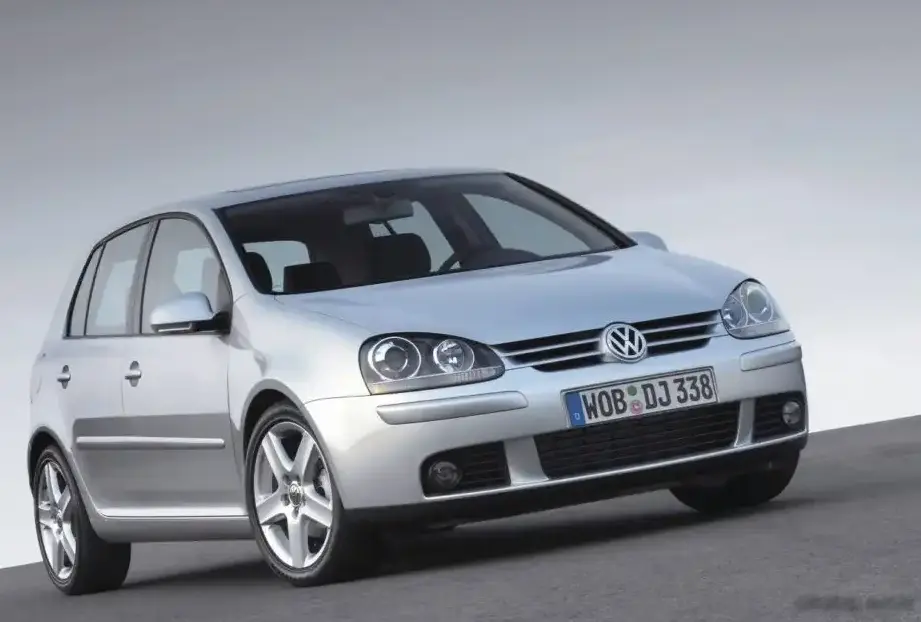
The Volkswagen Golf V R32, produced between 2005 and 2008, represents the pinnacle of performance for the fifth-generation Golf (Mk5) hatchback. Positioned as the flagship model, the R32 combined a potent 3.2-liter VR6 engine with Volkswagen’s 4MOTION all-wheel-drive system and a Direct-Shift Gearbox (DSG) for a compelling blend of speed and all-weather capability. This variant was primarily marketed in Europe and select international markets, offering a more focused driving experience than the more mainstream Golf trims. It served as a direct competitor to performance hatchbacks like the Audi S3 and BMW 130i.
Technical Specifications
| Brand | Volkswagen |
| Model | Golf |
| Generation | Golf V (5-door) |
| Type (Engine) | R32 3.2 V6 (250 Hp) 4MOTION DSG |
| Start of production | 2005 |
| End of production | 2008 |
| Powertrain Architecture | Internal Combustion engine |
| Body type | Hatchback |
| Seats | 5 |
| Doors | 5 |
| Fuel consumption (economy) – urban (NEDC) | 13.1-13.2 l/100 km (18 – 17.8 US mpg, 21.6 – 21.4 UK mpg, 7.6 – 7.6 km/l) |
| Fuel consumption (economy) – extra urban (NEDC) | 7.7-7.8 l/100 km (30.5 – 30.2 US mpg, 36.7 – 36.2 UK mpg, 13 – 12.8 km/l) |
| Fuel consumption (economy) – combined (NEDC) | 9.7-9.8 l/100 km (24.2 – 24 US mpg, 29.1 – 28.8 UK mpg, 10.3 – 10.2 km/l) |
| CO2 emissions (NEDC) | 231-235 g/km |
| Fuel Type | Petrol (Gasoline) |
| Acceleration 0 – 100 km/h | 6.2 sec |
| Acceleration 0 – 62 mph | 6.2 sec |
| Acceleration 0 – 60 mph | 5.9 sec |
| Maximum speed | 248 km/h (154.1 mph) |
| Emission standard | Euro 4 |
| Weight-to-power ratio | 6.3 kg/Hp, 159.3 Hp/tonne |
| Weight-to-torque ratio | 4.9 kg/Nm, 204 Nm/tonne |
| Power | 250 Hp @ 6300 rpm |
| Torque | 320 Nm @ 2800-3000 rpm (236.02 lb.-ft. @ 2800-3000 rpm) |
| Engine layout | Front, Transverse |
| Engine Model/Code | BUB, CBRA |
| Engine displacement | 3189 cm3 (194.6 cu. in.) |
| Number of cylinders | 6 |
| Engine configuration | VR-engine |
| Cylinder Bore | 84 mm (3.31 in.) |
| Piston Stroke | 95.9 mm (3.78 in.) |
| Compression ratio | 10.9:1 |
| Number of valves per cylinder | 4 |
| Fuel injection system | Multi-port manifold injection |
| Engine aspiration | Naturally aspirated engine |
| Valvetrain | DOHC |
| Engine oil capacity | 5.5 l (5.81 US qt | 4.84 UK qt) |
| Coolant | 9 l (9.51 US qt | 7.92 UK qt) |
| Kerb Weight | 1569 kg (3459.05 lbs.) |
| Max. weight | 2070 kg (4563.57 lbs.) |
| Max load | 501 kg (1104.52 lbs.) |
| Trunk (boot) space – minimum | 275 l (9.71 cu. ft.) |
| Trunk (boot) space – maximum | 1230 l (43.44 cu. ft.) |
| Fuel tank capacity | 60 l (15.85 US gal | 13.2 UK gal) |
| Max. roof load | 75 kg (165.35 lbs.) |
| Length | 4246 mm (167.17 in.) |
| Width | 1759 mm (69.25 in.) |
| Width including mirrors | 2010 mm (79.13 in.) |
| Height | 1465 mm (57.68 in.) |
| Wheelbase | 2578 mm (101.5 in.) |
| Front track | 1535 mm (60.43 in.) |
| Rear (Back) track | 1515 mm (59.65 in.) |
| Minimum turning circle | 10.9 m (35.76 ft.) |
| Drivetrain Architecture | All wheel drive (4×4). ICE drives front wheels, rear driven by clutch. |
| Number of gears and type of gearbox | 6 gears, automatic transmission DSG |
| Front suspension | Independent, McPherson with coil spring and anti-roll bar |
| Rear suspension | Independent multi-link spring suspension with stabilizer |
| Front brakes | Ventilated discs |
| Rear brakes | Disc |
| Assisting systems | ABS (Anti-lock braking system) |
| Steering type | Steering rack and pinion |
| Power steering | Electric |
| Tires size | 225/40 R18 |
| Wheel rims size | 7.5J x 18 |
INTRODUCTION
The Golf V R32, launched in 2005, was the performance halo for the Mk5 Golf range. Building upon the success of previous R32 models (Mk4 and earlier), it aimed to deliver a more refined and technologically advanced driving experience. The R32 distinguished itself from other Golf V variants through its unique engine, all-wheel-drive system, and sporty styling cues. Production concluded in 2008, making it a relatively rare and sought-after model among enthusiasts.
Powertrain & Engine Architecture
The heart of the R32 is the 3.2-liter VR6 engine, designated BUB or CBRA depending on the specific production year and market. This engine is a narrow-angle V6, meaning the cylinder banks are very closely spaced, resulting in a more compact design than a traditional V6. It features multi-port fuel injection and a double overhead camshaft (DOHC) valvetrain. The VR6 produces 250 horsepower at 6300 rpm and 320 Nm (236 lb-ft) of torque between 2800 and 3000 rpm. The engine’s inherent smoothness and responsiveness were key selling points.
Power is transmitted to all four wheels via Volkswagen’s 4MOTION system, a permanent all-wheel-drive setup utilizing a viscous coupling to distribute torque between the front and rear axles. The R32 exclusively used Volkswagen’s 6-speed Direct-Shift Gearbox (DSG), a dual-clutch transmission that offers both the efficiency of a manual gearbox and the convenience of an automatic. The DSG’s quick and precise shifts contributed significantly to the R32’s performance.
Driving Characteristics
The Golf V R32 offered a noticeably more engaging driving experience than lower-spec Golf models. The 3.2-liter VR6 provided strong acceleration, with 0-60 mph times consistently around 5.9 seconds. The 4MOTION system provided excellent traction, particularly in adverse weather conditions, and minimized understeer. The DSG transmission allowed for both automatic operation and manual gear changes via steering wheel-mounted paddles or the gear lever. While not as raw or focused as some dedicated sports cars, the R32 struck a good balance between performance and everyday usability. The gear ratios were tuned for a blend of acceleration and highway cruising, providing ample power throughout the rev range.
Equipment & Trim Levels
The R32 came generously equipped as standard. Key features included sport seats upholstered in “Kevlar” fabric (a unique R32 design), a leather-wrapped steering wheel and gear knob, automatic climate control, and a premium audio system. Exterior styling cues included a unique front bumper with larger air intakes, bi-xenon headlights, a rear spoiler, and quad exhaust pipes. Optional extras included navigation system, sunroof, and parking sensors.
Chassis & Braking
The R32 featured a sport-tuned suspension with stiffer springs and dampers compared to standard Golf V models. It also benefited from a thicker stabilizer bar, reducing body roll during cornering. Braking duties were handled by ventilated discs on all four wheels, providing ample stopping power. The R32’s chassis was designed to handle the increased power and torque of the VR6 engine while maintaining a comfortable ride quality.
Market Reception & Comparison
The Golf V R32 was generally well-received by automotive critics, who praised its performance, handling, and refinement. However, its relatively high price tag compared to other Golf models and competitors was a common criticism. Compared to the Golf GTI, the R32 offered significantly more power and all-wheel-drive traction, but at a higher cost. Against the more focused Audi S3, the R32 offered a more comfortable ride and greater practicality. Fuel economy, while respectable for a performance car, was not a strong point, averaging around 24 mpg combined.
Legacy
The Golf V R32 has become a desirable used car, appreciated by enthusiasts for its unique combination of performance, practicality, and refinement. The VR6 engine, while known for its complexity, is generally reliable if properly maintained. Common issues include oil leaks and potential problems with the timing chain tensioners. The DSG transmission requires regular servicing, including fluid changes, to ensure longevity. Today, well-maintained examples command a premium in the used car market, solidifying the Golf V R32’s status as a modern classic.