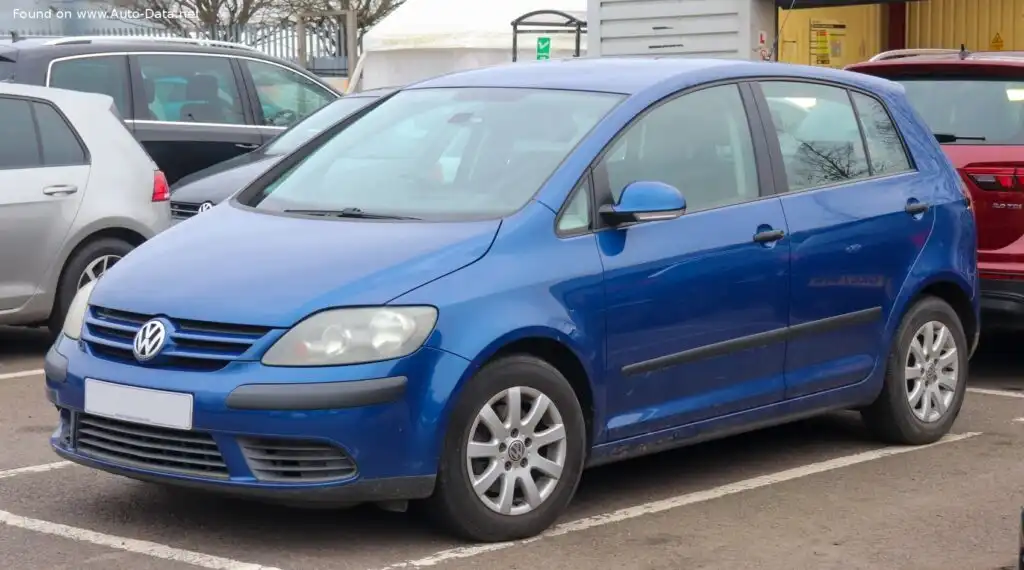
The Volkswagen Golf V Plus 1.4 16V, produced from December 2004 to April 2006, represented an entry-level offering within the Golf V Plus range – a compact minivan based on the Golf Mk5 (1HX0/A3 platform). Positioned as a more practical and spacious alternative to the standard Golf hatchback, the Golf V Plus aimed to cater to families and individuals requiring increased cargo capacity and interior flexibility. This particular 1.4-liter variant, generating 75 horsepower, served as the base engine option, prioritizing fuel efficiency and affordability over outright performance. It was primarily sold in European markets, where compact MPVs were a popular segment.
Technical Specifications
| Brand | Volkswagen |
| Model | Golf |
| Generation | Golf V Plus |
| Type (Engine) | 1.4 16V (75 Hp) |
| Start of production | December, 2004 |
| End of production | April, 2006 |
| Powertrain Architecture | Internal Combustion engine |
| Body type | Minivan |
| Seats | 5 |
| Doors | 5 |
| Fuel consumption (urban) | 9.7 l/100 km (24.2 US mpg, 29.1 UK mpg, 10.3 km/l) |
| Fuel consumption (extra urban) | 5.7 l/100 km (41.3 US mpg, 49.6 UK mpg, 17.5 km/l) |
| Fuel consumption (combined) | 7.1 l/100 km (33.1 US mpg, 39.8 UK mpg, 14.1 km/l) |
| Fuel Type | Petrol (Gasoline) |
| Acceleration 0 – 100 km/h | 16.2 sec |
| Acceleration 0 – 62 mph | 16.2 sec |
| Acceleration 0 – 60 mph | 15.4 sec |
| Maximum speed | 161 km/h (100.04 mph) |
| Weight-to-power ratio | 17.2 kg/Hp, 58 Hp/tonne |
| Weight-to-torque ratio | 10.3 kg/Nm, 97.4 Nm/tonne |
| Power | 75 Hp @ 5000 rpm |
| Power per litre | 54 Hp/l |
| Torque | 126 Nm @ 3800 rpm (92.93 lb.-ft. @ 3800 rpm) |
| Engine layout | Front, Transverse |
| Engine Model/Code | BCA |
| Engine displacement | 1390 cm3 (84.82 cu. in.) |
| Number of cylinders | 4 |
| Engine configuration | Inline |
| Cylinder Bore | 76.5 mm (3.01 in.) |
| Piston Stroke | 75.6 mm (2.98 in.) |
| Compression ratio | 10:1 |
| Number of valves per cylinder | 4 |
| Fuel injection system | Multi-port manifold injection |
| Engine aspiration | Naturally aspirated engine |
| Valvetrain | OHC |
| Engine oil capacity | 3.2 l (3.38 US qt | 2.82 UK qt) |
| Coolant | 5.6 l (5.92 US qt | 4.93 UK qt) |
| Kerb Weight | 1293 kg (2850.58 lbs.) |
| Trunk (boot) space – minimum | 395 l (13.95 cu. ft.) |
| Trunk (boot) space – maximum | 1450 l (51.21 cu. ft.) |
| Fuel tank capacity | 55 l (14.53 US gal | 12.1 UK gal) |
| Length | 4206 mm (165.59 in.) |
| Width | 1759 mm (69.25 in.) |
| Height | 1580 mm (62.2 in.) |
| Wheelbase | 2578 mm (101.5 in.) |
| Front track | 1539 mm (60.59 in.) |
| Rear (Back) track | 1528 mm (60.16 in.) |
| Drivetrain Architecture | The Internal combustion engine (ICE) drives the front wheels of the vehicle. |
| Drive wheel | Front wheel drive |
| Number of gears and type of gearbox | 5 gears, manual transmission |
| Front suspension | Spring Strut |
| Rear suspension | Coil spring |
| Front brakes | Ventilated discs |
| Rear brakes | Disc |
| Assisting systems | ABS (Anti-lock braking system) |
| Steering type | Steering rack and pinion |
| Tires size | 195/65 R15T |
| Wheel rims size | 6J x 15 |
Powertrain & Engine Architecture
The Golf V Plus 1.4 16V utilized the Volkswagen BCA engine code, a 1.4-liter inline-four cylinder gasoline engine. This engine featured a single overhead camshaft (OHC) design with four valves per cylinder. Fuel delivery was managed by a multi-port fuel injection system, a common setup for engines of this era. The BCA engine was known for its relatively simple design and ease of maintenance. The 75 horsepower output was achieved at 5000 rpm, while peak torque of 126 Nm (92.93 lb-ft) arrived at 3800 rpm. The engine’s compression ratio was 10:1. The standard transmission for this variant was a five-speed manual gearbox, although a four-speed automatic transmission was also available as an option. The automatic transmission, while offering convenience, did impact acceleration and fuel economy compared to the manual version.
Driving Characteristics
The 1.4 16V engine in the Golf V Plus, particularly when paired with the five-speed manual transmission, provided adequate performance for everyday driving. However, it was not a particularly sporty engine. Acceleration from 0 to 60 mph took approximately 15.4 seconds, and the top speed was around 100 mph. The engine felt somewhat strained when fully loaded or climbing hills. The automatic transmission further diminished performance, resulting in slower acceleration and a less engaging driving experience. Gear ratios were optimized for fuel efficiency rather than outright speed. The Golf V Plus 1.4 16V prioritized comfortable cruising and ease of use over dynamic handling.
Equipment & Trim Levels
The base Golf V Plus 1.4 16V typically came equipped with features such as power windows, central locking, and an audio system. Air conditioning was often an optional extra. Interior upholstery was typically cloth, and the dashboard featured a functional, if somewhat basic, design. Higher trim levels, such as the Trendline and Comfortline, added features like alloy wheels, upgraded audio systems, and climate control. The Golf V Plus offered a flexible interior with sliding rear seats and a large cargo area, making it a practical choice for families. Optional extras included parking sensors, a sunroof, and a navigation system.
Chassis & Braking
The Golf V Plus 1.4 16V utilized a front-wheel-drive layout with a MacPherson strut suspension in the front and a coil spring suspension in the rear. The front brakes were ventilated discs, while the rear brakes were solid discs. ABS (Anti-lock Braking System) was standard. The suspension was tuned for comfort, providing a relatively smooth ride. The weight of the vehicle (approximately 1293 kg or 2850.58 lbs) and the relatively low power output meant that the braking system was adequate for most driving situations. Stabilizer bars were included to reduce body roll during cornering.
Market Reception & Comparison
The Golf V Plus 1.4 16V was generally well-received as an affordable and practical family vehicle. Critics praised its spacious interior and flexible seating arrangements. However, the 1.4-liter engine was often criticized for its lack of power, especially when compared to the more potent 1.9 TDI diesel and 2.0-liter gasoline variants. The 1.9 TDI offered significantly better fuel economy and torque, making it a popular choice for long-distance drivers. The 2.0-liter engine provided more responsive performance. The 1.4 16V’s fuel economy was respectable, averaging around 33.1 US mpg in combined driving, but it lagged behind the diesel option. Reliability was generally good, with the BCA engine proving to be durable.
Legacy
The Volkswagen Golf V Plus 1.4 16V remains a relatively common sight on European roads today. The BCA engine is known for its reliability, although regular maintenance is essential to prevent issues such as oil leaks and timing chain wear. Parts availability is generally good, and the vehicle is relatively affordable to repair. In the used car market, the 1.4 16V variant is often the most affordable Golf V Plus option, making it an attractive choice for budget-conscious buyers. While it may not offer the performance of its more powerful siblings, its practicality, fuel efficiency, and reliability have ensured its continued relevance.