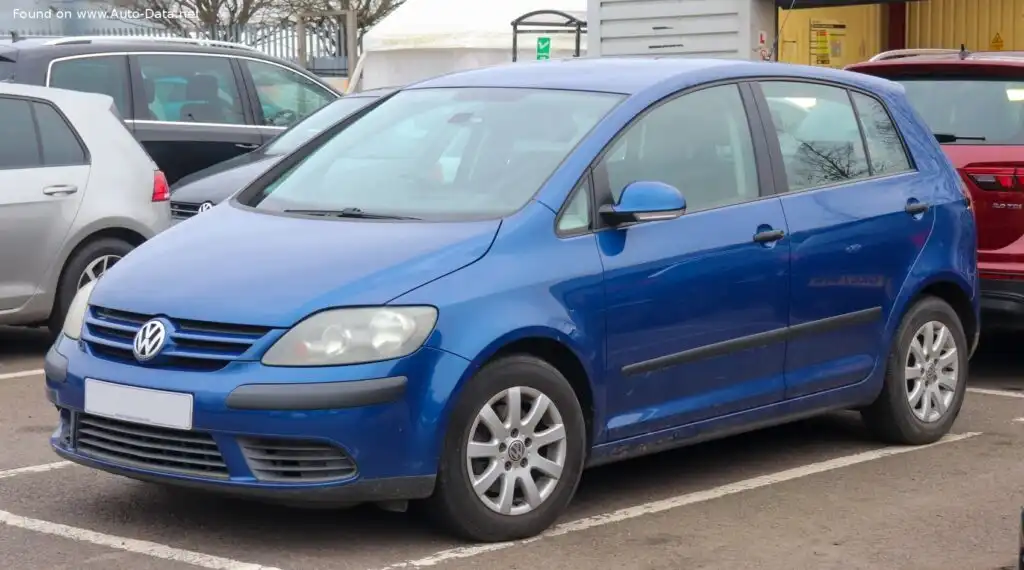
The Volkswagen Golf V Plus 1.6, producing 102 horsepower, was a key variant within the Golf V Plus range, manufactured between April 2005 and November 2008. Positioned as an entry-level to mid-range option, it offered a more affordable and fuel-efficient alternative to the more powerful engine choices available in the Golf V Plus lineup. The Golf V Plus itself was a compact multi-purpose vehicle (MPV), essentially a stretched and slightly taller version of the standard Golf V, designed to offer increased interior space and practicality. It sat on the Volkswagen Group’s A5 (or 1HX) platform, shared with models like the Audi A3 and SEAT Altea.
Technical Specifications
| Brand | Volkswagen |
| Model | Golf |
| Generation | Golf V Plus |
| Type (Engine) | 1.6 (102 Hp) |
| Start of production | April, 2005 |
| End of production | November, 2008 |
| Powertrain Architecture | Internal Combustion engine |
| Body type | Minivan |
| Seats | 5 |
| Doors | 5 |
| Fuel consumption (urban) | 10.2 l/100 km (23.1 US mpg) |
| Fuel consumption (extra urban) | 6.3 l/100 km (37.3 US mpg) |
| Fuel consumption (combined) | 7.7 l/100 km (30.5 US mpg) |
| Fuel Type | Petrol (Gasoline) |
| Acceleration 0 – 100 km/h | 12 sec |
| Acceleration 0 – 62 mph | 12 sec |
| Acceleration 0 – 60 mph | 11.4 sec |
| Maximum speed | 180 km/h (111.85 mph) |
| Emission standard | Euro 4 |
| Weight-to-power ratio | 12.9 kg/Hp |
| Weight-to-torque ratio | 8.9 kg/Nm |
| Power | 102 Hp @ 5600 rpm |
| Torque | 148 Nm @ 3800 rpm (109.16 lb.-ft. @ 3800 rpm) |
| Engine layout | Front, Transverse |
| Engine Model/Code | BSE, BSF |
| Engine displacement | 1595 cm3 (97.33 cu. in.) |
| Number of cylinders | 4 |
| Engine configuration | Inline |
| Cylinder Bore | 81 mm (3.19 in.) |
| Piston Stroke | 77.4 mm (3.05 in.) |
| Compression ratio | 10.5:1 |
| Number of valves per cylinder | 2 |
| Fuel injection system | Multi-port manifold injection |
| Engine aspiration | Naturally aspirated engine |
| Valvetrain | OHC |
| Engine oil capacity | 4.5 l (4.76 US qt | 3.96 UK qt) |
| Coolant | 8 l (8.45 US qt | 7.04 UK qt) |
| Kerb Weight | 1318 kg (2905.69 lbs.) |
| Trunk (boot) space – minimum | 395 l (13.95 cu. ft.) |
| Trunk (boot) space – maximum | 1450 l (51.21 cu. ft.) |
| Fuel tank capacity | 55 l (14.53 US gal | 12.1 UK gal) |
| Length | 4206 mm (165.59 in.) |
| Width | 1759 mm (69.25 in.) |
| Height | 1580 mm (62.2 in.) |
| Wheelbase | 2578 mm (101.5 in.) |
| Front track | 1539 mm (60.59 in.) |
| Rear (Back) track | 1528 mm (60.16 in.) |
| Drivetrain Architecture | The Internal combustion engine (ICE) drives the front wheels of the vehicle. |
| Drive wheel | Front wheel drive |
| Number of gears and type of gearbox | 6 gears, manual transmission |
| Front suspension | Spring Strut |
| Rear suspension | Coil spring |
| Front brakes | Ventilated discs |
| Rear brakes | Disc |
| Assisting systems | ABS (Anti-lock braking system) |
| Steering type | Steering rack and pinion |
| Tires size | 195/65 R15H |
| Wheel rims size | 6J x 15 |
Powertrain & Engine Architecture
The Golf V Plus 1.6 utilized the Volkswagen EA827 engine family, specifically the BSE or BSF engine code depending on the exact production date and market. This 1.6-liter inline-four engine featured a naturally aspirated configuration with two valves per cylinder and a single overhead camshaft (OHC). Fuel delivery was handled by a multi-port fuel injection system, a common setup for engines of this era. The engine produced 102 horsepower at 5600 rpm and 148 Nm (109 lb-ft) of torque at 3800 rpm. The engine’s relatively simple design prioritized reliability and fuel efficiency over outright performance. The six-speed manual transmission was the standard offering, providing a decent spread of gears for both city and highway driving. While an automatic transmission was available as an option, it was typically a four-speed unit, which impacted acceleration and fuel economy compared to the manual.
Driving Characteristics
The 1.6-liter engine in the Golf V Plus delivered adequate, but not exhilarating, performance. Acceleration from 0 to 60 mph took around 11.4 seconds, and top speed was limited to 111.85 mph. The engine felt somewhat strained when fully loaded or tackling steep inclines. The six-speed manual transmission helped to keep the engine in its optimal power band, but the automatic version, with its fewer gears, often resulted in the engine feeling sluggish. The Golf V Plus 1.6 was best suited for relaxed driving and commuting, prioritizing fuel economy and comfort over sporty handling. The suspension was tuned for comfort, providing a reasonably smooth ride, although it wasn’t particularly engaging for enthusiastic drivers.
Equipment & Trim Levels
The Golf V Plus 1.6 typically came with a reasonable level of standard equipment. This included power windows, central locking, air conditioning, and an audio system. Higher trim levels, such as the ‘Trendline’ or ‘Comfortline’, added features like alloy wheels, upgraded upholstery, and a multi-function steering wheel. Optional extras included a sunroof, parking sensors, and a more advanced audio system with CD changer. Interior upholstery was typically cloth, with the option of upgraded materials on higher trims. The dashboard layout was functional and straightforward, typical of Volkswagen’s design philosophy at the time.
Chassis & Braking
The Golf V Plus 1.6 featured a front-wheel-drive layout with a MacPherson strut suspension at the front and a coil spring suspension at the rear. The braking system consisted of ventilated discs on the front wheels and solid discs on the rear. Anti-lock Braking System (ABS) was standard. The suspension setup was geared towards comfort and ride quality, rather than sporty handling. The weight distribution was reasonably balanced, contributing to predictable handling characteristics. Stabilizer bars were included to reduce body roll during cornering, but the overall handling experience was more focused on stability and ease of driving than outright performance.
Market Reception & Comparison
The Golf V Plus 1.6 was generally well-received as a practical and affordable MPV. Critics praised its spacious interior, comfortable ride, and fuel efficiency. However, the engine was often criticized for being underpowered, particularly when the vehicle was fully loaded. Compared to the more powerful 1.9 TDI diesel or the 2.0-liter petrol versions, the 1.6-liter engine offered significantly less performance. The 1.9 TDI, in particular, was favored by those seeking better fuel economy and more torque. The 1.6-liter version appealed to buyers who prioritized affordability and simplicity over outright performance.
Legacy
The Volkswagen Golf V Plus 1.6, while not the most exciting variant in the lineup, proved to be a reliable and economical choice for many buyers. The EA827 engine is known for its durability, and with regular maintenance, these engines can continue to provide years of service. In the used car market, the Golf V Plus 1.6 remains a relatively affordable option, appealing to those seeking a practical and spacious MPV. However, potential buyers should be aware of the engine’s limitations and the potential for higher maintenance costs as the vehicle ages. The simplicity of the 1.6-liter engine also makes it a relatively straightforward and inexpensive engine to repair compared to more complex, higher-output variants.