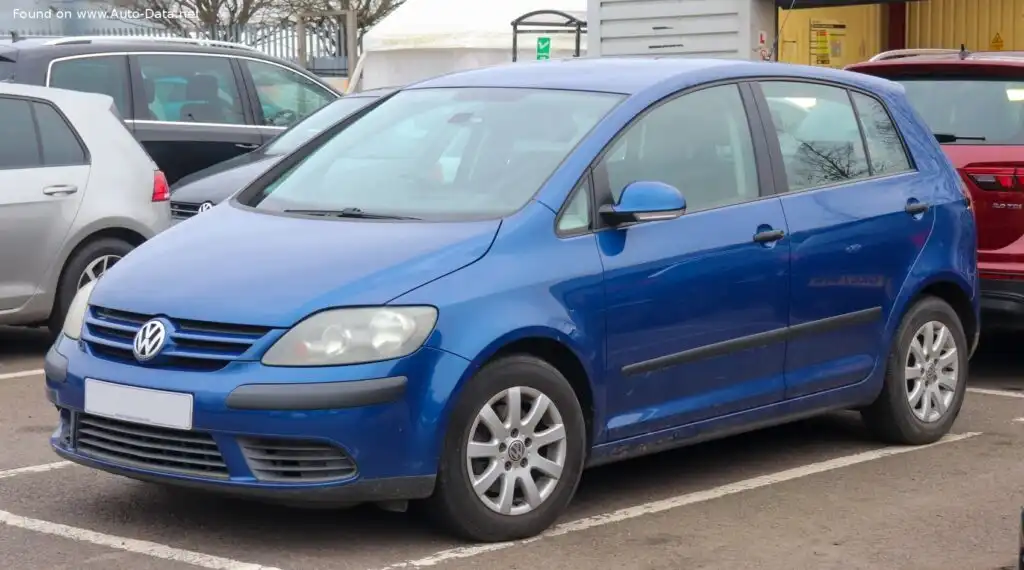
The Volkswagen Golf V Plus 1.6 FSI, produced from December 2004 to October 2007, represented a practical and fuel-efficient entry point into the Golf V Plus range. Positioned as a compact minivan (often referred to as a Sports Wagon or Tourer in European markets), the Golf V Plus aimed to bridge the gap between the standard Golf hatchback and larger MPVs. This variant, powered by the 1.6-liter FSI engine producing 115 horsepower, was primarily targeted at families and individuals seeking a versatile vehicle with reasonable running costs. It was a key offering in the European market, where compact MPVs were – and remain – highly popular.
Technical Specifications
| Brand | Volkswagen |
| Model | Golf |
| Generation | Golf V Plus |
| Type (Engine) | 1.6 FSI (115 Hp) |
| Start of production | December, 2004 |
| End of production | October, 2007 |
| Powertrain Architecture | Internal Combustion engine |
| Body type | Minivan |
| Seats | 5 |
| Doors | 5 |
| Fuel consumption (urban) | 9.6 l/100 km (24.5 US mpg) |
| Fuel consumption (extra urban) | 5.8 l/100 km (40.6 US mpg) |
| Fuel consumption (combined) | 7.2 l/100 km (32.7 US mpg) |
| Fuel Type | Petrol (Gasoline) |
| Acceleration 0 – 100 km/h | 11.8 sec |
| Acceleration 0 – 62 mph | 11.8 sec |
| Acceleration 0 – 60 mph | 11.2 sec |
| Maximum speed | 189 km/h (117.44 mph) |
| Weight-to-power ratio | 11.5 kg/Hp |
| Weight-to-torque ratio | 8.5 kg/Nm |
| Power | 115 Hp @ 6000 rpm |
| Power per litre | 72 Hp/l |
| Torque | 155 Nm @ 4000 rpm (114.32 lb.-ft. @ 4000 rpm) |
| Engine layout | Front, Transverse |
| Engine Model/Code | BLF |
| Engine displacement | 1598 cm3 (97.52 cu. in.) |
| Number of cylinders | 4 |
| Engine configuration | Inline |
| Cylinder Bore | 76.5 mm (3.01 in.) |
| Piston Stroke | 86.9 mm (3.42 in.) |
| Compression ratio | 12:1 |
| Number of valves per cylinder | 4 |
| Fuel injection system | Direct injection |
| Engine aspiration | Naturally aspirated engine |
| Valvetrain | DOHC |
| Engine oil capacity | 3.6 l (3.8 US qt | 3.17 UK qt) |
| Coolant | 5.6 l (5.92 US qt | 4.93 UK qt) |
| Kerb Weight | 1318 kg (2905.69 lbs.) |
| Trunk (boot) space – minimum | 395 l (13.95 cu. ft.) |
| Trunk (boot) space – maximum | 1450 l (51.21 cu. ft.) |
| Fuel tank capacity | 55 l (14.53 US gal | 12.1 UK gal) |
| Length | 4206 mm (165.59 in.) |
| Width | 1759 mm (69.25 in.) |
| Height | 1580 mm (62.2 in.) |
| Wheelbase | 2578 mm (101.5 in.) |
| Front track | 1539 mm (60.59 in.) |
| Rear (Back) track | 1528 mm (60.16 in.) |
| Drivetrain Architecture | The Internal combustion engine (ICE) drives the front wheels of the vehicle. |
| Drive wheel | Front wheel drive |
| Number of gears and type of gearbox | 6 gears, manual transmission |
| Front suspension | Spring Strut |
| Rear suspension | Coil spring |
| Front brakes | Ventilated discs |
| Rear brakes | Disc |
| Assisting systems | ABS (Anti-lock braking system) |
| Steering type | Steering rack and pinion |
| Tires size | 195/65 R15H |
| Wheel rims size | 6J x 15 |
INTRODUCTION
The Golf V Plus, launched in 2004, was Volkswagen’s attempt to capitalize on the growing demand for compact MPVs in Europe. Based on the Golf V (Mk5) platform – specifically the 1HX0/A3 variant – it offered increased interior space and versatility compared to the standard Golf hatchback, while remaining more manageable in size than larger people carriers. The 1.6 FSI engine, designated with the engine code BLF, was a key component of the lineup, offering a balance of performance and fuel economy. This particular configuration was aimed at buyers who prioritized practicality and affordability over outright speed.
Powertrain & Engine Architecture
The 1.6 FSI engine is a naturally aspirated, four-cylinder inline engine featuring direct fuel injection (FSI – Fuel Stratified Injection). This technology, a significant advancement at the time, allowed for more precise fuel delivery, resulting in improved fuel efficiency and increased power output compared to traditional port fuel injection systems. The BLF engine boasts a displacement of 1598cc, a compression ratio of 12:1, and a dual overhead camshaft (DOHC) valvetrain with four valves per cylinder. The FSI system utilizes a high-pressure fuel pump to inject fuel directly into the combustion chamber, creating a stratified charge – a mixture of air and fuel that is richer near the spark plug and leaner elsewhere – for optimal combustion. The engine was typically paired with a 5-speed manual transmission, but a 6-speed automatic transmission was also available, though less common. The automatic transmission was a conventional torque converter type, prioritizing smooth shifts over outright performance.
Driving Characteristics
The Golf V Plus 1.6 FSI with the manual transmission offered adequate, though not exhilarating, performance. With 115 horsepower and 155 Nm (114 lb-ft) of torque, acceleration from 0-60 mph took around 11.2 seconds, and top speed was approximately 117 mph. The automatic transmission slightly dulled performance, adding a fraction of a second to the 0-60 time. The engine felt relatively responsive at lower RPMs, making it suitable for everyday driving. However, it did require downshifting to maintain momentum when overtaking or climbing hills. The gear ratios in the manual transmission were well-spaced, providing a reasonable balance between fuel economy and performance. The automatic transmission, while smooth, could sometimes feel hesitant, particularly when attempting quick acceleration. Compared to the more powerful 1.9 TDI diesel or the 2.0 FSI petrol variants, the 1.6 FSI felt noticeably less potent, but it offered a quieter and smoother driving experience.
Equipment & Trim Levels
The Golf V Plus 1.6 FSI typically came equipped with a reasonable level of standard features. These included central locking, electric front windows, power steering, ABS brakes, and a basic audio system. Higher trim levels, such as Trendline and Comfortline, added features like alloy wheels, air conditioning, a multi-function steering wheel, and upgraded upholstery. Optional extras included a sunroof, parking sensors, and a more advanced audio system with CD changer. Interior upholstery was typically cloth, with the option of leather upgrades on higher trims. The dashboard layout was similar to that of the standard Golf V, with a functional and ergonomic design.
Chassis & Braking
The Golf V Plus utilized a MacPherson strut front suspension and a multi-link rear suspension, providing a comfortable and controlled ride. The suspension was tuned to prioritize comfort over sporty handling. Braking duties were handled by ventilated discs at the front and solid discs at the rear. ABS (Anti-lock Braking System) was standard. The weight distribution was relatively balanced, contributing to stable handling. Stabilizer bars were fitted to both the front and rear axles to reduce body roll during cornering. The 195/65 R15 tires provided adequate grip in most conditions.
Market Reception & Comparison
The Golf V Plus 1.6 FSI was generally well-received by critics as a practical and fuel-efficient family car. It was praised for its spacious interior, comfortable ride, and reasonable running costs. However, some reviewers criticized its lack of outright performance and the somewhat hesitant nature of the automatic transmission. Compared to the 1.9 TDI, the 1.6 FSI offered lower fuel economy but a smoother and quieter engine. The 2.0 FSI provided significantly more power but at the expense of fuel efficiency. The 1.6 FSI occupied a middle ground, appealing to buyers who prioritized practicality and affordability.
Legacy
The 1.6 FSI engine, while not known for being particularly robust, generally proved reliable with regular maintenance. Common issues included occasional problems with the fuel injectors and the ignition coils. The Golf V Plus itself has proven to be a durable and well-built vehicle. Today, the Golf V Plus 1.6 FSI can be found on the used car market at relatively affordable prices. It remains a practical and economical choice for those seeking a versatile family car, though potential buyers should be aware of the potential for age-related issues and ensure a thorough inspection before purchase. Its blend of practicality, fuel efficiency, and Volkswagen build quality ensures it remains a relevant option in the used car segment.