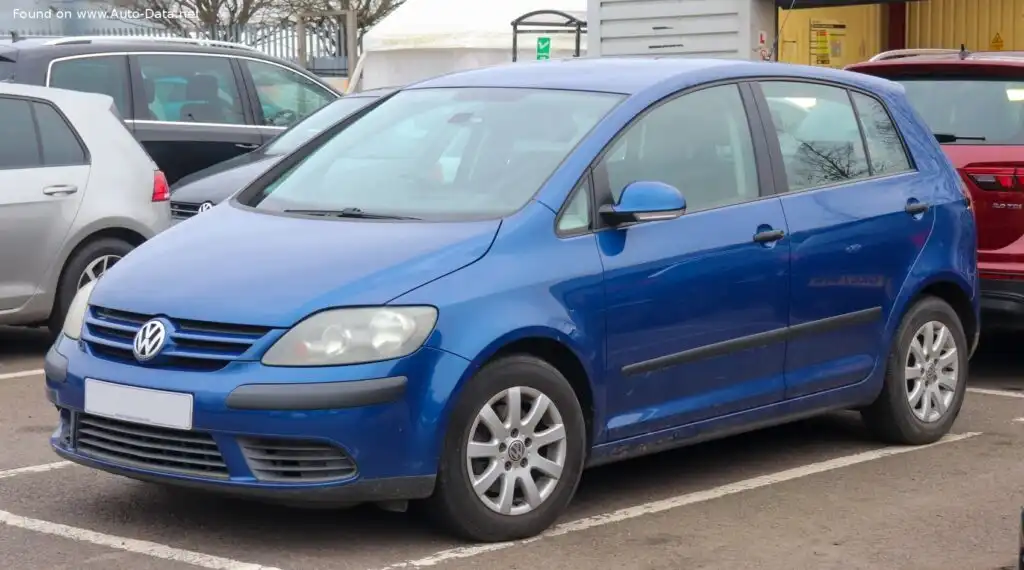
The Volkswagen Golf V Plus 2.0 TDI, produced from November 2005 to November 2008, represented a practical and versatile offering within the fifth generation of the Golf family. Positioned as a compact multi-purpose vehicle (MPV), the Golf V Plus aimed to bridge the gap between a traditional hatchback and a larger minivan, offering increased interior space and flexibility. This particular variant, equipped with the 2.0-liter TDI engine producing 140 horsepower, was a popular choice in European markets, balancing fuel efficiency with adequate performance for everyday driving. It sat in the mid-range of the V Plus lineup, offering a step up in power and refinement compared to the lower-displacement diesel options, but remaining more accessible than the range-topping petrol engines.
Technical Specifications
| Brand | Volkswagen |
| Model | Golf |
| Generation | Golf V Plus |
| Type (Engine) | 2.0 TDI (140 Hp) |
| Start of production | November, 2005 |
| End of production | November, 2008 |
| Powertrain Architecture | Internal Combustion engine |
| Body type | Minivan |
| Seats | 5 |
| Doors | 5 |
| Fuel consumption (urban) | 7.3 l/100 km (32.2 US mpg, 38.7 UK mpg, 13.7 km/l) |
| Fuel consumption (extra urban) | 4.7 l/100 km (50 US mpg, 60.1 UK mpg, 21.3 km/l) |
| Fuel consumption (combined) | 5.7 l/100 km (41.3 US mpg, 49.6 UK mpg, 17.5 km/l) |
| Fuel Type | Diesel |
| Acceleration 0 – 100 km/h | 9.7 sec |
| Acceleration 0 – 62 mph | 9.7 sec |
| Acceleration 0 – 60 mph | 9.2 sec |
| Maximum speed | 202 km/h (125.52 mph) |
| Weight-to-power ratio | 10.2 kg/Hp, 98.2 Hp/tonne |
| Weight-to-torque ratio | 4.5 kg/Nm, 224.4 Nm/tonne |
| Power | 140 Hp @ 4000 rpm |
| Power per litre | 71.1 Hp/l |
| Torque | 320 Nm @ 1750 rpm (236.02 lb.-ft. @ 1750 rpm) |
| Engine layout | Front, Transverse |
| Engine Model/Code | EA188 / BKD |
| Engine displacement | 1968 cm3 (120.09 cu. in.) |
| Number of cylinders | 4 |
| Engine configuration | Inline |
| Cylinder Bore | 81 mm (3.19 in.) |
| Piston Stroke | 95.5 mm (3.76 in.) |
| Compression ratio | 18.5:1 |
| Number of valves per cylinder | 4 |
| Fuel injection system | Pump-nozzle (Unit Injector) |
| Engine aspiration | Turbocharger, Intercooler |
| Engine oil capacity | 3.8 l (4.02 US qt | 3.34 UK qt) |
| Coolant | 8 l (8.45 US qt | 7.04 UK qt) |
| Kerb Weight | 1426 kg (3143.79 lbs.) |
| Trunk (boot) space – minimum | 395 l (13.95 cu. ft.) |
| Trunk (boot) space – maximum | 1450 l (51.21 cu. ft.) |
| Fuel tank capacity | 55 l (14.53 US gal | 12.1 UK gal) |
| Length | 4206 mm (165.59 in.) |
| Width | 1759 mm (69.25 in.) |
| Height | 1580 mm (62.2 in.) |
| Wheelbase | 2578 mm (101.5 in.) |
| Front track | 1539 mm (60.59 in.) |
| Rear (Back) track | 1528 mm (60.16 in.) |
| Drivetrain Architecture | The Internal combustion engine (ICE) drives the front wheels of the vehicle. |
| Drive wheel | Front wheel drive |
| Number of gears and type of gearbox | 6 gears, manual transmission |
| Front suspension | Spring Strut |
| Rear suspension | Coil spring |
| Front brakes | Ventilated discs |
| Rear brakes | Disc |
| Assisting systems | ABS (Anti-lock braking system) |
| Steering type | Steering rack and pinion |
| Tires size | 195/65 R15V |
| Wheel rims size | 6J x 15 |
Powertrain & Engine Architecture
The heart of the Golf V Plus 2.0 TDI was the EA188 series engine, specifically the BKD code. This 1968cc, four-cylinder diesel engine utilized a common-rail direct injection system with pump-nozzle technology. This system allowed for precise fuel delivery and optimized combustion, contributing to both power output and fuel efficiency. The engine featured a single overhead camshaft (SOHC) operating four valves per cylinder, enhancing breathing and volumetric efficiency. A turbocharger with an intercooler was employed to boost power and torque, delivering 140 horsepower at 4000 rpm and a substantial 320 Nm (236 lb-ft) of torque from as low as 1750 rpm. The engine’s robust bottom end and well-designed cooling system contributed to its durability. The 6-speed manual transmission was the standard offering, providing well-spaced gear ratios to maximize the engine’s torque curve and deliver responsive acceleration.
Driving Characteristics
The 2.0 TDI engine in the Golf V Plus provided a noticeable step up in performance compared to the smaller 1.9 TDI variants. While not a sports car, the 140 hp engine offered ample power for comfortable highway cruising and confident overtaking. The readily available torque meant that strong acceleration was achievable without needing to rev the engine excessively. The 6-speed manual transmission allowed drivers to keep the engine in its optimal power band, enhancing both performance and fuel economy. Compared to the petrol engines, the 2.0 TDI offered significantly better fuel economy, making it a popular choice for drivers covering long distances. The suspension, tuned for comfort, provided a reasonably compliant ride, although it wasn’t as sporty as some of its hatchback siblings.
Equipment & Trim Levels
The Golf V Plus 2.0 TDI typically came equipped with a respectable level of standard features. These included air conditioning, power windows, central locking, and an integrated audio system. Higher trim levels offered options such as alloy wheels, a multi-function steering wheel, automatic climate control, and a sunroof. Interior upholstery was typically cloth, with leather options available as an upgrade. The Golf V Plus’s interior was designed with practicality in mind, featuring numerous storage compartments and a flexible seating arrangement. The rear seats could be folded down to increase cargo space, and the entire rear bench could be removed for maximum versatility.
Chassis & Braking
The Golf V Plus utilized a MacPherson strut front suspension and a multi-link rear suspension, providing a good balance between ride comfort and handling. The front brakes were ventilated discs, offering strong stopping power, while the rear brakes were solid discs. Anti-lock Braking System (ABS) was standard, enhancing safety and stability during emergency braking. The chassis was reinforced to accommodate the increased weight and dimensions of the MPV body style. Stabilizer bars were fitted to both the front and rear axles to reduce body roll during cornering.
Market Reception & Comparison
The Golf V Plus 2.0 TDI was generally well-received by automotive critics. It was praised for its spacious interior, practical design, and fuel-efficient engine. However, some critics noted that the ride could be a bit firm on rough roads and that the interior materials weren’t as premium as those found in some competitors. Compared to other MPVs in its class, the Golf V Plus offered a more refined driving experience and a higher level of build quality. Against other Golf V variants, the 2.0 TDI provided a compelling alternative to the petrol engines, offering superior fuel economy and torque without sacrificing too much performance.
Legacy
The EA188 2.0 TDI engine, as found in the Golf V Plus, has proven to be a relatively reliable powertrain when properly maintained. However, it is known to be susceptible to issues with the diesel particulate filter (DPF) and the dual-mass flywheel, particularly if the vehicle is primarily used for short trips. Despite these potential issues, the Golf V Plus 2.0 TDI remains a popular choice in the used car market, offering a practical and economical option for families and individuals seeking a versatile compact MPV. Its reputation for reliability, combined with its fuel efficiency and spacious interior, ensures its continued relevance in the automotive landscape.