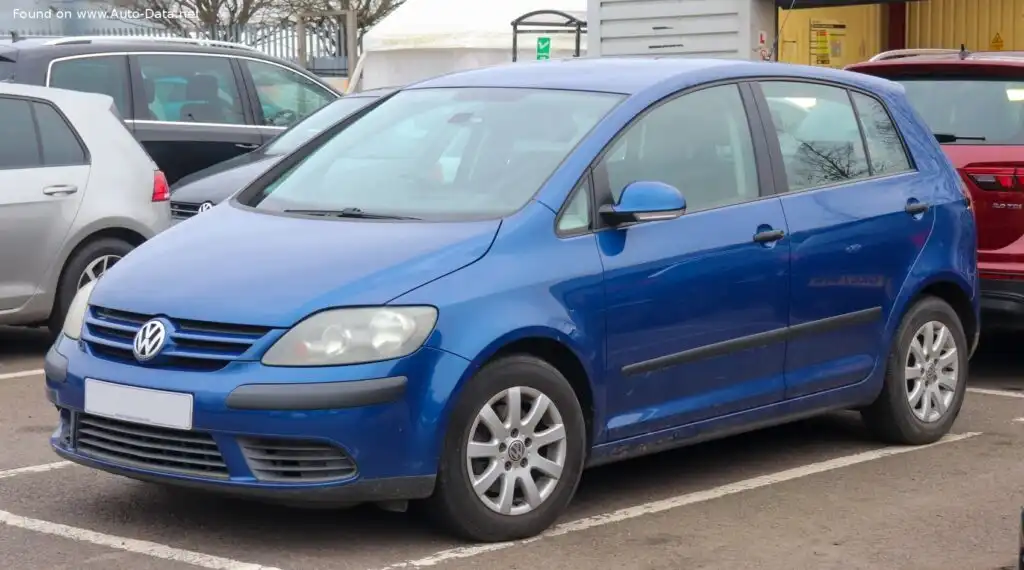
The Volkswagen Golf V Plus 2.0 TDI with the Direct-Shift Gearbox (DSG) was a popular variant of the Golf V Plus (also known as the Golf Plus) produced between November 2005 and November 2008. Positioned as a mid-range offering within the Golf V Plus lineup, it aimed to provide a balance of fuel efficiency, performance, and practicality for European buyers. The Golf V Plus itself was a five-door compact multi-purpose vehicle (MPV), essentially a taller, more spacious version of the standard Golf V, built on the A5 (1HX0/A3) platform. This variant distinguished itself with a diesel engine paired with Volkswagen’s then-advanced DSG transmission.
Technical Specifications
| Brand | Volkswagen |
| Model | Golf |
| Generation | Golf V Plus |
| Type (Engine) | 2.0 TDI (140 Hp) DSG |
| Start of production | November, 2005 |
| End of production | November, 2008 |
| Powertrain Architecture | Internal Combustion engine |
| Body type | Minivan |
| Seats | 5 |
| Doors | 5 |
| Fuel consumption (urban) | 8.2 l/100 km (28.7 US mpg) |
| Fuel consumption (extra urban) | 5.2 l/100 km (45.2 US mpg) |
| Fuel consumption (combined) | 6.2 l/100 km (37.9 US mpg) |
| Fuel Type | Diesel |
| Acceleration 0 – 100 km/h | 9.7 sec |
| Acceleration 0 – 62 mph | 9.7 sec |
| Acceleration 0 – 60 mph | 9.2 sec |
| Maximum speed | 200 km/h (124.27 mph) |
| Weight-to-power ratio | 10.2 kg/Hp |
| Weight-to-torque ratio | 4.5 kg/Nm |
| Power | 140 Hp @ 4000 rpm |
| Power per litre | 71.1 Hp/l |
| Torque | 320 Nm @ 1750 rpm (236.02 lb.-ft. @ 1750 rpm) |
| Engine layout | Front, Transverse |
| Engine Model/Code | EA188 / BKD |
| Engine displacement | 1968 cm3 (120.09 cu. in.) |
| Number of cylinders | 4 |
| Engine configuration | Inline |
| Cylinder Bore | 81 mm (3.19 in.) |
| Piston Stroke | 95.5 mm (3.76 in.) |
| Compression ratio | 18.5:1 |
| Number of valves per cylinder | 4 |
| Fuel injection system | Pump-nozzle (Unit Injector) |
| Engine aspiration | Turbocharger, Intercooler |
| Engine oil capacity | 3.8 l (4.02 US qt | 3.34 UK qt) |
| Coolant | 8 l (8.45 US qt | 7.04 UK qt) |
| Kerb Weight | 1426 kg (3143.79 lbs.) |
| Trunk (boot) space – minimum | 395 l (13.95 cu. ft.) |
| Trunk (boot) space – maximum | 1450 l (51.21 cu. ft.) |
| Fuel tank capacity | 55 l (14.53 US gal | 12.1 UK gal) |
| Length | 4206 mm (165.59 in.) |
| Width | 1759 mm (69.25 in.) |
| Height | 1580 mm (62.2 in.) |
| Wheelbase | 2578 mm (101.5 in.) |
| Front track | 1539 mm (60.59 in.) |
| Rear (Back) track | 1528 mm (60.16 in.) |
| Drivetrain Architecture | Front wheel drive |
| Number of gears and type of gearbox | 6 gears, automatic transmission |
| Front suspension | Spring Strut |
| Rear suspension | Coil spring |
| Front brakes | Ventilated discs |
| Rear brakes | Disc |
| Assisting systems | ABS (Anti-lock braking system) |
| Steering type | Steering rack and pinion |
| Tires size | 195/65 R15V |
| Wheel rims size | 6J x 15 |
Powertrain & Engine Architecture
The heart of the Golf V Plus 2.0 TDI DSG was the EA188 series 2.0-liter inline-four diesel engine, specifically the BKD engine code. This engine featured common-rail direct injection, a turbocharger with an intercooler, and four valves per cylinder. The pump-nozzle injection system, while effective, was gradually being replaced by common-rail technology in later VW models. The BKD engine produced 140 horsepower at 4000 rpm and a substantial 320 Nm (236 lb-ft) of torque from as low as 1750 rpm. This torque output was a key characteristic of the engine, providing strong pulling power for everyday driving. The engine’s robust construction and relatively simple design contributed to its longevity. The DSG (Direct-Shift Gearbox) was a six-speed dual-clutch transmission. It offered the convenience of an automatic while providing quicker and more direct gear changes than a traditional torque-converter automatic. This contributed to improved acceleration and fuel efficiency.
Driving Characteristics
The 2.0 TDI DSG Golf V Plus offered a refined driving experience. The ample torque meant that strong acceleration was available from low engine speeds, making it well-suited for overtaking and merging onto highways. The DSG transmission shifted smoothly and responsively, enhancing the overall driving feel. While not a sports car, the Golf V Plus 2.0 TDI DSG provided adequate performance for most drivers. Compared to the base 1.6-liter gasoline engine, the 2.0 TDI offered significantly more power and torque. It also outperformed the lower-powered 1.9 TDI variants in terms of outright speed. However, it didn’t match the performance of the more expensive Golf V Plus models equipped with the 2.0-liter gasoline engine or the high-performance GTI.
Equipment & Trim Levels
The Golf V Plus 2.0 TDI DSG typically came with a reasonable level of standard equipment. This included air conditioning, power windows, central locking, and an audio system. Higher trim levels added features such as alloy wheels, a multi-function steering wheel, and upgraded interior trim. Optional extras included a sunroof, parking sensors, and a navigation system. Interior upholstery was typically cloth, with leather options available as an upgrade. The dashboard layout was functional and straightforward, typical of Volkswagen interiors of the period.
Chassis & Braking
The Golf V Plus utilized a MacPherson strut front suspension and a multi-link rear suspension, providing a comfortable ride and good handling characteristics. The front brakes were ventilated discs, while the rear brakes were solid discs. Anti-lock Braking System (ABS) was standard. The suspension was tuned to prioritize comfort over outright sportiness, but still offered a stable and predictable driving experience. The weight distribution was reasonably balanced, contributing to the car’s handling capabilities.
Market Reception & Comparison
The Golf V Plus 2.0 TDI DSG was well-received by European automotive critics. It was praised for its fuel efficiency, strong performance, and comfortable ride. The DSG transmission was also a highlight, offering a smooth and responsive driving experience. Compared to other compact MPVs, the Golf V Plus was considered a more refined and enjoyable vehicle to drive. Fuel economy was a key selling point, with the 2.0 TDI achieving around 37.9 US mpg on the combined cycle. Reliability was generally good, although some owners reported issues with the DSG transmission, particularly early units.
Legacy
The Golf V Plus 2.0 TDI DSG remains a popular used car in Europe. The BKD engine is known for its durability, and the DSG transmission, while potentially requiring maintenance, offers a superior driving experience. These vehicles are often sought after by buyers looking for a practical, fuel-efficient, and comfortable compact MPV. While newer Golf models offer more advanced technology and features, the Golf V Plus 2.0 TDI DSG represents a well-engineered and reliable vehicle that continues to provide good value in the used car market. The combination of a torquey diesel engine and a smooth-shifting DSG transmission made it a compelling choice for drivers seeking a balance of performance and economy.