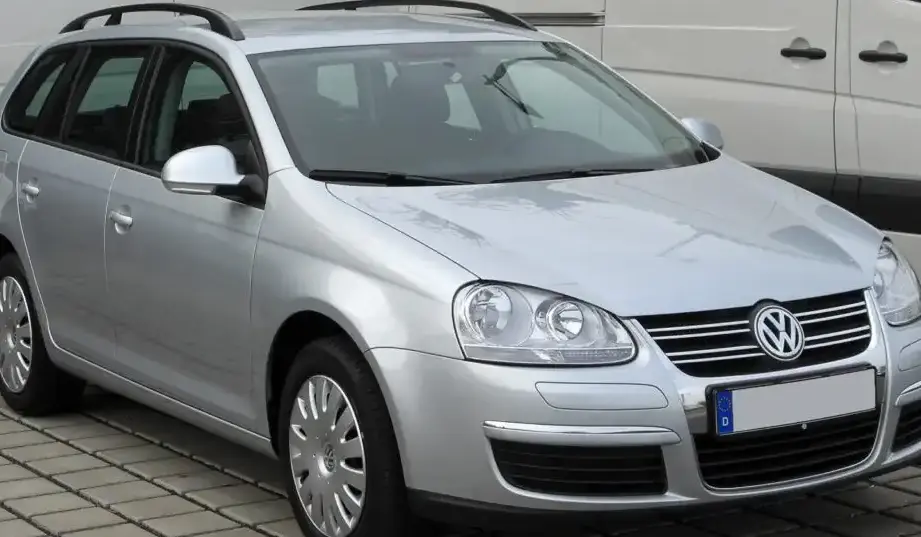
The Volkswagen Golf V Variant 1.4 TSI (140 hp) was a station wagon (estate) model produced between March 2007 and May 2008. It represented a key offering within the Golf Mk5 Variant range, blending practicality with Volkswagen’s then-new turbocharged direct injection (TSI) engine technology. Positioned as a mid-range option, it aimed to provide a balance between fuel efficiency, performance, and affordability within the broader Golf V lineup. The Golf V Variant, built on the A5 platform (internally designated 1HX0), offered increased cargo capacity compared to the standard hatchback, making it a popular choice for families and those requiring versatile load-carrying capabilities.
Technical Specifications
| Brand | Volkswagen |
| Model | Golf |
| Generation | Golf V Variant |
| Type (Engine) | 1.4 TSI (140 Hp) |
| Start of production | March, 2007 |
| End of production | May, 2008 |
| Powertrain Architecture | Internal Combustion engine |
| Body type | Station wagon (estate) |
| Seats | 5 |
| Doors | 5 |
| Fuel consumption (urban) | 9.5 l/100 km (24.8 US mpg, 29.7 UK mpg, 10.5 km/l) |
| Fuel consumption (extra urban) | 5.7 l/100 km (41.3 US mpg, 49.6 UK mpg, 17.5 km/l) |
| Fuel consumption (combined) | 7.1 l/100 km (33.1 US mpg, 39.8 UK mpg, 14.1 km/l) |
| Fuel Type | Petrol (Gasoline) |
| Acceleration 0 – 100 km/h | 9.5 sec |
| Acceleration 0 – 62 mph | 9.5 sec |
| Acceleration 0 – 60 mph | 9 sec |
| Maximum speed | 205 km/h (127.38 mph) |
| Emission standard | Euro 4 |
| Weight-to-power ratio | 9.7 kg/Hp, 103.5 Hp/tonne |
| Weight-to-torque ratio | 6.2 kg/Nm, 162.6 Nm/tonne |
| Power | 140 Hp @ 5600 rpm |
| Power per litre | 100.7 Hp/l |
| Torque | 220 Nm @ 1500-4000 rpm (162.26 lb.-ft. @ 1500-4000 rpm) |
| Engine layout | Front, Transverse |
| Engine Model/Code | BMY |
| Engine displacement | 1390 cm3 (84.82 cu. in.) |
| Number of cylinders | 4 |
| Engine configuration | Inline |
| Cylinder Bore | 76.5 mm (3.01 in.) |
| Piston Stroke | 75.6 mm (2.98 in.) |
| Number of valves per cylinder | 4 |
| Fuel injection system | Direct injection |
| Engine aspiration | Turbocharger, Intercooler |
| Valvetrain | DOHC |
| Engine oil capacity | 3.6 l (3.8 US qt | 3.17 UK qt) |
| Coolant | 5.6 l (5.92 US qt | 4.93 UK qt) |
| Kerb Weight | 1353 kg (2982.85 lbs.) |
| Max. weight | 1960 kg (4321.06 lbs.) |
| Max load | 607 kg (1338.21 lbs.) |
| Trunk (boot) space – minimum | 505 l (17.83 cu. ft.) |
| Trunk (boot) space – maximum | 1495 l (52.8 cu. ft.) |
| Fuel tank capacity | 55 l (14.53 US gal | 12.1 UK gal) |
| Length | 4556 mm (179.37 in.) |
| Width | 1781 mm (70.12 in.) |
| Height | 1504 mm (59.21 in.) |
| Wheelbase | 2578 mm (101.5 in.) |
| Front track | 1535 mm (60.43 in.) |
| Rear (Back) track | 1508 mm (59.37 in.) |
| Minimum turning circle | 10.5 m (34.45 ft.) |
| Drivetrain Architecture | The Internal combustion engine (ICE) drives the front wheels of the vehicle. |
| Drive wheel | Front wheel drive |
| Number of gears and type of gearbox | 6 gears, manual transmission |
| Assisting systems | ABS (Anti-lock braking system) |
| Tires size | 205/55 R16 |
| Wheel rims size | 6.5J x 16 |
Powertrain & Engine Architecture
The heart of the Golf V Variant 1.4 TSI was the BMY engine code, a 1.4-liter inline-four cylinder gasoline engine. This engine was a significant step forward for Volkswagen, utilizing both turbocharging and direct fuel injection to deliver a compelling blend of power and efficiency. The direct injection system, injecting fuel directly into the combustion chamber, allowed for more precise fuel control and higher compression ratios, contributing to improved thermal efficiency. The turbocharger, coupled with an intercooler, boosted power output by forcing more air into the engine. The engine featured a dual overhead camshaft (DOHC) valvetrain, optimizing airflow for enhanced performance. The 6-speed manual transmission was standard, providing drivers with precise control over the engine’s power delivery. The engine’s torque curve was relatively flat, with peak torque of 220 Nm (162 lb-ft) available from 1500 to 4000 rpm, making it responsive in everyday driving situations.
Driving Characteristics
The 140 hp 1.4 TSI engine in the Golf V Variant provided adequate performance for most drivers. Acceleration from 0 to 100 km/h (0-62 mph) took approximately 9.5 seconds, and top speed was rated at 205 km/h (127 mph). While not a sports car, the engine offered sufficient power for highway cruising and overtaking maneuvers. Compared to the higher-output 2.0 TSI variants, the 1.4 TSI felt less eager to rev, but its broader torque band made it more forgiving in everyday traffic. The manual transmission’s gear ratios were well-matched to the engine’s characteristics, providing smooth and predictable shifts. The 1.4 TSI was noticeably more fuel-efficient than the larger-displacement engines, making it an attractive option for those prioritizing economy.
Equipment & Trim Levels
The Golf V Variant 1.4 TSI typically came with a reasonable level of standard equipment. This included features like air conditioning, power windows, central locking, and an audio system. Interior upholstery was generally cloth, with options for upgraded materials available. Dashboard configuration was typical of the Mk5 Golf, with a functional and straightforward layout. Optional extras included alloy wheels, a sunroof, parking sensors, and upgraded audio systems. Specific trim levels varied depending on the market, but the 1.4 TSI generally occupied a mid-range position, offering a good balance of features and price.
Chassis & Braking
The Golf V Variant’s chassis was based on the proven A5 platform, providing a comfortable and stable ride. The front suspension utilized MacPherson struts, while the rear suspension employed a multi-link setup. This configuration offered a good balance between ride comfort and handling precision. Braking systems varied depending on the specific configuration, but typically included front disc brakes and rear drum brakes. ABS (Anti-lock Braking System) was standard. Stabilizer bars were fitted to both the front and rear axles to reduce body roll during cornering.
Market Reception & Comparison
The Golf V Variant 1.4 TSI was generally well-received by automotive critics. It was praised for its fuel efficiency, refined engine, and practical estate car body style. Compared to the 1.6-liter naturally aspirated engine, the 1.4 TSI offered a significant performance boost without a substantial penalty in fuel economy. However, some critics noted that the engine could feel strained when fully loaded or driving uphill. Compared to the more powerful 2.0 TSI variants, the 1.4 TSI offered a more affordable entry point into the Golf V Variant range, appealing to a wider range of buyers.
Legacy
The 1.4 TSI engine proved to be a reliable and durable powertrain when properly maintained. The BMY engine code is generally considered to be relatively robust, although regular oil changes and adherence to the manufacturer’s maintenance schedule are crucial. In the used car market today, the Golf V Variant 1.4 TSI represents a good value proposition, offering a practical and fuel-efficient estate car at an affordable price. Its combination of practicality, efficiency, and relatively low running costs continues to make it a popular choice for buyers seeking a versatile and reliable vehicle.