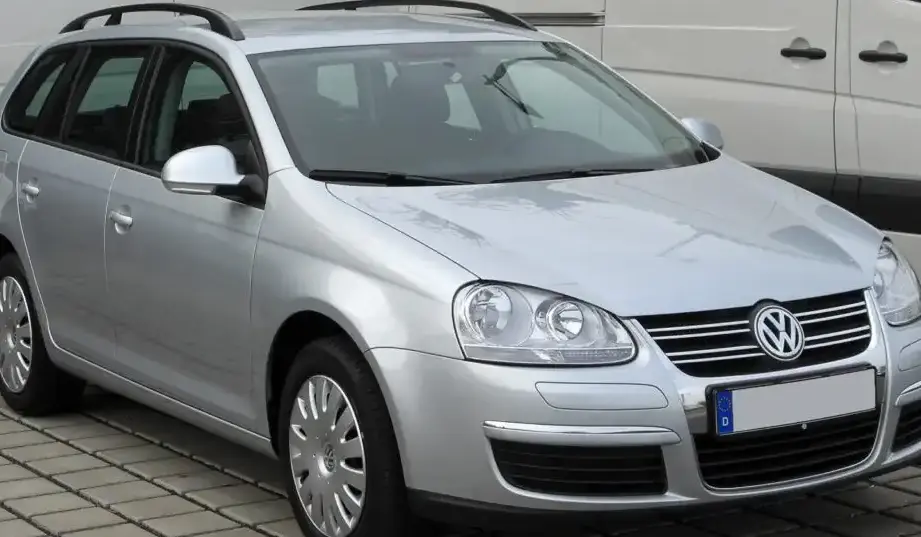
The Volkswagen Golf V Variant 1.4 TSI (160 hp) was a station wagon (estate) model produced between May 2008 and May 2009. It represented a key offering within the Golf Mk5 Variant range, blending practicality with a relatively efficient and powerful turbocharged engine. Positioned as a mid-range option, it aimed to appeal to buyers seeking more than the base engine offered but didn’t require the performance of the GTI or diesel variants. The Golf V Variant, built on the A5 platform (internally designated 1HX0), was Volkswagen’s attempt to provide a more versatile body style to the popular Golf lineup, competing with other compact estates like the Ford Focus Estate and Opel Astra Sports Tourer.
Technical Specifications
| Brand | Volkswagen |
| Model | Golf |
| Generation | Golf V Variant |
| Type (Engine) | 1.4 TSI (160 Hp) |
| Start of production | May, 2008 |
| End of production | May, 2009 |
| Powertrain Architecture | Internal Combustion engine |
| Body type | Station wagon (estate) |
| Seats | 5 |
| Doors | 5 |
| Fuel consumption (economy) – urban (NEDC) | 8.6 l/100 km (27.4 US mpg, 32.8 UK mpg, 11.6 km/l) |
| Fuel consumption (economy) – extra urban (NEDC) | 5.5 l/100 km (42.8 US mpg, 51.4 UK mpg, 18.2 km/l) |
| Fuel consumption (economy) – combined (NEDC) | 6.6 l/100 km (35.6 US mpg, 42.8 UK mpg, 15.2 km/l) |
| CO2 emissions (NEDC) | 154 g/km |
| Fuel Type | Petrol (Gasoline) |
| Acceleration 0 – 100 km/h | 8.5 sec |
| Acceleration 0 – 62 mph | 8.5 sec |
| Acceleration 0 – 60 mph | 8.1 sec |
| Maximum speed | 220 km/h (136.7 mph) |
| Emission standard | Euro 4 |
| Weight-to-power ratio | 8.5 kg/Hp, 118.2 Hp/tonne |
| Weight-to-torque ratio | 5.6 kg/Nm, 177.3 Nm/tonne |
| Power | 160 Hp @ 5800 rpm |
| Power per litre | 115.1 Hp/l |
| Torque | 240 Nm @ 1500-4500 rpm (177.01 lb.-ft. @ 1500-4500 rpm) |
| Engine layout | Front, Transverse |
| Engine Model/Code | EA111 / CAVD |
| Engine displacement | 1390 cm3 (84.82 cu. in.) |
| Number of cylinders | 4 |
| Engine configuration | Inline |
| Cylinder Bore | 76.5 mm (3.01 in.) |
| Piston Stroke | 75.6 mm (2.98 in.) |
| Compression ratio | 9.7:1 |
| Number of valves per cylinder | 4 |
| Fuel injection system | Direct injection |
| Engine aspiration | Turbocharging and Supercharger, Intercooler |
| Valvetrain | DOHC |
| Engine oil capacity | 3.6 l (3.8 US qt | 3.17 UK qt) |
| Coolant | 5.6 l (5.92 US qt | 4.93 UK qt) |
| Kerb Weight | 1354 kg (2985.06 lbs.) |
| Max. weight | 1960 kg (4321.06 lbs.) |
| Max load | 606 kg (1336 lbs.) |
| Trunk (boot) space – minimum | 505 l (17.83 cu. ft.) |
| Trunk (boot) space – maximum | 1495 l (52.8 cu. ft.) |
| Fuel tank capacity | 55 l (14.53 US gal | 12.1 UK gal) |
| Max. roof load | 75 kg (165.35 lbs.) |
| Permitted trailer load with brakes (8%) | 1700 kg (3747.86 lbs.) |
| Permitted trailer load with brakes (12%) | 1400 kg (3086.47 lbs.) |
| Permitted trailer load without brakes | 710 kg (1565.28 lbs.) |
| Permitted towbar download | 75 kg (165.35 lbs.) |
| Length | 4556 mm (179.37 in.) |
| Width | 1781 mm (70.12 in.) |
| Width including mirrors | 2003 mm (78.86 in.) |
| Height | 1504 mm (59.21 in.) |
| Wheelbase | 2578 mm (101.5 in.) |
| Front track | 1535 mm (60.43 in.) |
| Rear (Back) track | 1508 mm (59.37 in.) |
| Minimum turning circle (turning diameter) | 10.9 m (35.76 ft.) |
| Approach angle | 13.6° |
| Departure angle | 11.9° |
| Ramp-over (brakeover) angle | 8.8° |
| Drivetrain Architecture | The Internal combustion engine (ICE) drives the front wheels of the vehicle. |
| Drive wheel | Front wheel drive |
| Number of gears and type of gearbox | 6 gears, manual transmission |
| Front suspension | Independent, type McPherson with coil spring and anti-roll bar |
| Rear suspension | Independent multi-link spring suspension with stabilizer |
| Front brakes | Ventilated discs |
| Rear brakes | Disc |
| Assisting systems | ABS (Anti-lock braking system) |
| Steering type | Steering rack and pinion |
| Power steering | Electric Steering |
| Tires size | 205/55 R16; 225/45 R17 |
| Wheel rims size | 6.5J x 16; 7J x 17 |
Powertrain & Engine Architecture
The heart of the Golf V Variant 1.4 TSI was the EA111 engine code, specifically the CAVD variant. This 1.4-liter inline-four engine was notable for its combination of turbocharging and supercharging – a relatively uncommon setup at the time. The supercharger provided immediate boost at low engine speeds, eliminating turbo lag, while the turbocharger took over at higher RPMs for sustained power. This dual-charging system, coupled with direct fuel injection, allowed for a broad torque curve and respectable power output. The engine featured a double overhead camshaft (DOHC) valvetrain with four valves per cylinder. The six-speed manual transmission was standard, offering precise shifts and contributing to the car’s overall efficiency.
Driving Characteristics
The 160 hp 1.4 TSI engine in the Golf V Variant provided a good balance between performance and fuel economy. Acceleration from 0-60 mph took approximately 8.1 seconds, making it reasonably quick for a family estate. The supercharger ensured responsive acceleration from a standstill, while the turbocharger provided ample power for overtaking maneuvers. Compared to the base 1.6-liter engine, the 1.4 TSI offered a significant performance upgrade. However, it didn’t match the outright speed of the Golf GTI or the torque of the 2.0 TDI diesel variants. The six-speed manual transmission was well-matched to the engine’s characteristics, offering a good spread of gears for both city driving and highway cruising. The front-wheel-drive configuration provided predictable handling, although it could exhibit some torque steer under hard acceleration.
Equipment & Trim Levels
The Golf V Variant 1.4 TSI typically came with a reasonable level of standard equipment. This included air conditioning, electric front windows, central locking, and a basic audio system. Higher trim levels added features such as alloy wheels, a multi-function steering wheel, cruise control, and upgraded upholstery. Optional extras included a sunroof, parking sensors, and a more sophisticated navigation system. Interior upholstery was typically cloth, with the option of leather upgrades. The dashboard layout was typical of the Mk5 Golf, with a functional and ergonomic design.
Chassis & Braking
The Golf V Variant featured independent suspension on all four wheels. The front suspension utilized a McPherson strut setup, while the rear employed a multi-link system. This configuration provided a comfortable ride and good handling characteristics. The 1.4 TSI variant typically came equipped with ventilated front disc brakes and solid rear disc brakes. Anti-lock Braking System (ABS) was standard. Stabilizer bars were fitted to both the front and rear axles to reduce body roll during cornering. The suspension was tuned to prioritize comfort and practicality, making it well-suited for everyday driving and carrying passengers or cargo.
Market Reception & Comparison
The Golf V Variant 1.4 TSI was generally well-received by automotive critics. It was praised for its refined engine, good fuel economy, and practical estate car body style. However, some reviewers noted that the engine could feel slightly strained when fully loaded or driving uphill. Compared to the 1.6-liter Golf Variant, the 1.4 TSI offered a noticeable performance improvement, but at a slightly higher price point. The 2.0 TDI diesel variants offered even better fuel economy and torque, but were more expensive to purchase. The 1.4 TSI represented a good compromise for buyers seeking a balance between performance, economy, and practicality.
Legacy
The EA111 1.4 TSI engine, while innovative, did have some known issues. Early versions were prone to carbon buildup on the intake valves, which could lead to rough running and reduced performance. Regular servicing and the use of quality fuel were essential to mitigate this problem. Despite these potential issues, the engine proved to be relatively durable when properly maintained. Today, the Golf V Variant 1.4 TSI can be found on the used car market at affordable prices. It remains a practical and versatile option for buyers seeking a compact estate car, but potential buyers should be aware of the potential carbon buildup issue and ensure that the vehicle has been well-maintained.