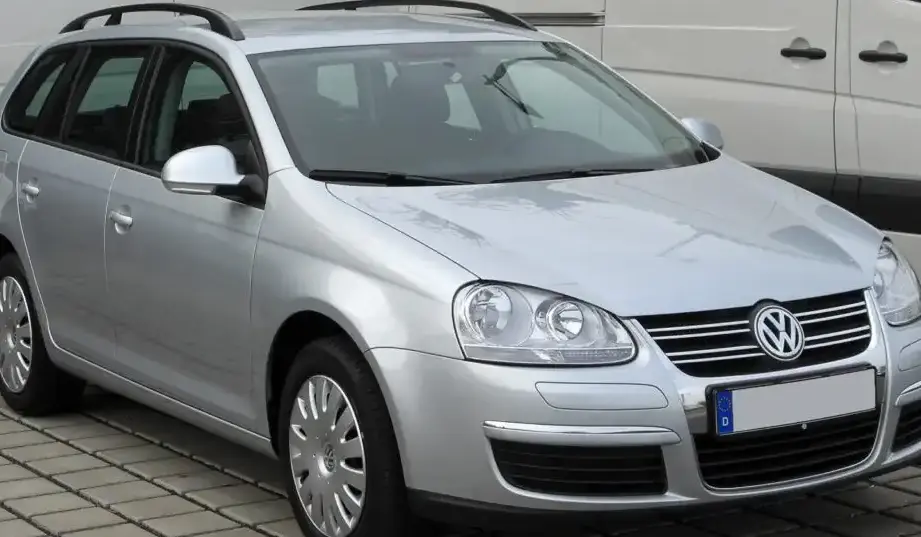
The Volkswagen Golf V Variant 1.4 TSI (160 hp) DSG was a station wagon (estate) model produced between May 2008 and May 2009. It represented a key offering within the Golf Mk5 Variant range, blending practicality with a relatively efficient and powerful turbocharged engine. Positioned as a mid-range option, it aimed to provide a balance between affordability and performance, appealing to buyers seeking a versatile family vehicle. The Golf V Variant, built on the A5 platform (internally designated 1HX0), offered increased cargo capacity compared to the standard Golf hatchback, making it a popular choice in European markets.
Technical Specifications
| Brand | Volkswagen |
| Model | Golf |
| Generation | Golf V Variant |
| Type (Engine) | 1.4 TSI (160 Hp) DSG |
| Start of production | May, 2008 |
| End of production | May, 2009 |
| Powertrain Architecture | Internal Combustion engine |
| Body type | Station wagon (estate) |
| Seats | 5 |
| Doors | 5 |
| Fuel consumption (economy) – urban (NEDC) | 8 l/100 km (29.4 US mpg, 35.3 UK mpg, 12.5 km/l) |
| Fuel consumption (economy) – extra urban (NEDC) | 5.4 l/100 km (43.6 US mpg, 52.3 UK mpg, 18.5 km/l) |
| Fuel consumption (economy) – combined (NEDC) | 6.4 l/100 km (36.8 US mpg, 44.1 UK mpg, 15.6 km/l) |
| CO2 emissions (NEDC) | 148 g/km |
| Fuel Type | Petrol (Gasoline) |
| Acceleration 0 – 100 km/h | 8.5 sec |
| Acceleration 0 – 62 mph | 8.5 sec |
| Acceleration 0 – 60 mph | 8.1 sec |
| Maximum speed | 220 km/h (136.7 mph) |
| Emission standard | Euro 4 |
| Weight-to-power ratio | 8.6 kg/Hp, 116.9 Hp/tonne |
| Weight-to-torque ratio | 5.7 kg/Nm, 175.3 Nm/tonne |
| Power | 160 Hp @ 5800 rpm |
| Power per litre | 115.1 Hp/l |
| Torque | 240 Nm @ 1500-4500 rpm (177.01 lb.-ft. @ 1500-4500 rpm) |
| Engine layout | Front, Transverse |
| Engine Model/Code | EA111 / CAVD |
| Engine displacement | 1390 cm3 (84.82 cu. in.) |
| Number of cylinders | 4 |
| Engine configuration | Inline |
| Cylinder Bore | 76.5 mm (3.01 in.) |
| Piston Stroke | 75.6 mm (2.98 in.) |
| Compression ratio | 9.7:1 |
| Number of valves per cylinder | 4 |
| Fuel injection system | Direct injection |
| Engine aspiration | Turbocharging and Supercharger, Intercooler |
| Valvetrain | DOHC |
| Engine oil capacity | 3.6 l (3.8 US qt | 3.17 UK qt) |
| Coolant | 5.6 l (5.92 US qt | 4.93 UK qt) |
| Kerb Weight | 1369 kg (3018.13 lbs.) |
| Max. weight | 1970 kg (4343.11 lbs.) |
| Max load | 601 kg (1324.98 lbs.) |
| Trunk (boot) space – minimum | 505 l (17.83 cu. ft.) |
| Trunk (boot) space – maximum | 1495 l (52.8 cu. ft.) |
| Fuel tank capacity | 55 l (14.53 US gal | 12.1 UK gal) |
| Max. roof load | 75 kg (165.35 lbs.) |
| Permitted trailer load with brakes (8%) | 1700 kg (3747.86 lbs.) |
| Permitted trailer load with brakes (12%) | 1400 kg (3086.47 lbs.) |
| Permitted trailer load without brakes | 720 kg (1587.33 lbs.) |
| Permitted towbar download | 75 kg (165.35 lbs.) |
| Length | 4556 mm (179.37 in.) |
| Width | 1781 mm (70.12 in.) |
| Width including mirrors | 2003 mm (78.86 in.) |
| Height | 1504 mm (59.21 in.) |
| Wheelbase | 2578 mm (101.5 in.) |
| Front track | 1535 mm (60.43 in.) |
| Rear (Back) track | 1508 mm (59.37 in.) |
| Minimum turning circle (turning diameter) | 10.9 m (35.76 ft.) |
| Approach angle | 13.6° |
| Departure angle | 11.9° |
| Ramp-over (brakeover) angle | 8.8° |
| Drivetrain Architecture | The Internal combustion engine (ICE) drives the front wheels of the vehicle. |
| Drive wheel | Front wheel drive |
| Number of gears and type of gearbox | 7 gears, automatic transmission DSG |
| Front suspension | Independent, type McPherson with coil spring and anti-roll bar |
| Rear suspension | Independent multi-link spring suspension with stabilizer |
| Front brakes | Ventilated discs |
| Rear brakes | Disc |
| Assisting systems | ABS (Anti-lock braking system) |
| Steering type | Steering rack and pinion |
| Power steering | Electric Steering |
| Tires size | 205/55 R16; 225/45 R17 |
| Wheel rims size | 6.5J x 16; 7J x 17 |
Powertrain & Engine Architecture
The heart of the Golf V Variant 1.4 TSI (160 hp) DSG is the EA111 engine code, specifically the CAVD variant. This 1.4-liter inline-four cylinder engine utilizes both a turbocharger and a supercharger – a configuration known as “twincharging.” The supercharger provides immediate boost at low engine speeds, eliminating turbo lag, while the turbocharger takes over at higher RPMs for sustained power delivery. Direct fuel injection further enhances efficiency and performance. The engine produces 160 horsepower at 5800 rpm and 240 Nm (177 lb-ft) of torque between 1500 and 4500 rpm. This broad torque curve contributes to strong acceleration and flexible performance in everyday driving. The engine is transversely mounted, driving the front wheels. The DSG (Direct-Shift Gearbox) is a seven-speed dual-clutch transmission, offering quick and smooth gear changes, contributing to both performance and fuel economy.
Driving Characteristics
The 1.4 TSI with the DSG transmission provided a surprisingly sprightly driving experience for a family-oriented station wagon. Acceleration to 60 mph took approximately 8.1 seconds, and the car felt responsive in most driving situations. The DSG transmission’s quick shifts helped to maximize the engine’s power output. Compared to the base 1.6-liter engine, the 1.4 TSI offered a significant performance upgrade. While not as powerful as the Golf GT models with larger engines, the 1.4 TSI provided a good balance of performance and fuel efficiency. The DSG transmission, while generally smooth, could occasionally exhibit some low-speed jerkiness. The gear ratios were tuned for a blend of acceleration and fuel economy, prioritizing usability over outright performance.
Equipment & Trim Levels
The 1.4 TSI DSG variant of the Golf V Variant typically came equipped with a reasonable level of standard features. These included air conditioning, power windows, power mirrors, a CD stereo system, and alloy wheels. Safety features such as ABS, front and side airbags, and a driver information system were also standard. Optional extras included a sunroof, upgraded audio systems, parking sensors, and leather upholstery. Trim levels varied slightly depending on the market, but generally, this engine/transmission combination represented a mid-range offering, positioned above the base models but below the more performance-focused GT variants.
Chassis & Braking
The Golf V Variant’s chassis featured independent suspension all around – McPherson struts at the front and a multi-link setup at the rear. This configuration provided a comfortable ride and good handling characteristics. The front brakes were ventilated discs, while the rear brakes were solid discs. ABS (Anti-lock Braking System) was standard. Stabilizer bars were fitted to both the front and rear axles to reduce body roll during cornering. The suspension tuning was geared towards comfort and everyday usability, rather than outright sportiness.
Market Reception & Comparison
The Golf V Variant 1.4 TSI DSG was generally well-received by automotive critics. It was praised for its blend of performance, fuel efficiency, and practicality. The twincharged engine was considered a technological highlight, offering a unique driving experience. Compared to the 1.6-liter Golf Variant, the 1.4 TSI offered a noticeable performance improvement, while maintaining competitive fuel economy. The 2.0-liter TDI diesel variants offered even better fuel economy but at the expense of some refinement. The 1.4 TSI was often seen as a good compromise for buyers who wanted a balance of performance and efficiency.
Legacy
The EA111 1.4 TSI engine, while innovative, did experience some reliability issues, particularly related to carbon buildup on the intake valves. Regular servicing and the use of quality fuel were crucial to maintaining its long-term health. The DSG transmission, while generally reliable, could require expensive repairs if not properly maintained. Today, the Golf V Variant 1.4 TSI DSG can be found on the used car market at relatively affordable prices. It remains a practical and versatile option for buyers seeking a spacious and efficient station wagon, but potential buyers should be aware of the potential maintenance costs associated with the engine and transmission.