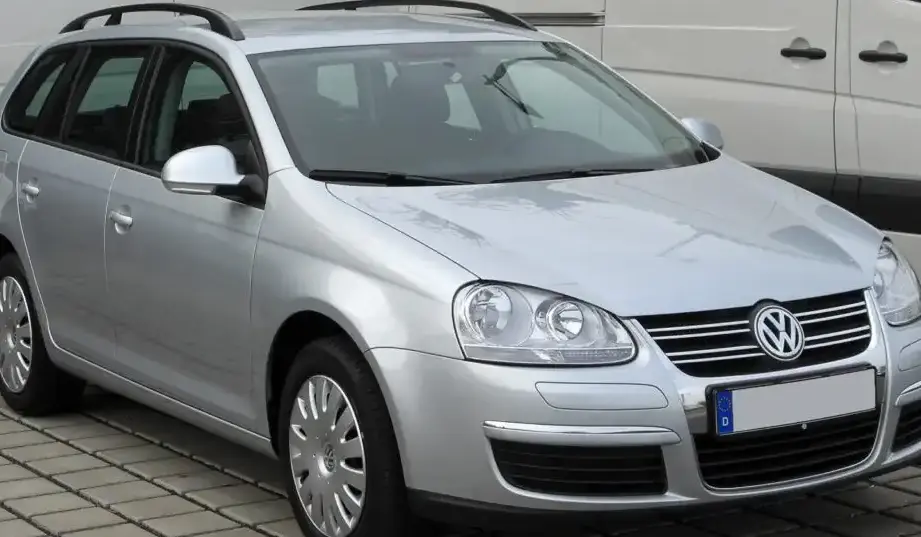
The Volkswagen Golf V Variant 1.6, producing 102 horsepower with an automatic transmission, was a popular choice in the European market between March 2007 and May 2009. Positioned as an entry-level to mid-range option within the Golf V Variant (estate) lineup, it offered practicality and fuel efficiency for families and individuals seeking a versatile vehicle. This variant was part of the Golf Mk5 generation (internally designated the 1HX0/A3 platform), known for its refined chassis and improved interior quality compared to its predecessor.
Technical Specifications
| Brand | Volkswagen |
| Model | Golf |
| Generation | Golf V Variant |
| Type (Engine) | 1.6 (102 Hp) Automatic |
| Start of production | March, 2007 |
| End of production | May, 2009 |
| Powertrain Architecture | Internal Combustion engine |
| Body type | Station wagon (estate) |
| Seats | 5 |
| Doors | 5 |
| Fuel consumption (economy) – urban (NEDC) | 11.3 l/100 km (20.8 US mpg, 25 UK mpg, 8.8 km/l) |
| Fuel consumption (economy) – extra urban (NEDC) | 6.4 l/100 km (36.8 US mpg, 44.1 UK mpg, 15.6 km/l) |
| Fuel consumption (economy) – combined (NEDC) | 8.2 l/100 km (28.7 US mpg, 34.4 UK mpg, 12.2 km/l) |
| CO2 emissions (NEDC) | 195 g/km |
| Fuel Type | Petrol (Gasoline) |
| Acceleration 0 – 100 km/h | 13.6 sec |
| Acceleration 0 – 62 mph | 13.6 sec |
| Acceleration 0 – 60 mph | 12.9 sec |
| Maximum speed | 181 km/h (112.47 mph) |
| Emission standard | Euro 4 |
| Weight-to-power ratio | 12.9 kg/Hp, 77.3 Hp/tonne |
| Weight-to-torque ratio | 8.9 kg/Nm, 112.2 Nm/tonne |
| Power | 102 Hp @ 5600 rpm |
| Power per litre | 63.9 Hp/l |
| Torque | 148 Nm @ 3800 rpm (109.16 lb.-ft. @ 3800 rpm) |
| Engine layout | Front, Transverse |
| Engine Model/Code | BSE, BSF |
| Engine displacement | 1595 cm3 (97.33 cu. in.) |
| Number of cylinders | 4 |
| Engine configuration | Inline |
| Cylinder Bore | 81 mm (3.19 in.) |
| Piston Stroke | 77.4 mm (3.05 in.) |
| Compression ratio | 10.5:1 |
| Number of valves per cylinder | 2 |
| Fuel injection system | Multi-port manifold injection |
| Engine aspiration | Naturally aspirated engine |
| Valvetrain | SOHC |
| Engine oil capacity | 4.5 l (4.76 US qt | 3.96 UK qt) |
| Coolant | 8 l (8.45 US qt | 7.04 UK qt) |
| Kerb Weight | 1319 kg (2907.9 lbs.) |
| Max. weight | 1940 kg (4276.97 lbs.) |
| Max load | 621 kg (1369.07 lbs.) |
| Trunk (boot) space – minimum | 505 l (17.83 cu. ft.) |
| Trunk (boot) space – maximum | 1495 l (52.8 cu. ft.) |
| Fuel tank capacity | 55 l (14.53 US gal | 12.1 UK gal) |
| Max. roof load | 75 kg (165.35 lbs.) |
| Permitted trailer load with brakes (8%) | 1500 kg (3306.93 lbs.) |
| Permitted trailer load with brakes (12%) | 1200 kg (2645.55 lbs.) |
| Permitted trailer load without brakes | 690 kg (1521.19 lbs.) |
| Permitted towbar download | 75 kg (165.35 lbs.) |
| Length | 4556 mm (179.37 in.) |
| Width | 1781 mm (70.12 in.) |
| Width including mirrors | 2003 mm (78.86 in.) |
| Height | 1504 mm (59.21 in.) |
| Wheelbase | 2578 mm (101.5 in.) |
| Front track | 1535 mm (60.43 in.) |
| Rear (Back) track | 1508 mm (59.37 in.) |
| Minimum turning circle (turning diameter) | 10.9 m (35.76 ft.) |
| Approach angle | 13.6° |
| Departure angle | 11.9° |
| Ramp-over (brakeover) angle | 8.8° |
| Drivetrain Architecture | The Internal combustion engine (ICE) drives the front wheels of the vehicle. |
| Drive wheel | Front wheel drive |
| Number of gears and type of gearbox | 6 gears, automatic transmission |
| Front suspension | Independent, type McPherson with coil spring and anti-roll bar |
| Rear suspension | Independent multi-link spring suspension with stabilizer |
| Front brakes | Ventilated discs |
| Rear brakes | Disc |
| Assisting systems | ABS (Anti-lock braking system) |
| Steering type | Steering rack and pinion |
| Power steering | Electric Steering |
| Tires size | 205/55 R16; 225/45 R17 |
| Wheel rims size | 6.5J x 16; 7J x 17 |
Powertrain & Engine Architecture
The Golf V Variant 1.6 Automatic was powered by the BSE or BSF engine code, a 1.6-liter inline-four cylinder gasoline engine. This engine featured a single overhead camshaft (SOHC) valvetrain with two valves per cylinder. Fuel delivery was managed by a multi-port fuel injection system, a common setup for engines of this era. The engine’s 102 horsepower output at 5600 rpm and 148 Nm (109 lb-ft) of torque at 3800 rpm were considered adequate for everyday driving, but not particularly sporty. The engine was transversely mounted in the front of the vehicle. The automatic transmission was a conventional six-speed unit, offering smooth shifts but contributing to slightly slower acceleration compared to the manual transmission options.
Driving Characteristics
The 1.6-liter engine paired with the automatic transmission delivered a comfortable, if not exhilarating, driving experience. Acceleration from 0 to 60 mph took around 12.9 seconds, and the top speed was 112.47 mph. The automatic transmission’s gear ratios were tuned for fuel efficiency rather than performance. While the engine provided sufficient power for highway cruising and city driving, overtaking maneuvers required careful planning. Compared to the more powerful 1.9 TDI diesel or the 2.0-liter FSI gasoline engines available in the Golf V Variant range, this variant felt noticeably slower. However, the automatic transmission made it a more accessible option for drivers who preferred the convenience of not having to shift gears.
Equipment & Trim Levels
The 1.6-liter Automatic Golf V Variant typically came with a reasonable level of standard equipment. This included power windows, central locking, air conditioning, and an audio system. Interior upholstery was usually cloth, with options for upgraded materials available. Depending on the specific market and optional packages selected, features like alloy wheels, a multi-function steering wheel, and parking sensors could be added. The trim level generally sat in the lower-mid range of the Golf V Variant lineup, offering a good balance of features and affordability.
Chassis & Braking
The Golf V Variant featured an independent suspension setup, with McPherson struts at the front and a multi-link system at the rear. This provided a comfortable ride and decent handling characteristics. The front brakes were ventilated discs, while the rear brakes were solid discs. Anti-lock Braking System (ABS) was standard. The suspension was tuned to prioritize comfort over sporty handling, making it well-suited for everyday driving and long journeys. Stabilizer bars were included both front and rear to reduce body roll during cornering.
Market Reception & Comparison
The Golf V Variant 1.6 Automatic was generally well-received as a practical and economical family car. Critics praised its spacious interior, comfortable ride, and fuel efficiency. However, some reviewers noted its relatively slow acceleration and lack of sporty driving dynamics. Compared to the diesel variants, the 1.6-liter gasoline engine offered lower fuel economy but a quieter and smoother driving experience. Against the more powerful gasoline engines, it provided a more affordable entry point into the Golf V Variant range, appealing to buyers who prioritized value and practicality over performance.
Legacy
The BSE and BSF engines, while not known for being particularly groundbreaking, proved to be relatively reliable. Common issues included occasional oil leaks and sensor failures, but these were generally not major concerns. Today, the Golf V Variant 1.6 Automatic can be found on the used car market at affordable prices. Its simplicity and relatively low maintenance costs make it an attractive option for budget-conscious buyers. While it may not offer the performance or advanced features of more modern vehicles, it remains a practical and dependable choice for those seeking a spacious and versatile estate car.