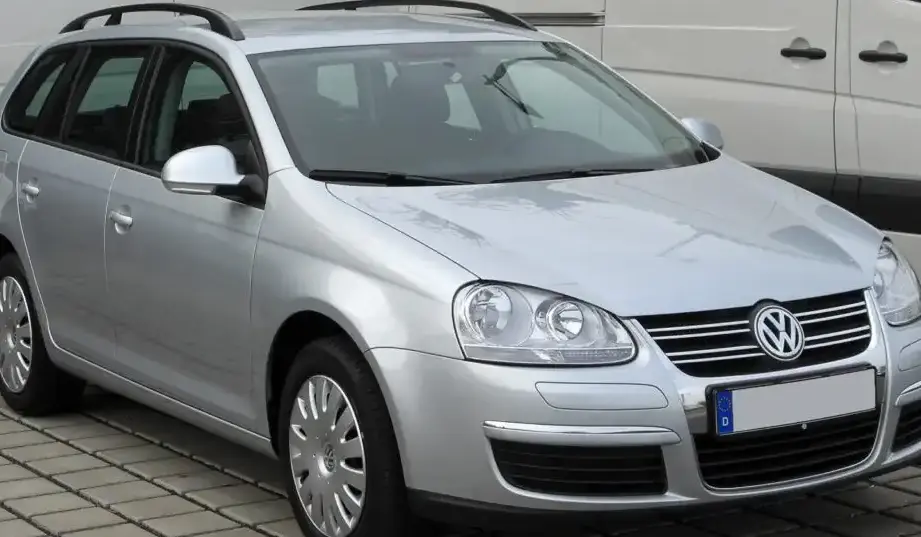
The Volkswagen Golf V Variant 1.9 TDI (105 hp) with the Direct-Shift Gearbox (DSG) was a popular configuration within the Golf Mk5 estate (wagon) range, produced between March 2007 and May 2009. Positioned as a fuel-efficient and practical option, it catered to buyers seeking a balance between economy, usability, and the convenience of an automatic transmission. This variant occupied a mid-range position in the Golf V Variant lineup, slotting below the more powerful petrol and higher-output diesel models, and above the base-level trims. It was primarily sold in the European market, where compact wagons were, and continue to be, highly sought after.
Technical Specifications
| Brand | Volkswagen |
| Model | Golf |
| Generation | Golf V Variant |
| Type (Engine) | 1.9 TDI (105 Hp) DSG |
| Start of production | March, 2007 |
| End of production | May, 2009 |
| Powertrain Architecture | Internal Combustion engine |
| Body type | Station wagon (estate) |
| Seats | 5 |
| Doors | 5 |
| Fuel consumption (urban) | 7.8 l/100 km (30.2 US mpg, 36.2 UK mpg, 12.8 km/l) |
| Fuel consumption (extra urban) | 5.1 l/100 km (46.1 US mpg, 55.4 UK mpg, 19.6 km/l) |
| Fuel consumption (combined) | 6 l/100 km (39.2 US mpg, 47.1 UK mpg, 16.7 km/l) |
| Fuel Type | Diesel |
| Acceleration 0 – 100 km/h | 12.6 sec |
| Acceleration 0 – 62 mph | 12.6 sec |
| Acceleration 0 – 60 mph | 12 sec |
| Maximum speed | 185 km/h (114.95 mph) |
| Emission standard | Euro 4 |
| Weight-to-power ratio | 13.3 kg/Hp, 75.3 Hp/tonne |
| Weight-to-torque ratio | 5.6 kg/Nm, 179.3 Nm/tonne |
| Power | 105 Hp @ 4000 rpm |
| Power per litre | 55.4 Hp/l |
| Torque | 250 Nm @ 1900 rpm (184.39 lb.-ft. @ 1900 rpm) |
| Engine layout | Front, Transverse |
| Engine Model/Code | EA188 / BXE |
| Engine displacement | 1896 cm3 (115.7 cu. in.) |
| Number of cylinders | 4 |
| Engine configuration | Inline |
| Cylinder Bore | 79.5 mm (3.13 in.) |
| Piston Stroke | 95.5 mm (3.76 in.) |
| Compression ratio | 19:1 |
| Number of valves per cylinder | 2 |
| Fuel injection system | Pump-nozzle (Unit Injector) |
| Engine aspiration | Turbocharger, Intercooler |
| Engine oil capacity | 3.8 l (4.02 US qt | 3.34 UK qt) |
| Coolant | 8 l (8.45 US qt | 7.04 UK qt) |
| Kerb Weight | 1394 kg (3073.24 lbs.) |
| Max. weight | 2020 kg (4453.34 lbs.) |
| Max load | 626 kg (1380.09 lbs.) |
| Trunk (boot) space – minimum | 505 l (17.83 cu. ft.) |
| Trunk (boot) space – maximum | 1495 l (52.8 cu. ft.) |
| Fuel tank capacity | 55 l (14.53 US gal | 12.1 UK gal) |
| Length | 4556 mm (179.37 in.) |
| Width | 1781 mm (70.12 in.) |
| Height | 1504 mm (59.21 in.) |
| Wheelbase | 2578 mm (101.5 in.) |
| Front track | 1535 mm (60.43 in.) |
| Rear (Back) track | 1508 mm (59.37 in.) |
| Minimum turning circle | 10.9 m (35.76 ft.) |
Powertrain & Engine Architecture
The heart of this Golf Variant is the 1.9-liter (1896 cc) inline-four cylinder diesel engine, designated the EA188 series and specifically coded BXE. This engine is a turbocharged diesel, utilizing a pump-nozzle (unit injector) fuel injection system. This system, while effective, was gradually replaced by common rail technology in later Volkswagen models. The BXE engine features a single overhead camshaft (SOHC) operating two valves per cylinder. The turbocharger, coupled with an intercooler, provides a boost in power and torque, allowing for reasonable performance despite the relatively small displacement. The engine produces 105 horsepower at 4000 rpm and 250 Nm (184 lb-ft) of torque at a low 1900 rpm. The engine’s transverse mounting and front-wheel drive configuration were standard for the Golf V.
The DSG (Direct-Shift Gearbox) is a six-speed automated manual transmission. It utilizes two separate clutches – one for the odd-numbered gears and one for the even-numbered gears. This allows for incredibly fast and smooth gear changes, offering a more engaging driving experience than a traditional automatic transmission while still providing the convenience of automatic operation. The DSG’s programming in this variant prioritized fuel efficiency and smooth shifts over outright performance.
Driving Characteristics
The 1.9 TDI (105 hp) DSG Golf V Variant offered a comfortable and practical driving experience. Acceleration from 0-100 km/h (0-62 mph) took approximately 12.6 seconds, and top speed was limited to 185 km/h (115 mph). While not particularly sporty, the engine’s strong low-end torque made it well-suited for everyday driving and overtaking maneuvers. The DSG transmission contributed to a smooth and refined driving experience, with quick and seamless gear changes. Compared to the manual transmission version, the DSG offered increased convenience, especially in urban traffic. However, it did slightly diminish fuel economy and offered a less direct connection to the engine. Compared to the more powerful 2.0 TDI variants, this engine felt noticeably less responsive, but it provided a significant fuel economy advantage.
Equipment & Trim Levels
The Golf V Variant 1.9 TDI (105 hp) DSG typically came equipped with a reasonable level of standard features. These included air conditioning, power windows, central locking, and an audio system. Interior upholstery was generally cloth, with options for upgraded materials available. Common optional extras included alloy wheels, a sunroof, parking sensors, and a more advanced audio system. Trim levels varied slightly depending on the specific market, but generally, this variant was positioned as a mid-range offering, providing a good balance of features and affordability.
Chassis & Braking
The Golf V Variant featured independent suspension at the front (MacPherson strut) and a multi-link rear suspension. This setup provided a comfortable ride and good handling characteristics. Braking systems varied, with lower trims often equipped with rear drum brakes, while higher trims received rear disc brakes. Anti-lock Braking System (ABS) was standard. Stabilizer bars were fitted to both the front and rear axles to reduce body roll during cornering. The suspension tuning was geared towards comfort and practicality rather than outright sportiness.
Market Reception & Comparison
The Golf V Variant 1.9 TDI (105 hp) DSG was well-received in the European market as a practical and fuel-efficient family car. Critics praised its comfortable ride, spacious interior, and the convenience of the DSG transmission. However, some noted that the engine lacked the punch of the more powerful petrol and diesel options. Fuel economy was a major selling point, with combined fuel consumption figures around 6 l/100 km (39.2 US mpg). Compared to the 2.0 TDI variants, this engine offered better fuel economy but less performance. Compared to petrol engines, the 1.9 TDI provided significantly better fuel economy and torque, making it ideal for long-distance driving and carrying loads.
Legacy
The 1.9 TDI engine, particularly the BXE code, is generally considered a reliable unit, although pump-nozzle injection systems can be prone to issues with the injectors over time. The DSG transmission, while sophisticated, requires regular maintenance (fluid changes) to ensure longevity. Today, the Golf V Variant 1.9 TDI (105 hp) DSG can be found on the used car market at relatively affordable prices. It remains a popular choice for buyers seeking a practical, fuel-efficient, and well-built estate car. Its reputation for reliability and low running costs continues to make it a desirable option, despite its age.