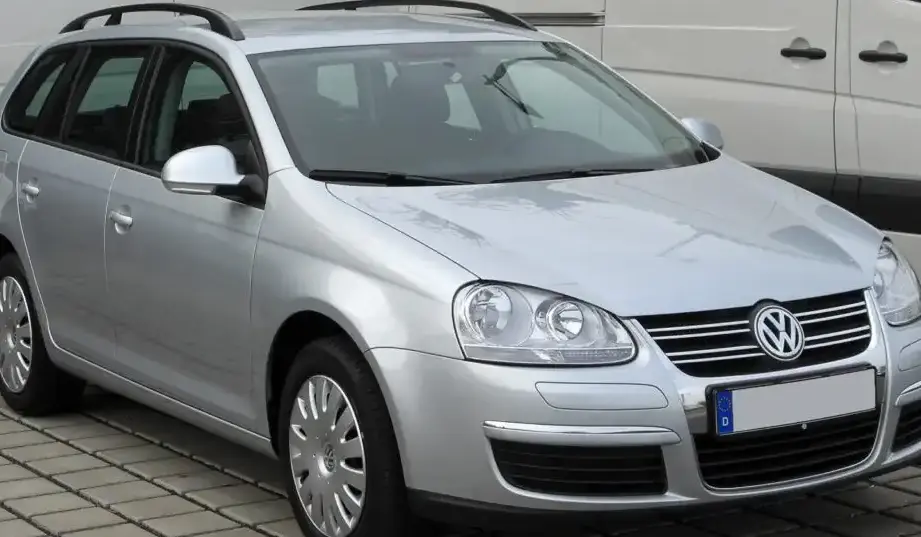
The Volkswagen Golf V Variant 2.0 TDI (140 hp) DPF, produced from May 2008 to May 2009, represents a practical and efficient offering within the fifth generation (Mk V) Golf lineup. As a station wagon (estate) variant, it catered to buyers needing increased cargo capacity without sacrificing the Golf’s renowned handling and build quality. This particular model occupied a mid-range position in the Golf V Variant portfolio, offering a balance between performance, fuel economy, and equipment levels. It was primarily marketed in Europe, where the station wagon body style remained highly popular, offering a compelling alternative to more expensive and less fuel-efficient vehicles.
Technical Specifications
| Brand | Volkswagen |
| Model | Golf |
| Generation | Golf V Variant |
| Type (Engine) | 2.0 TDI (140 Hp) DPF |
| Start of production | May, 2008 |
| End of production | May, 2009 |
| Powertrain Architecture | Internal Combustion engine |
| Body type | Station wagon (estate) |
| Seats | 5 |
| Doors | 5 |
| Fuel consumption (economy) – urban (NEDC) | 7.1 l/100 km (33.1 US mpg, 39.8 UK mpg, 14.1 km/l) |
| Fuel consumption (economy) – extra urban (NEDC) | 4.5 l/100 km (52.3 US mpg, 62.8 UK mpg, 22.2 km/l) |
| Fuel consumption (economy) – combined (NEDC) | 5.5 l/100 km (42.8 US mpg, 51.4 UK mpg, 18.2 km/l) |
| CO2 emissions (NEDC) | 143 g/km |
| Fuel Type | Diesel |
| Acceleration 0 – 100 km/h | 9.7 sec |
| Acceleration 0 – 62 mph | 9.7 sec |
| Acceleration 0 – 60 mph | 9.2 sec |
| Maximum speed | 205 km/h (127.38 mph) |
| Emission standard | Euro 4 |
| Weight-to-power ratio | 10 kg/Hp, 100.1 Hp/tonne |
| Weight-to-torque ratio | 4.4 kg/Nm, 228.7 Nm/tonne |
| Power | 140 Hp @ 4200 rpm |
| Power per litre | 71.1 Hp/l |
| Torque | 320 Nm @ 1750-2500 rpm (236.02 lb.-ft. @ 1750-2500 rpm) |
| Engine layout | Front, Transverse |
| Engine Model/Code | CBDB |
| Engine displacement | 1968 cm3 (120.09 cu. in.) |
| Number of cylinders | 4 |
| Engine configuration | Inline |
| Cylinder Bore | 81 mm (3.19 in.) |
| Piston Stroke | 95.5 mm (3.76 in.) |
| Compression ratio | 18.5:1 |
| Number of valves per cylinder | 4 |
| Fuel injection system | Diesel Commonrail |
| Engine aspiration | Turbocharger, Intercooler |
| Valvetrain | DOHC |
| Engine oil capacity | 4.3 l (4.54 US qt | 3.78 UK qt) |
| Coolant | 8 l (8.45 US qt | 7.04 UK qt) |
| Kerb Weight | 1399 kg (3084.27 lbs.) |
| Max. weight | 2010 kg (4431.29 lbs.) |
| Max load | 611 kg (1347.02 lbs.) |
| Trunk (boot) space – minimum | 505 l (17.83 cu. ft.) |
| Trunk (boot) space – maximum | 1495 l (52.8 cu. ft.) |
| Fuel tank capacity | 55 l (14.53 US gal | 12.1 UK gal) |
| Max. roof load | 75 kg (165.35 lbs.) |
| Permitted trailer load with brakes (8%) | 1700 kg (3747.86 lbs.) |
| Permitted trailer load with brakes (12%) | 1500 kg (3306.93 lbs.) |
| Permitted trailer load without brakes | 730 kg (1609.37 lbs.) |
| Permitted towbar download | 75 kg (165.35 lbs.) |
| Length | 4556 mm (179.37 in.) |
| Width | 1781 mm (70.12 in.) |
| Width including mirrors | 2003 mm (78.86 in.) |
| Height | 1504 mm (59.21 in.) |
| Wheelbase | 2578 mm (101.5 in.) |
| Front track | 1535 mm (60.43 in.) |
| Rear (Back) track | 1508 mm (59.37 in.) |
| Minimum turning circle (turning diameter) | 10.9 m (35.76 ft.) |
| Drivetrain Architecture | The Internal combustion engine (ICE) drives the front wheels of the vehicle. |
| Drive wheel | Front wheel drive |
| Number of gears and type of gearbox | 6 gears, manual transmission |
| Front suspension | Independent, type McPherson with coil spring and anti-roll bar |
| Rear suspension | Independent multi-link spring suspension with stabilizer |
| Front brakes | Ventilated discs |
| Rear brakes | Disc |
| Assisting systems | ABS (Anti-lock braking system) |
| Steering type | Steering rack and pinion |
| Power steering | Electric Steering |
| Tires size | 205/55 R16; 225/45 R17 |
| Wheel rims size | 6.5J x 16; 7J x 17 |
Powertrain & Engine Architecture
The heart of the Golf V Variant 2.0 TDI was the CBDB engine, a 1968cc inline-four cylinder diesel engine. This engine utilized a common rail direct injection system, delivering fuel directly into the combustion chamber at extremely high pressure for improved efficiency and reduced emissions. The CBDB featured a turbocharger with an intercooler, boosting power output to 140 horsepower at 4200 rpm and 320 Nm (236 lb-ft) of torque between 1750 and 2500 rpm. The engine employed a double overhead camshaft (DOHC) valvetrain with four valves per cylinder, optimizing gas flow for enhanced performance. A Diesel Particulate Filter (DPF) was standard equipment, crucial for meeting stringent Euro 4 emission standards. The engine was transversely mounted in the front of the vehicle, driving the front wheels. The 6-speed manual transmission was the standard gearbox, providing a good balance between fuel economy and driver control.
Driving Characteristics
The 2.0 TDI 140 hp engine in the Golf V Variant offered a respectable level of performance for everyday driving. Acceleration from 0 to 100 km/h (0-62 mph) took approximately 9.7 seconds, and top speed was rated at 205 km/h (127 mph). While not a sports car, the engine provided ample torque for comfortable cruising and overtaking maneuvers. The manual transmission allowed for precise gear selection, and the relatively long gearing contributed to good fuel economy. Compared to the more powerful 2.0 TDI 170 hp variant, the 140 hp version felt less urgent in its acceleration, but it offered a more relaxed driving experience. The 1.9 TDI models, while more economical, lacked the refinement and overall power of the 2.0-liter engine.
Equipment & Trim Levels
The Golf V Variant 2.0 TDI (140 hp) typically came equipped with a reasonable level of standard features. These included air conditioning, power windows, central locking, and an audio system. Interior upholstery was generally cloth, with options for upgraded materials. Trim levels varied by market, but common options included alloy wheels, a multi-function steering wheel, and parking sensors. Higher trim levels might also include features like automatic climate control, rain-sensing wipers, and a more advanced audio system. The Golf V Variant prioritized practicality and functionality, offering a comfortable and well-equipped interior without excessive luxury.
Chassis & Braking
The Golf V Variant featured an independent suspension system on both the front and rear axles. The front suspension utilized a McPherson strut design with coil springs and an anti-roll bar, while the rear employed a multi-link setup, also with a stabilizer bar. This configuration provided a good balance between ride comfort and handling precision. Brakes consisted of ventilated discs on the front wheels and solid discs on the rear. Anti-lock Braking System (ABS) was standard, enhancing safety during emergency braking situations. The chassis was designed to accommodate the increased weight of the station wagon body style while maintaining the Golf’s characteristic handling dynamics.
Market Reception & Comparison
The Golf V Variant 2.0 TDI (140 hp) was generally well-received by automotive critics. It was praised for its fuel efficiency, spacious interior, and comfortable ride. The engine was considered a good compromise between performance and economy. Compared to other station wagons in its class, the Golf V Variant offered a more refined driving experience and a higher perceived quality. The 140 hp version was often seen as a sweet spot in the lineup, offering enough power for most drivers without the higher running costs associated with the more powerful engines. Fuel economy figures of around 5.5 l/100 km (42.8 US mpg) were considered excellent for a vehicle of its size and type.
Legacy
The CBDB engine, while generally reliable, is known to have some potential issues, including DPF clogging and occasional turbocharger failures. Regular maintenance, including timely oil changes and DPF regeneration, is crucial for ensuring long-term reliability. Today, the Golf V Variant 2.0 TDI (140 hp) can be found on the used car market at relatively affordable prices. It remains a popular choice for buyers seeking a practical, fuel-efficient, and well-built station wagon. Its reputation for reliability, combined with the Golf’s enduring appeal, ensures that it continues to hold its value and remain a viable option for those seeking a dependable family vehicle.