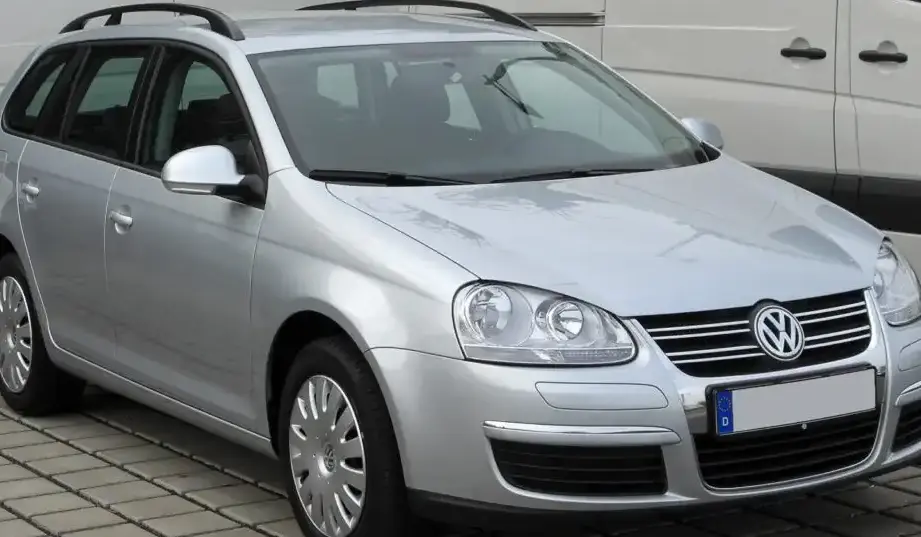
The Volkswagen Golf V Variant 2.0 TDI with 140 horsepower and a Direct-Shift Gearbox (DSG) was a popular configuration within the Golf Mk5 estate (wagon) range, produced between May 2008 and May 2009. Positioned as a mid-range offering, it balanced fuel efficiency with respectable performance, appealing to buyers seeking a practical and economical family vehicle. This variant was primarily sold in the European market, where station wagons held a significant share of the automotive landscape. It represented a key part of Volkswagen’s strategy to offer a diverse Golf lineup catering to various customer needs.
Technical Specifications
| Brand | Volkswagen |
| Model | Golf |
| Generation | Golf V Variant |
| Type (Engine) | 2.0 TDI (140 Hp) DPF DSG |
| Start of production | May, 2008 |
| End of production | May, 2009 |
| Powertrain Architecture | Internal Combustion engine |
| Body type | Station wagon (estate) |
| Seats | 5 |
| Doors | 5 |
| Fuel consumption (economy) – urban (NEDC) | 7.6 l/100 km (30.9 US mpg, 37.2 UK mpg, 13.2 km/l) |
| Fuel consumption (economy) – extra urban (NEDC) | 4.8 l/100 km (49 US mpg, 58.9 UK mpg, 20.8 km/l) |
| Fuel consumption (economy) – combined (NEDC) | 5.8 l/100 km (40.6 US mpg, 48.7 UK mpg, 17.2 km/l) |
| CO2 emissions (NEDC) | 154 g/km |
| Fuel Type | Diesel |
| Acceleration 0 – 100 km/h | 9.7 sec |
| Acceleration 0 – 62 mph | 9.7 sec |
| Acceleration 0 – 60 mph | 9.2 sec |
| Maximum speed | 203 km/h (126.14 mph) |
| Emission standard | Euro 4 |
| Weight-to-power ratio | 10.2 kg/Hp, 97.9 Hp/tonne |
| Weight-to-torque ratio | 4.5 kg/Nm, 223.8 Nm/tonne |
| Power | 140 Hp @ 4200 rpm |
| Power per litre | 71.1 Hp/l |
| Torque | 320 Nm @ 1750-2500 rpm (236.02 lb.-ft. @ 1750-2500 rpm) |
| Engine layout | Front, Transverse |
| Engine Model/Code | CBDB |
| Engine displacement | 1968 cm3 (120.09 cu. in.) |
| Number of cylinders | 4 |
| Engine configuration | Inline |
| Cylinder Bore | 81 mm (3.19 in.) |
| Piston Stroke | 95.5 mm (3.76 in.) |
| Compression ratio | 18.5:1 |
| Number of valves per cylinder | 4 |
| Fuel injection system | Diesel Commonrail |
| Engine aspiration | Turbocharger, Intercooler |
| Valvetrain | DOHC |
| Engine oil capacity | 4.3 l (4.54 US qt | 3.78 UK qt) |
| Coolant | 8 l (8.45 US qt | 7.04 UK qt) |
| Kerb Weight | 1430 kg (3152.61 lbs.) |
| Max. weight | 2040 kg (4497.43 lbs.) |
| Max load | 610 kg (1344.82 lbs.) |
| Trunk (boot) space – minimum | 505 l (17.83 cu. ft.) |
| Trunk (boot) space – maximum | 1495 l (52.8 cu. ft.) |
| Fuel tank capacity | 55 l (14.53 US gal | 12.1 UK gal) |
| Max. roof load | 75 kg (165.35 lbs.) |
| Permitted trailer load with brakes (8%) | 1700 kg (3747.86 lbs.) |
| Permitted trailer load with brakes (12%) | 1500 kg (3306.93 lbs.) |
| Permitted trailer load without brakes | 740 kg (1631.42 lbs.) |
| Permitted towbar download | 75 kg (165.35 lbs.) |
| Length | 4556 mm (179.37 in.) |
| Width | 1781 mm (70.12 in.) |
| Width including mirrors | 2003 mm (78.86 in.) |
| Height | 1504 mm (59.21 in.) |
| Wheelbase | 2578 mm (101.5 in.) |
| Front track | 1535 mm (60.43 in.) |
| Rear (Back) track | 1508 mm (59.37 in.) |
| Minimum turning circle (turning diameter) | 10.9 m (35.76 ft.) |
| Front suspension | Independent, type McPherson with coil spring and anti-roll bar |
| Rear suspension | Independent multi-link spring suspension with stabilizer |
| Front brakes | Ventilated discs |
| Rear brakes | Disc |
| Number of gears and type of gearbox | 6 gears, automatic transmission DSG |
INTRODUCTION
The Golf V Variant 2.0 TDI 140 DSG, launched in 2008, was a key component of Volkswagen’s strategy to broaden the appeal of the Mk5 Golf range. Building upon the success of the hatchback, the Variant (estate) offered increased practicality with a larger cargo area. This particular engine and transmission combination aimed to provide a balance between performance, fuel economy, and driving convenience. The 2.0 TDI engine was a mainstay of the Volkswagen Group’s diesel offerings, known for its robust nature and efficiency. The inclusion of the DSG gearbox, a dual-clutch transmission, further enhanced the driving experience by offering smooth and rapid gear changes.
Powertrain & Engine Architecture
The heart of this Golf Variant is the CBDB engine code, a 1968cc inline-four cylinder diesel engine. This engine utilizes a common rail direct injection system, delivering fuel directly into the combustion chamber at extremely high pressure. This technology, coupled with a turbocharger and intercooler, allows for increased power output and improved fuel efficiency. The engine features a double overhead camshaft (DOHC) valvetrain with four valves per cylinder, optimizing gas flow for enhanced performance. The 2.0 TDI produces 140 horsepower at 4200 rpm and 320 Nm (236 lb-ft) of torque between 1750 and 2500 rpm. The engine’s robust construction and advanced fuel injection system contribute to its reliability and longevity.
The DSG (Direct-Shift Gearbox) is a six-speed automatic transmission that operates on the principle of two separate clutches. One clutch controls the odd-numbered gears, while the other controls the even-numbered gears. This allows for seamless gear changes without interruption of power delivery. The DSG offers both fully automatic and manual shift modes, providing the driver with greater control. The transmission is electronically controlled, optimizing shift points for fuel efficiency or performance based on driving conditions.
Driving Characteristics
The 2.0 TDI 140 DSG Golf Variant offered a comfortable and refined driving experience. The engine provided ample torque for everyday driving, making overtaking and hill climbing relatively effortless. While not a sports car, the 9.7-second 0-62 mph acceleration was respectable for a family estate. The DSG gearbox contributed to smooth and quick gear changes, enhancing the overall driving experience. Compared to the lower-powered 1.9 TDI variants, the 2.0 TDI offered noticeably more performance. However, it didn’t quite match the responsiveness of the higher-output TDI models or the petrol-powered Golfs. The gear ratios were tuned for a balance between fuel economy and performance, prioritizing efficiency during cruising and providing sufficient power when needed.
Equipment & Trim Levels
The Golf V Variant 2.0 TDI 140 DSG typically came equipped with a reasonable level of standard features. These included air conditioning, electric windows, central locking, and a basic audio system. Higher trim levels offered additional features such as alloy wheels, a multi-function steering wheel, and upgraded upholstery. Optional extras included a sunroof, parking sensors, and a more advanced navigation system. Interior upholstery was typically cloth, with leather options available as an upgrade. The dashboard layout was functional and well-designed, with clear instrumentation and intuitive controls.
Chassis & Braking
The Golf V Variant featured independent suspension on all four wheels. The front suspension utilized a McPherson strut setup with coil springs and an anti-roll bar, while the rear suspension employed a multi-link system with a stabilizer bar. This configuration provided a comfortable ride and good handling characteristics. The braking system consisted of ventilated discs on the front wheels and solid discs on the rear. Anti-lock Braking System (ABS) was standard, enhancing safety by preventing wheel lockup during emergency braking. The suspension was tuned to provide a balance between comfort and handling, making it suitable for both city driving and long-distance journeys.
Market Reception & Comparison
The Golf V Variant 2.0 TDI 140 DSG was generally well-received by automotive critics. It was praised for its fuel efficiency, comfortable ride, and practical interior. However, some critics noted that the engine could be somewhat noisy under heavy acceleration. Compared to other trims in the Golf lineup, the 2.0 TDI 140 DSG offered a good balance between performance and economy. The 1.9 TDI variants were more fuel-efficient but lacked the power of the 2.0 TDI. The higher-output TDI models offered more performance but came at a higher price. The petrol-powered Golfs provided a more refined driving experience but were less fuel-efficient.
Legacy
The 2.0 TDI engine, in various iterations, proved to be a reliable and durable powerplant. The CBDB engine code, while not without its potential issues (such as DPF clogging and turbocharger wear), generally offered good longevity with proper maintenance. Today, the Golf V Variant 2.0 TDI 140 DSG can be found on the used car market at relatively affordable prices. It remains a popular choice for buyers seeking a practical, economical, and reliable estate car. However, potential buyers should be aware of the potential maintenance costs associated with diesel engines, such as DPF replacement and injector servicing. Overall, the Golf V Variant 2.0 TDI 140 DSG represents a well-rounded and capable vehicle that continues to offer good value for money.