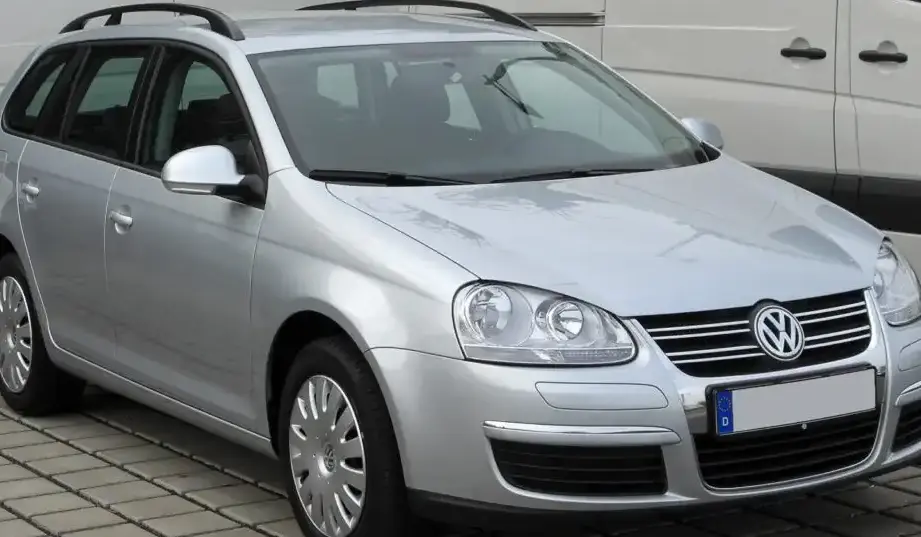
The Volkswagen Golf V Variant 2.0 TDI with 140 horsepower and a Direct-Shift Gearbox (DSG) was a popular configuration within the Golf Mk5 estate (wagon) range, produced between March 2007 and May 2008. Positioned as a mid-range offering, it aimed to balance fuel efficiency with respectable performance for European drivers seeking a practical and versatile family vehicle. This variant represented a significant step up in both power and driving experience compared to the lower-spec petrol engines, while remaining more affordable than the range-topping models. It was primarily sold in the European market, where diesel engines and station wagons held a substantial share of the automotive landscape.
Technical Specifications
| Brand | Volkswagen |
| Model | Golf |
| Generation | Golf V Variant |
| Type (Engine) | 2.0 TDI (140 Hp) DSG |
| Start of production | March, 2007 |
| End of production | May, 2008 |
| Powertrain Architecture | Internal Combustion engine |
| Body type | Station wagon (estate) |
| Seats | 5 |
| Doors | 5 |
| Fuel consumption (urban) | 8 l/100 km (29.4 US mpg, 35.3 UK mpg, 12.5 km/l) |
| Fuel consumption (extra urban) | 5 l/100 km (47 US mpg, 56.5 UK mpg, 20 km/l) |
| Fuel consumption (combined) | 6.1 l/100 km (38.6 US mpg, 46.3 UK mpg, 16.4 km/l) |
| Fuel Type | Diesel |
| Acceleration 0 – 100 km/h | 9.7 sec |
| Acceleration 0 – 62 mph | 9.7 sec |
| Acceleration 0 – 60 mph | 9.2 sec |
| Maximum speed | 203 km/h (126.14 mph) |
| Emission standard | Euro 4 |
| Weight-to-power ratio | 10.1 kg/Hp, 99 Hp/tonne |
| Weight-to-torque ratio | 4.4 kg/Nm, 226.3 Nm/tonne |
| Power | 140 Hp @ 4000 rpm |
| Power per litre | 71.1 Hp/l |
| Torque | 320 Nm @ 1750 rpm (236.02 lb.-ft. @ 1750 rpm) |
| Engine layout | Front, Transverse |
| Engine Model/Code | EA188 / BKD |
| Engine displacement | 1968 cm3 (120.09 cu. in.) |
| Number of cylinders | 4 |
| Engine configuration | Inline |
| Cylinder Bore | 81 mm (3.19 in.) |
| Piston Stroke | 95.5 mm (3.76 in.) |
| Compression ratio | 18.5:1 |
| Number of valves per cylinder | 4 |
| Fuel injection system | Pump-nozzle (Unit Injector) |
| Engine aspiration | Turbocharger, Intercooler |
| Engine oil capacity | 3.8 l (4.02 US qt | 3.34 UK qt) |
| Coolant | 8 l (8.45 US qt | 7.04 UK qt) |
| Kerb Weight | 1414 kg (3117.34 lbs.) |
| Max. weight | 2040 kg (4497.43 lbs.) |
| Max load | 626 kg (1380.09 lbs.) |
| Trunk (boot) space – minimum | 505 l (17.83 cu. ft.) |
| Trunk (boot) space – maximum | 1495 l (52.8 cu. ft.) |
| Fuel tank capacity | 55 l (14.53 US gal | 12.1 UK gal) |
| Length | 4556 mm (179.37 in.) |
| Width | 1781 mm (70.12 in.) |
| Height | 1504 mm (59.21 in.) |
| Wheelbase | 2578 mm (101.5 in.) |
| Front track | 1535 mm (60.43 in.) |
| Rear (Back) track | 1508 mm (59.37 in.) |
| Minimum turning circle | 10.9 m (35.76 ft.) |
Powertrain & Engine Architecture
The heart of this Golf Variant is the EA188 series 2.0-liter inline-four cylinder diesel engine, specifically the BKD engine code. This engine utilizes a common-rail direct injection system with pump-nozzle technology, delivering fuel directly into the combustion chamber at extremely high pressure. This system, coupled with a variable geometry turbocharger and intercooler, allows for a broad torque curve and efficient combustion. The engine features four valves per cylinder and a robust internal construction designed for longevity. The 18.5:1 compression ratio is typical for a diesel engine, contributing to its thermal efficiency. The engine is transversely mounted in the front of the vehicle, driving the front wheels.
The DSG (Direct-Shift Gearbox) is a six-speed dual-clutch transmission. It operates similarly to two manual gearboxes in one, with one clutch controlling the odd gears and the other controlling the even gears. This allows for incredibly fast and smooth gear changes, enhancing both performance and fuel economy. The DSG’s programming is tuned for a balance between comfort and responsiveness, offering both automatic and manual shift modes.
Driving Characteristics
The 2.0 TDI with 140 hp and the DSG transmission provides a noticeably more spirited driving experience than the base 1.6-liter petrol variants. Acceleration from 0-60 mph takes approximately 9.2 seconds, and the car feels capable on the highway. The DSG transmission contributes to this by providing quick and precise shifts, keeping the engine in its optimal power band. While not a sports car, the Golf V Variant 2.0 TDI offers ample power for everyday driving and overtaking maneuvers. Compared to the higher-output 170 hp TDI, this version feels less urgent, but the difference is often considered acceptable for drivers prioritizing fuel economy and a more relaxed driving style. The gear ratios are optimized for both fuel efficiency and usable power across a wide speed range.
Equipment & Trim Levels
The 2.0 TDI DSG variant typically came equipped with a reasonable level of standard features. This included air conditioning, power windows, central locking, an integrated radio/CD player, and alloy wheels. Safety features such as ABS, traction control, and multiple airbags were also standard. Higher trim levels, such as ‘Comfortline’ or ‘Highline’, added features like automatic climate control, upgraded upholstery, parking sensors, and a more sophisticated infotainment system. Optional extras included a sunroof, leather seats, and a navigation system.
Chassis & Braking
The Golf V Variant’s chassis utilizes independent suspension at the front (MacPherson strut) and a multi-link rear suspension. This setup provides a good balance between ride comfort and handling. The 2.0 TDI models generally featured slightly stiffer suspension components compared to the lower-spec versions to cope with the increased weight and power. Braking systems consisted of ventilated front discs and either disc or drum brakes at the rear, depending on the specific trim level. ABS (Anti-lock Braking System) was standard across the range.
Market Reception & Comparison
The Golf V Variant 2.0 TDI DSG was generally well-received by automotive critics. It was praised for its fuel efficiency, comfortable ride, and practical estate car body style. The DSG transmission was a particular highlight, offering a smooth and responsive driving experience. Compared to the 1.9 TDI models, the 2.0 TDI offered more power and refinement, albeit at a slightly higher price point. Against competitors like the Ford Focus Estate and Opel/Vauxhall Astra Estate, the Golf V Variant was often seen as offering a more premium feel and a more sophisticated driving experience.
Legacy
The EA188 2.0 TDI engine, in its various iterations, proved to be a relatively reliable powertrain, although early versions were known to have some issues with diesel particulate filter (DPF) clogging and turbocharger failures. Proper maintenance, including regular oil changes and DPF regeneration, is crucial for long-term reliability. Today, the Golf V Variant 2.0 TDI DSG can be found on the used car market at affordable prices. It remains a practical and economical choice for those seeking a versatile family vehicle, but potential buyers should be aware of the potential maintenance costs associated with a diesel engine and DSG transmission.