Technical Specifications
| Brand | Volkswagen |
| Model | Golf |
| Generation | Golf VI (3-door) |
| Type (Engine) | 2.5 (170 Hp) Tiptronic |
| Start of production | 2009 |
| End of production | 2013 |
| Powertrain Architecture | Internal Combustion engine |
| Body type | Hatchback |
| Seats | 5 |
| Doors | 3 |
| Fuel consumption (economy) – urban (EPA) | 9.8 l/100 km (24 US mpg) |
| Fuel consumption (economy) – extra urban (EPA) | 7.6 l/100 km (30.9 US mpg) |
| Fuel Type | Petrol (Gasoline) |
| Weight-to-power ratio | 8.1 kg/Hp, 124 Hp/tonne |
| Weight-to-torque ratio | 5.7 kg/Nm, 175.1 Nm/tonne |
| Power | 170 Hp @ 5700 rpm |
| Power per litre | 68.5 Hp/l |
| Torque | 240 Nm @ 4250 rpm (177.01 lb.-ft. @ 4250 rpm) |
| Engine layout | Front, Transverse |
| Engine Model/Code | CBTA, CBUA |
| Engine displacement | 2480 cm3 (151.34 cu. in.) |
| Number of cylinders | 5 |
| Engine configuration | Inline |
| Cylinder Bore | 82.5 mm (3.25 in.) |
| Piston Stroke | 92.8 mm (3.65 in.) |
| Compression ratio | 9.5:1 |
| Number of valves per cylinder | 4 |
| Fuel injection system | Multi-port manifold injection |
| Engine aspiration | Naturally aspirated engine |
| Valvetrain | DOHC |
| Engine oil capacity | 5.5 l (5.81 US qt | 4.84 UK qt) |
| Coolant | 9 l (9.51 US qt | 7.92 UK qt) |
| Kerb Weight | 1371 kg (3022.54 lbs.) |
| Max. weight | 1940 kg (4276.97 lbs.) |
| Max load | 569 kg (1254.43 lbs.) |
| Trunk (boot) space – minimum | 350 l (12.36 cu. ft.) |
| Trunk (boot) space – maximum | 1305 l (46.09 cu. ft.) |
| Fuel tank capacity | 55 l (14.53 US gal | 12.1 UK gal) |
| Length | 4210 mm (165.75 in.) |
| Width | 1786 mm (70.31 in.) |
| Width including mirrors | 2048 mm (80.63 in.) |
| Height | 1479 mm (58.23 in.) |
| Wheelbase | 2578 mm (101.5 in.) |
| Front track | 1541 mm (60.67 in.) |
| Rear (Back) track | 1514 mm (59.61 in.) |
| Ride height (ground clearance) | 137 mm (5.39 in.) |
| Drag coefficient (Cd) | 0.32 |
| Minimum turning circle (turning diameter) | 10.9 m (35.76 ft.) |
| Drivetrain Architecture | The Internal combustion engine (ICE) drives the front wheels of the vehicle. |
| Drive wheel | Front wheel drive |
| Number of gears and type of gearbox | 6 gears, automatic transmission Tiptronic |
| Front suspension | Independent, type McPherson with coil spring and anti-roll bar |
| Rear suspension | Independent multi-link spring suspension with stabilizer |
| Front brakes | Ventilated discs, 287×25 mm |
| Rear brakes | Disc, 272×10 mm |
| Assisting systems | ABS (Anti-lock braking system) |
| Steering type | Steering rack and pinion |
| Power steering | Electric Steering |
| Tires size | 195/65 R15 |
| Wheel rims size | 6J x 15 |
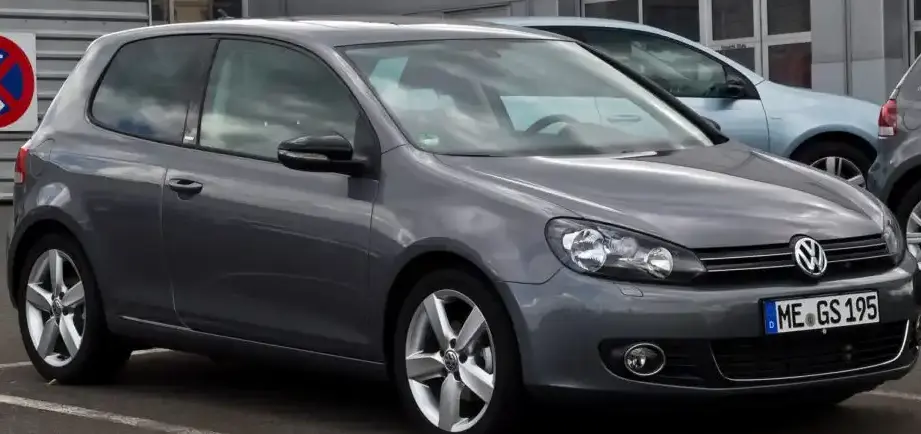
The Volkswagen Golf VI 2.5 Tiptronic (3-door) represents a specific configuration within the highly successful sixth generation of the Golf, produced from 2009 to 2013. Positioned as a mid-range offering, particularly in North America, this variant combined a 2.5-liter inline-five cylinder engine with a six-speed automatic transmission featuring a “Tiptronic” manual shift mode. It aimed to provide a balance of performance and convenience for drivers seeking a more refined Golf experience than the base models, while remaining more accessible than the performance-oriented GTI or diesel options.
Powertrain & Engine Architecture
The Golf VI 2.5 Tiptronic is powered by the CBTA or CBUA engine code, a 2.5-liter inline-five cylinder gasoline engine. This engine was specifically developed for North American markets and represents a deviation from the more common four-cylinder Golf engines. It utilizes multi-port fuel injection and a double overhead camshaft (DOHC) valvetrain. The engine’s design emphasizes smooth power delivery and refinement over outright performance. The six-speed Tiptronic automatic transmission provides smooth shifts and allows the driver to manually select gears when desired, offering a degree of control beyond a traditional automatic. The Tiptronic system employs a torque converter for smooth launches and low-speed operation, and electronically controlled hydraulics to manage gear changes.
Driving Characteristics
The 2.5-liter engine, producing 170 horsepower and 177 lb-ft of torque, delivers adequate performance for everyday driving. Acceleration is respectable, estimated around 8.5-9 seconds for a 0-60 mph sprint, though not particularly quick. The Tiptronic transmission is tuned for comfort, with gear changes occurring smoothly and predictably. Compared to the manual transmission versions of the 2.5, the automatic offers less driver engagement but greater convenience. In contrast to the more powerful GTI or the fuel-efficient TDI models, the 2.5 Tiptronic prioritizes a relaxed driving experience. The gear ratios are optimized for highway cruising, making it a comfortable long-distance vehicle. However, it may feel somewhat sluggish during quick overtaking maneuvers.
Equipment & Trim Levels
The Golf VI 2.5 Tiptronic typically came well-equipped, although standard features varied depending on the market. Common features included air conditioning, power windows and locks, a CD player with MP3 compatibility, and alloy wheels. Higher trim levels offered options such as a sunroof, leather upholstery, heated front seats, and a premium sound system. The interior design was a significant improvement over the Mk5, featuring higher-quality materials and a more modern layout. The 3-door configuration often included sport seats as standard, enhancing the driving experience.
Chassis & Braking
The Golf VI utilizes an independent McPherson strut suspension in the front and a multi-link suspension in the rear, providing a comfortable and controlled ride. The suspension is tuned to balance handling and comfort, making it suitable for both city driving and highway cruising. Braking is handled by ventilated discs in the front and solid discs in the rear, equipped with ABS (Anti-lock Braking System) as standard. The braking system provides adequate stopping power for everyday driving, though it isn’t as powerful as those found on the GTI or other performance-oriented models.
Market Reception & Comparison
The Golf VI 2.5 Tiptronic was generally well-received by automotive critics, who praised its comfortable ride, refined interior, and user-friendly automatic transmission. However, some reviewers noted that the engine lacked the excitement of the GTI or the fuel efficiency of the TDI. Compared to the 2.0-liter four-cylinder engine offered in some markets, the 2.5-liter provided more power but slightly lower fuel economy. The Tiptronic transmission was considered a good compromise between convenience and driver control, but some enthusiasts preferred the engagement of a manual gearbox. Reliability was generally good, with few major issues reported.
Legacy
The Golf VI 2.5 Tiptronic has proven to be a relatively reliable and durable vehicle. Used examples are readily available and generally hold their value well, particularly those in good condition with low mileage. The inline-five engine, while less common than four-cylinder engines, has a reputation for longevity. Common maintenance items include regular oil changes, timing belt replacement (depending on mileage), and inspection of the Tiptronic transmission fluid. Today, the Golf VI 2.5 Tiptronic remains a popular choice for buyers seeking a practical, comfortable, and well-built hatchback with a touch of European refinement.