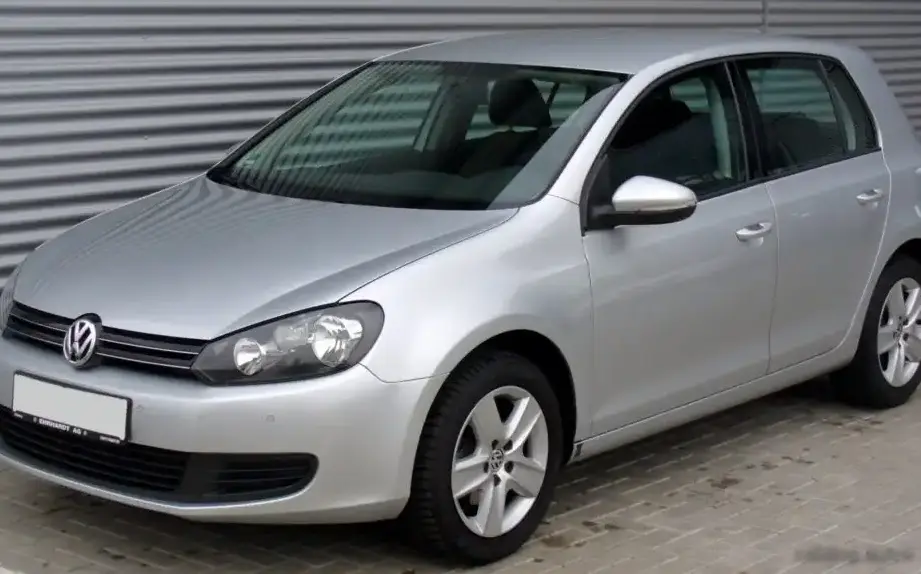
The Volkswagen Golf VI 1.6 TDI (105 hp) BMT, produced from 2009 to 2012, represented an important entry point into the sixth generation of Volkswagen’s iconic hatchback. Positioned as a fuel-efficient and practical option, this variant played a significant role in the Golf VI’s success, particularly in European markets where diesel engines were highly favored. It was part of the 5-door body style, offering a balance between passenger space and everyday usability. The “BMT” designation signifies Volkswagen’s BlueMotion Technology, emphasizing fuel economy and reduced emissions.
Technical Specifications
| Brand | Volkswagen |
| Model | Golf |
| Generation | Golf VI (5-door) |
| Type (Engine) | 1.6 TDI (105 Hp) BMT |
| Start of production | 2009 |
| End of production | 2012 |
| Powertrain Architecture | Internal Combustion engine |
| Body type | Hatchback |
| Seats | 5 |
| Doors | 5 |
| Fuel consumption (urban) | 5.2 l/100 km (45.2 US mpg, 54.3 UK mpg, 19.2 km/l) |
| Fuel consumption (extra urban) | 3.5 l/100 km (67.2 US mpg, 80.7 UK mpg, 28.6 km/l) |
| Fuel consumption (combined) | 4.1 l/100 km (57.4 US mpg, 68.9 UK mpg, 24.4 km/l) |
| CO2 emissions | 107 g/km |
| Fuel Type | Diesel |
| Acceleration 0 – 100 km/h | 11.3 sec |
| Acceleration 0 – 62 mph | 11.3 sec |
| Acceleration 0 – 60 mph | 10.7 sec |
| Maximum speed | 190 km/h (118.06 mph) |
| Emission standard | Euro 5 |
| Weight-to-power ratio | 11.8 kg/Hp, 84.5 Hp/tonne |
| Weight-to-torque ratio | 5 kg/Nm, 201.1 Nm/tonne |
| Power | 105 Hp @ 4400 rpm |
| Power per litre | 65.7 Hp/l |
| Torque | 250 Nm @ 1500-2500 rpm (184.39 lb.-ft. @ 1500-2500 rpm) |
| Engine layout | Front, Transverse |
| Engine Model/Code | CAYC |
| Engine displacement | 1598 cm3 (97.52 cu. in.) |
| Number of cylinders | 4 |
| Engine configuration | Inline |
| Number of valves per cylinder | 4 |
| Fuel injection system | Diesel Commonrail |
| Engine aspiration | Turbocharger, Intercooler |
| Valvetrain | DOHC |
| Engine oil capacity | 4.3 l (4.54 US qt | 3.78 UK qt) |
| Kerb Weight | 1243 kg (2740.35 lbs.) |
| Max. weight | 1840 kg (4056.51 lbs.) |
| Max load | 597 kg (1316.16 lbs.) |
| Trunk (boot) space – minimum | 350 l (12.36 cu. ft.) |
| Trunk (boot) space – maximum | 1305 l (46.09 cu. ft.) |
| Fuel tank capacity | 55 l (14.53 US gal | 12.1 UK gal) |
| Max. roof load | 75 kg (165.35 lbs.) |
| Permitted trailer load with brakes (12%) | 1400 kg (3086.47 lbs.) |
| Permitted trailer load without brakes | 650 kg (1433 lbs.) |
| Permitted towbar download | 75 kg (165.35 lbs.) |
| Length | 4199 mm (165.31 in.) |
| Width | 1786 mm (70.31 in.) |
| Width including mirrors | 2048 mm (80.63 in.) |
| Height | 1480 mm (58.27 in.) |
| Wheelbase | 2578 mm (101.5 in.) |
| Front track | 1541 mm (60.67 in.) |
| Rear track | 1514 mm (59.61 in.) |
| Ride height (ground clearance) | 150 mm (5.91 in.) |
| Minimum turning circle | 10.9 m (35.76 ft.) |
| Front suspension | Independent type McPherson, Transverse stabilizer |
| Rear suspension | Independent multi-link suspension, Transverse stabilizer |
| Front brakes | Ventilated discs |
| Rear brakes | Disc |
| Assisting systems | ABS (Anti-lock braking system) |
| Steering type | Steering rack and pinion |
| Power steering | Electric Steering |
| Tires size | 195/65 R 15 |
| Wheel rims size | 6 J x 15 |
| Number of gears | 5 |
| Gearbox type | Manual transmission |
INTRODUCTION
The Volkswagen Golf VI, launched in 2008, continued the Golf’s tradition of being a versatile and well-rounded compact car. The 1.6 TDI (105 hp) BMT variant, available from 2009-2012, was specifically designed to appeal to buyers prioritizing fuel efficiency and lower running costs. Built on the A6 platform (also known as the 1HX0), this Golf offered improvements in interior quality and technology over its predecessor, the Golf V. The 1.6 TDI BMT served as an entry-level diesel option, sitting below the more powerful 2.0 TDI models in the Golf VI lineup.
Powertrain & Engine Architecture
The heart of the Golf VI 1.6 TDI BMT is the CAYC engine code, a 1.6-liter inline-four cylinder diesel engine. This engine utilizes a common rail direct injection system, delivering fuel directly into the combustion chamber at extremely high pressure for improved efficiency and reduced emissions. The engine features a turbocharger with an intercooler, boosting power output and providing a broader torque curve. The valvetrain employs a dual overhead camshaft (DOHC) design with four valves per cylinder, optimizing airflow for enhanced performance. The BMT designation indicates the inclusion of Volkswagen’s BlueMotion Technology, which included features like start/stop functionality and optimized aerodynamics to further reduce fuel consumption. This engine was paired with a 5-speed manual transmission, chosen for its simplicity and contribution to fuel economy. The transmission’s gear ratios were tuned to maximize efficiency at highway speeds, while still providing adequate acceleration in urban environments.
Driving Characteristics
The 105 hp and 250 Nm (184 lb-ft) of torque produced by the 1.6 TDI engine provided adequate, though not exhilarating, performance. Acceleration from 0-60 mph took around 10.7 seconds, and top speed was approximately 118 mph. The engine’s peak torque was available from 1500-2500 rpm, providing good responsiveness for everyday driving situations. Compared to the more powerful 2.0 TDI variants, the 1.6 TDI felt noticeably slower, particularly when overtaking or climbing hills. However, the 5-speed manual transmission allowed drivers to keep the engine in its optimal power band. The gear ratios were relatively long, prioritizing fuel economy over outright acceleration. The driving experience was generally comfortable and refined, typical of the Golf VI, with well-weighted steering and a compliant suspension.
Equipment & Trim Levels
The Golf VI 1.6 TDI BMT typically came with a reasonable level of standard equipment. This included air conditioning, power windows, central locking, and an audio system with CD player. Safety features such as ABS, electronic stability control, and multiple airbags were also standard. Interior upholstery was typically cloth, with a functional and durable design. Optional extras included alloy wheels, a multi-function steering wheel, parking sensors, and a more advanced audio system. Trim levels varied depending on the market, but generally offered progressively more features as you moved up the range. The BMT variant often featured specific aerodynamic enhancements to improve fuel efficiency, such as a lowered ride height and optimized front grille.
Chassis & Braking
The Golf VI 1.6 TDI BMT utilized an independent McPherson strut suspension at the front and an independent multi-link suspension at the rear. This setup provided a good balance between ride comfort and handling. The suspension was tuned to be relatively soft, prioritizing comfort over sporty handling. Brakes consisted of ventilated discs at the front and solid discs at the rear. ABS (Anti-lock Braking System) was standard, providing enhanced braking performance in emergency situations. The steering was a rack and pinion system with electric power assistance, offering precise and responsive control.
Market Reception & Comparison
The Golf VI 1.6 TDI BMT was generally well-received by critics for its fuel efficiency and practicality. It was praised for its comfortable ride and refined interior. However, some reviewers noted that the engine lacked outright power, particularly when fully loaded or driving on steep inclines. Compared to the 2.0 TDI models, the 1.6 TDI offered significantly better fuel economy but at the expense of performance. The 1.6 TDI also proved to be more reliable than some of the more complex 2.0 TDI variants, with fewer reported issues related to the diesel particulate filter (DPF) and turbocharger. Its fuel economy, averaging around 57.4 US mpg, made it a compelling choice for drivers covering long distances.
Legacy
The 1.6 TDI engine, particularly the CAYC variant found in the Golf VI, has proven to be a relatively reliable powertrain when properly maintained. While diesel engines are inherently more complex than their gasoline counterparts, the 1.6 TDI has generally avoided the major issues that plagued some of the later generation diesel engines. On the used car market, the Golf VI 1.6 TDI BMT remains a popular choice for buyers seeking a fuel-efficient and practical hatchback. However, potential buyers should be aware of the importance of regular maintenance, including oil changes and DPF servicing, to ensure long-term reliability. The Golf VI 1.6 TDI BMT represents a significant step in Volkswagen’s efforts to produce more fuel-efficient and environmentally friendly vehicles, and it continues to be a relevant and affordable option in the used car market today.